
What an SEO Audit Checks in 2026: 6 Categories, 2 to 5 Business Days and the Files You Receive

Key takeaways
- An SEO audit is a structured check of whether search engines can crawl, index, understand and trust your website, and why it ranks where it does. A full audit covers six areas: technical, on-page, content and intent, links, local, and AI search. Our version runs 47 checks. A free audit takes about 2 business days and a full audit about 5, longer for sites above 10,000 pages. You should receive a prioritised fix list rather than a tool score. In Malaysia, one-off audits usually cost RM1,500 to RM5,000. Watch for the Health Score Trap: a site can score 82/100 in a tool and still have no XML sitemap.
In this article
In mid-2023 a Malaysian hotel group came to us with clicks and impressions close to zero. Its React front end had stopped sending Google indexable content and page-level meta tags. Their rankings tools showed nothing alarming because there was almost nothing left to track. After we found the cause and the fixes went live in October 2023, daily impressions climbed back to roughly 7,000 within days. By January 2024 the site was getting 210 clicks a day.
That is what an audit is for. It finds the one fault that is costing you the most, explains why, and tells you what to fix first.
What Is an SEO Audit, and Why Does the Order of Checks Matter?
An SEO audit is a diagnosis of a website against how search engines discover, index, rank and now cite pages in AI answers. A good one runs in dependency order: crawl access first, then indexing, then content and links. A page that never reaches Google’s index cannot rank, and it cannot appear as a link in AI Overviews either.
Search engines do not treat every URL they crawl equally. Google keeps tiers within its index. Pages with weak internal links, duplicated content or low perceived quality get stored in lower tiers or left out entirely. In Search Console, “Crawled, currently not indexed” usually means a page was found and then judged not worth keeping. In modern retrieval, only the pages that make an early shortlist get scored by the heavier ranking models. A page left off that shortlist is never compared with competitors at all.
AI search adds no shortcut. Google’s Search Central page on AI features says a page must be indexed and eligible to show with a snippet before it can be a supporting link in AI Overviews or AI Mode. It also says there are no additional technical requirements. So an audit that starts with schema or AI-readiness ideas before confirming indexing has the order backwards.
Key takeaway: Ask any auditor what they check first. If the answer isn’t crawl access and index coverage, the report will rank cosmetic issues above the ones that remove pages from search.
What Does an SEO Audit Check?
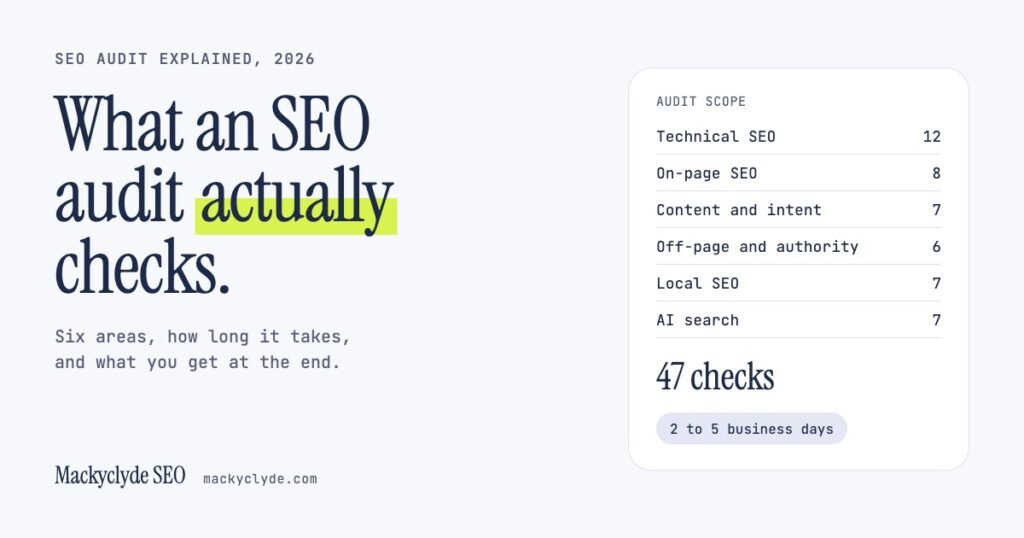
A full audit covers six categories: technical SEO, on-page SEO, content and search intent, off-page authority, local SEO, and AI search optimisation. Our audit runs 47 checkpoints across those six. Technical carries the most (12) because problems there block everything downstream.
Table 1: The six audit categories, checkpoint counts and what each covers
| Category | Checks | What gets examined |
|---|---|---|
| Technical SEO | 12 | Crawling, indexation, XML sitemaps, robots.txt, canonicals, redirects, HTTPS, page speed and Core Web Vitals, JavaScript rendering, structured data, server log files |
| On-page SEO | 8 | Title tags, meta descriptions, heading structure, keyword-to-page mapping, internal links, images, URLs, content depth |
| Content and search intent | 7 | Topic gaps against competitors, keyword cannibalisation, thin or duplicate pages, intent match, freshness, E-E-A-T signals, English and Bahasa Malaysia targeting with hreflang |
| Off-page and authority | 6 | Backlink profile, toxic links, anchor text, referring domain quality, link growth, unlinked brand mentions |
| Local SEO | 7 | Google Business Profile per branch, NAP consistency, citations, reviews, LocalBusiness schema, city and state pages, Map Pack gaps |
| AI search optimisation | 7 | AI Overview and AI Mode presence, AI crawler access, answer extractability, FAQ, Organisation and Service schema, entity consistency, brand mentions in AI answers, featured snippet eligibility |
Some of these checks carry more weight than they look. Take internal links. When Google renders a page it splits it into regions: header, main content, sidebar, footer. Content and links in the main body count for more than the same text or link in a footer or a sitewide widget. A link’s value also depends on how likely a reader is to click it. Position, prominence and anchor text all feed that estimate. So an audit that only counts internal links misses the point. The useful question is whether your priority pages get links from inside the body copy of related pages, with anchors that describe them. Page segmentation works the same way for AI answers. AI Overviews pull passages from the main content of a page, so an answer buried in a tab or footer accordion is less likely to be used.
If your site serves both English and Bahasa Malaysia, check that the audit includes hreflang and language targeting. Many tool-based audits skip it, and in our experience bilingual Malaysian sites often have one language version competing against the other.
How Long Does an SEO Audit Take?
A free or snapshot audit takes about 2 business days. A full audit takes about 5 business days, counted from when we receive access to Search Console, analytics and the CMS. Sites above 10,000 pages, multi-branch businesses and JavaScript-heavy builds take longer.
Table 2: Audit type, typical turnaround and what extends it
| Audit type | Typical turnaround | What usually extends it |
|---|---|---|
| Free snapshot (highest-impact checks only) | 2 business days | Very little; it runs on public data |
| Full audit, sites up to ~10,000 pages | 5 business days from access | Late Search Console or GA4 access, staging sites behind passwords |
| Full audit, sites above 10,000 pages | Scoped per site | Crawl time, log file volume, faceted URLs on e-commerce |
| JavaScript or headless builds (React, Next.js, Vue) | Add rendering tests to the above | Comparing raw HTML with rendered HTML, page by page |
| Multi-location (several branches) | Add per-branch GBP review | One Business Profile and one city page review per branch |
The 5 days are not mostly crawl time. A crawler can get through a 2,000-page site in under an hour. Most of the time goes on checking each warning by hand. For example, is a “duplicate title” warning a real problem, or a paginated archive that should look like that? Then the findings are ranked against your revenue pages.
What Do You Get at the End of an SEO Audit?
Expect a report that ranks every finding by impact and effort, not a raw export of tool warnings. A full Mackyclyde audit delivers six outputs: a 47-checkpoint technical report with severity ratings and fix steps, a keyword gap sheet, a competitor benchmark, a priority action matrix, an AI search readiness score, and a 30-minute walkthrough call.
Table 3: Audit deliverables, format and what each is used for
| Deliverable | Format | What you do with it |
|---|---|---|
| Technical audit report (47 checkpoints) | Hand fix instructions to your developer, one checkpoint at a time | |
| Keyword gap analysis | Google Sheet | See high-intent keywords your top 3 competitors rank for and you don’t |
| Competitor benchmark | Compare authority, content depth and technical setup with the sites above you | |
| Priority action matrix | Google Sheet | Sort fixes by impact and effort; this sheet decides your next 90 days |
| AI search readiness score | Baseline for AI Overview and AI Mode visibility (the free audit includes the score; the full audit adds the fixes) | |
| Walkthrough call | 30-minute video call | Questions answered before anyone touches the site |
The Health Score Trap
The Health Score Trap is when a site looks healthy because its audit tool gives it a high score, while the problems that actually hold back rankings never move that score. Here is a real example. One full audit we ran for a Malaysian F&B chain started from a tool score of 82 out of 100. That same site had no XML sitemap and 20 duplicate title tags. Only 49 of its 2,148 referring domains were Malaysian, which is a weak footprint for a business that only serves Malaysian customers.
Tool scores average hundreds of checks with similar weights. A missing alt attribute can count about as much as a missing sitemap. An audit is worth paying for when it does the weighting that the score does not.
How Much Does an SEO Audit Cost in Malaysia?
One-off SEO audits in Malaysia usually cost RM1,500 to RM5,000. Price rises with page count, number of branches and number of languages. Our full audit starts from RM3,000 with a fixed quote before work begins, and the free snapshot costs nothing and needs no card or contract.
What moves the price, ranked by impact:
- High: Page count and URL complexity. A 40-page service site and a 15,000-SKU store are different jobs.
- High: JavaScript rendering. Every template needs a raw-versus-rendered comparison.
- Medium: Number of locations, since each branch gets its own Business Profile and local page review.
- Medium: Number of languages. EN plus BM doubles the intent and hreflang work, and adding Chinese triples it.
- Lower: Backlink profile size. Reviewing 2,000 referring domains takes hours, not days.
For retainer pricing after the audit, see our SEO pricing guide for Malaysia.
Free SEO audit, 2 business days: We check your highest-impact technical and indexing issues, score your AI search readiness and send you the three fixes we would make first. Request the free audit →
Free Tool Audit, DIY or Agency Audit: Which Do You Need?
Small sites with stable traffic can get most of the value from Google Search Console plus a free crawler. Screaming Frog’s free version crawls up to 500 URLs. Pay for an agency audit when traffic has dropped without a clear reason, before or after a migration, or when the site is too large or too JavaScript-heavy to check by hand.
Table 4: Audit options compared by cost, depth and best fit
| Option | Cost | Depth | Best for |
|---|---|---|---|
| Search Console + free crawler | RM0 | Indexing, coverage, basic on-page | Sites under 500 URLs with stable traffic |
| Paid SEO tool site audit | Tool subscription | Hundreds of automated checks, no prioritisation | In-house marketers who can triage warnings themselves |
| Agency or consultant audit | RM1,500 to RM5,000 (Malaysia) | Manual verification, competitor and AI search context, ranked fixes | Traffic drops, migrations, JS sites, multi-branch businesses |
When an agency audit is a poor buy: say your site has fewer than 30 pages, launched in the last 3 months and has no traffic history. An audit will mostly report that nobody links to you yet. That RM3,000 will do more as content and links.
Page speed is another place where audits oversell. Google’s speed signal is built from real users’ load times (Chrome field data, the basis of Core Web Vitals), not lab scores. It works mainly as a tiebreaker between pages that are otherwise close on relevance. If an audit puts a 90+ PageSpeed lab score at the top of your fix list while 300 product pages are not indexed, the priorities are wrong.
Before paying, ask the auditor to show one finding from a past report that a free tool would have missed. The hotel group’s problem was raw HTML that no longer carried the page content. A crawler that renders JavaScript can make a page like that look fine.
What Happens After an SEO Audit, and How Often Should You Run One?
Fix in dependency order. Do indexing and crawl blockers in weeks 1 to 2, on-page and internal links in weeks 3 to 6, then content gaps and link building. Run a full audit once a year, and run a crawl-and-index check within 2 weeks of any redesign, platform change or migration.
Site-wide quality also matters for the fix order. Google’s quality systems judge sites at section and site level as well as page by page, so a large block of thin or duplicate pages can weigh on stronger pages nearby. This is why the content category in an audit includes pruning and consolidation, not only new topics. If your site has 400 blog posts and 40 of them get traffic, merging or retiring the weakest 100 often does more than writing 10 new ones.
Conclusion
An SEO audit tells you whether Google can find, index, understand and trust your pages, and which fix pays back first. Budget 2 to 5 business days and RM1,500 to RM5,000 for a full audit in Malaysia. Judge the report on its ordering, not its score. The hotel group’s fix was one rendering problem, and a high score in a health tool would not have revealed it.
If you are deciding between an audit and a retainer, an independent SEO consultant review can tell you which one your site needs. If AI answers are the bigger gap, start with our AI SEO service in Malaysia.
See what your audit would find. Send us your URL and within 2 business days we’ll return your top indexing issues, your AI search readiness score and a ranked list of the first three fixes. Get your free SEO audit →
Frequently Asked Questions
What is the Health Score Trap in an SEO audit? The Health Score Trap is when a site looks healthy because its audit tool gives it a high score, while the problems that actually limit rankings never lower that score. A site can score 82/100 with no XML sitemap. Weight findings by business impact, starting with indexing, before trusting any single number.
Can ChatGPT do an SEO audit? Only partly. ChatGPT can review page copy, titles and schema you paste in. It cannot see your Search Console index coverage, crawl your full site, render JavaScript as Googlebot does, or read your server logs. Those are where the costliest faults usually sit, so use it as an assistant rather than as the auditor.
What access does an SEO auditor need? A full audit normally needs read access to Google Search Console and GA4, plus CMS or staging access if the site is password-protected. Server log files are optional but useful for sites above 10,000 pages. Grant access as a user, not by sharing passwords. The turnaround clock usually starts when access arrives.
What is the difference between an SEO audit and a technical SEO audit? A technical SEO audit covers only crawling, indexing, rendering, speed, redirects and structured data. A full SEO audit adds on-page, content and intent, backlinks, local and AI search. Choose technical-only after a migration or a sudden traffic drop. Choose a full audit when rankings have been flat for months with no obvious cause.
Does an SEO audit cover Bahasa Malaysia pages? It should, but many tool audits don’t. A bilingual audit checks hreflang tags, separate keyword mapping per language and whether the EN and BM versions compete for the same queries. In Malaysia, BM searches often bring up different competitors from the English results, so each language needs its own gap analysis.
Will an SEO audit fix my rankings? No. An audit is a diagnosis, not the fix. Rankings change only after the fixes are implemented, and indexing fixes usually show results fastest. In one hotel group case, impressions recovered within days of a rendering fix. Content and link fixes usually take 3 to 6 months to show in rankings.