
The honest AI search checker.
CiteCheck is a free AI SEO checker: a browser extension that audits any web page for AI search readiness and classic on-page SEO in a single click, and labels every check with its evidence strength so you know which signals are documented, which are research-backed, and which are merely consensus.
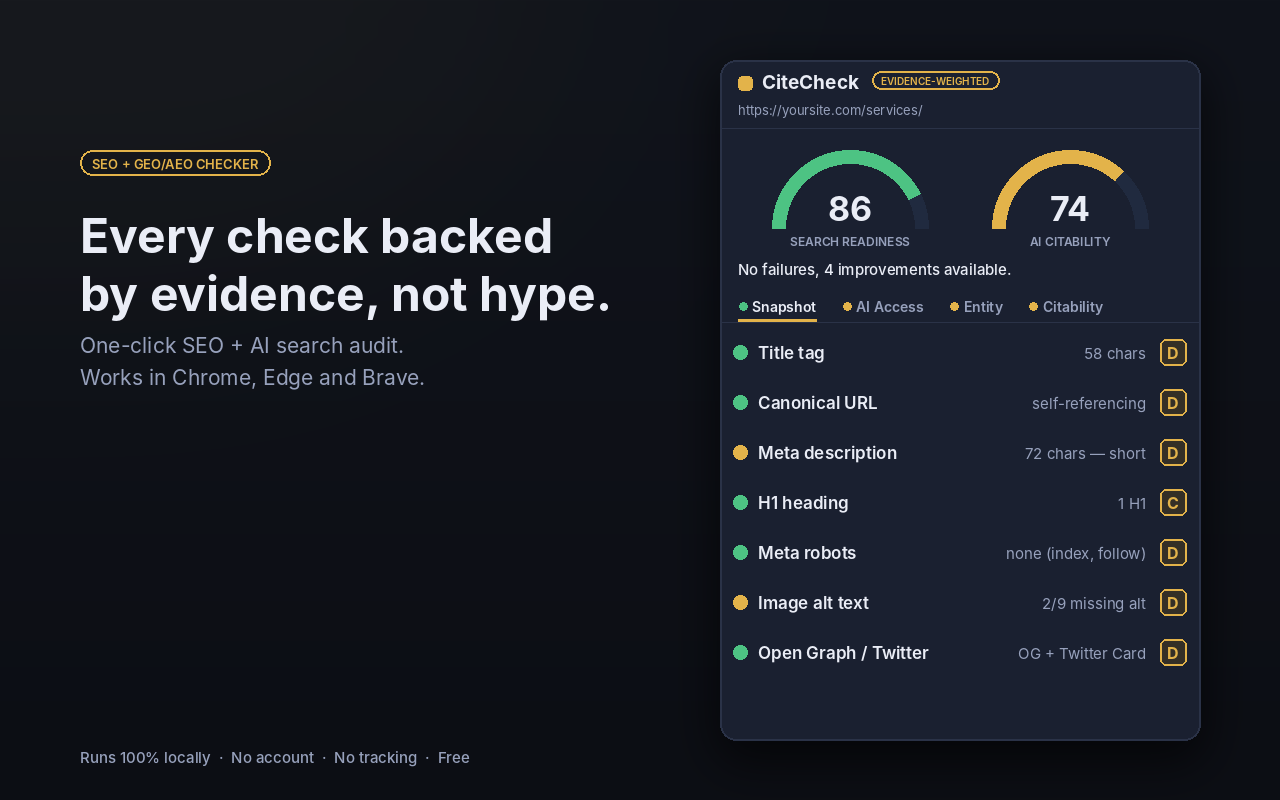
Built to be trusted, not just installed
Evidence-weighted, not guesswork
Every check is labelled Documented, Research-backed, or Consensus, with a source link, so you know exactly how much to trust it.
See what AI engines actually see
Checks whether GPTBot, ClaudeBot, PerplexityBot, and Google-Extended can access and cite your page, not just whether Googlebot can crawl it.
Zero permissions, zero trust issues
Runs on click via activeTab only. No account, no server, no persistent access to your browsing, the install prompt shows no scary warnings.
Four panels, one click
Snapshot
Classic on-page SEO: title, meta, canonical, headings, links, and indexability. Everything a daily-driver SEO extension covers.
- Title & meta description
- Canonical & robots directives
- Headings, links & image alt text
AI Access
Which AI crawlers can actually reach your page, checked against your real robots.txt, not a generic assumption.
- GPTBot, ChatGPT-User (OpenAI)
- ClaudeBot (Anthropic)
- PerplexityBot, Google-Extended
Entity
Catches when your own structured data contradicts itself, most checkers only look at whether schema exists, not whether it agrees with itself.
- Duplicate or conflicting schema blocks
- Name-casing mismatches
- Dates that disagree with the page
Citability
The GEO signals research shows make AI engines more likely to quote a page directly.
- Direct answers up front
- Cited sources & quotations
- Content freshness
What an AI SEO checker should actually check
Most tools in this category score whatever is easy to measure. Four things genuinely determine whether an AI assistant can use your page, and CiteCheck covers all four.
Can the crawlers reach you
Blocking a crawler that feeds live AI answers removes you from those answers entirely. CiteCheck reads your robots.txt and shows which crawlers are allowed, which are blocked, and the exact rule responsible. Crawlers that only gather training data are reported separately, because blocking those is a reasonable business decision rather than a mistake.
Can they read what is there
Most AI crawlers do not execute JavaScript. If your content only appears after rendering, it does not exist to them. The render gap check compares the raw HTML against the rendered page and tells you what proportion of your text survives.
Does your page agree with itself
Structured data that contradicts the visible page, or contradicts your own homepage, lowers an engine's confidence in every claim on the page. CiteCheck compares schema against visible content and against the homepage, then flags duplicate blocks, mismatched brand names, phone numbers that appear in one place but not the other, and dates that exist only in markup.
Is the content extractable
Assistants lift passages, not pages. Direct answers near the top, question-form headings, figures, cited sources, quotes, tables and visible dates all measurably improve the odds of being used. These checks are weighted by published research from Princeton and Georgia Tech rather than by opinion.
Check your first page in under a minute
Free · No account · No credit card
Frequently asked questions
What is an AI SEO checker?
An AI SEO checker audits whether AI search engines can find, read and cite your page. It differs from a classic SEO tool by checking AI crawler access, content extractability without JavaScript, and structured data consistency, rather than only Google indexing signals.
How is CiteCheck different from a normal SEO extension?
Classic SEO extensions check how Google sees your page. CiteCheck adds AI search readiness on top, and labels every check with its evidence strength and source. You can see whether a recommendation is documented in platform specs, measured in research, or simply consensus opinion.
Which AI crawlers does CiteCheck check?
CiteCheck reads your robots.txt and evaluates access for the major crawlers operated by OpenAI, Anthropic, Perplexity, Google and Microsoft, plus training only crawlers. Crawlers that feed live AI answers affect your score. Training crawlers are reported without scoring, since blocking them is a business choice.
Will this tell me if ChatGPT or Perplexity mentions my brand?
No. CiteCheck is a readiness checker, not a mention tracker. It tells you whether your page is technically capable of being crawled, read and cited, and what to fix if not. Tracking actual brand mentions in AI answers requires a separate monitoring tool.
Is CiteCheck free?
Yes, completely. There is no paid tier, no trial, no account and no upsell inside the extension. It was built by Mackyclyde SEO for our own client audits and released publicly. The only link out is a credit in the footer.
Does CiteCheck collect my data?
No. All analysis runs on your device. There is no account, no analytics and no telemetry. The only network requests are reads of the site you are analysing, such as its robots.txt and homepage. Nothing about your browsing ever reaches us. See the privacy policy for detail.
Why does CiteCheck refuse to score llms.txt?
Because independent crawler-log research found that almost no AI bot traffic requests the file, and Google has stated it does not use it. CiteCheck reports whether you have one, since it costs nothing to publish, but scoring it would imply a benefit the evidence does not support.
Which browsers does CiteCheck work in?
Chrome, Microsoft Edge and Brave, all from the same extension. Brave users can install directly from the Chrome Web Store. A Firefox version is under consideration. The extension requires no configuration in any browser.
How is the score calculated?
Two scores, one for search readiness and one for AI citability. Each check is weighted by evidence strength: documented signals count triple, research-backed double, consensus single. Passing earns full weight, a warning earns half. Checks that do not apply to your page type are excluded rather than failed.
Can I use CiteCheck reports with clients?
Yes. Add your agency name, website and accent colour in settings, then generate a branded report and print or save it as a PDF. Reports can also be copied as Markdown or exported as JSON. There is no restriction on commercial or client use.
What is GEO or AEO, and is it the same as AI SEO?
Generative engine optimisation and answer engine optimisation both describe optimising for AI generated answers rather than ranked links. In practice the terms are used interchangeably with AI SEO. CiteCheck covers the same ground regardless of which label you use.
Do I need to know SEO to use it?
No. Every check explains what it means, why it matters and how to fix it in plain language, with a link to the source. The verdict line at the top tells you what to address first. SEO professionals get the depth, everyone else gets a readable answer.