
Hotel SEO in Malaysia: The 5-Rung Playbook for Winning Direct Bookings Back from OTAs (2026)

Key takeaways
- Hotel SEO in Malaysia works when you stop fighting OTAs for keywords they own and climb the Direct-Booking Ladder instead: defend branded search, win the local pack, own "hotel near" queries, build booking-intent content, then earn AI recommendations, in that order.
- Concede generic head terms like "hotel kuala lumpur" to the OTAs and Google's hotel module. The winnable demand sits in branded, local pack, near-landmark, long-tail and AI assistant queries.
- Budget RM1,500 to RM8,000 a month depending on scope. Expect foundations by month 3, visible movement by month 6, and attributed direct bookings from months 5 to 9.
- Check the economics monthly with the Commission Payback Test: divide the retainer by the OTA commission on one average booking to get your break-even direct booking count.
- This playbook is published by Mackyclyde SEO. We have led hotel and serviced-apartment SEO audits for operators including Tune Hotels in Malaysia and a serviced apartment group in Thailand, and this is the full method we use, written for owners, GMs and marketing leads.
In this article
How Malaysian Travellers Actually Find Hotels
Quick Answer: Malaysian hotel demand splits across four surfaces: OTA apps and OTA-dominated Google results for generic queries, Google’s own hotel module and local pack for location queries, classic organic results for branded and long-tail searches, and a fast-growing layer of AI assistants answering “which hotel should I book” directly. A hotel can realistically win the last three.
Search “hotel kuala lumpur” and the page belongs to Agoda, Booking.com, Trivago and Google’s hotel module. That is not a fight, it is a landlord’s market, and the OTAs are the landlords. No independent property outranks a platform spending hundreds of millions on content and links for a two-word head term, and any agency that quotes you for it is selling a lottery ticket.
The demand worth chasing sits underneath. Travellers search your brand name (and misspell it). They search “hotel near KLCC” and “hotel near Axiata Arena” the week a concert is announced. They search in three languages, often within the same trip: “hotel murah melaka” from one family member, “hotel with connecting rooms Melaka” from another. And a growing share skip the search box entirely and ask ChatGPT or Gemini to shortlist for them. Visit Malaysia 2026 is pushing toward 47 million arrivals, so every one of these query types is growing at once.
Query territory map for Malaysian hotel search. Source: Mackyclyde analysis of live Google MY results for representative hotel queries, July 2026.
| Query type | Example | Who wins today | Can your hotel win it? |
|---|---|---|---|
| Generic head terms | “hotel kuala lumpur” | OTAs + Google hotel module | No. Concede it. |
| Branded | “[your hotel name] promo” | Contested: you vs OTAs | Yes, and you must. |
| Local pack / maps | “hotel near me”, “hotel bukit bintang” | Properties with strong profiles | Yes. |
| Near-landmark | “hotel near axiata arena” | Mixed OTA and hotel pages | Yes, with dedicated pages. |
| Booking-intent long-tail | “pet friendly hotel genting” | Thin OTA filter pages | Yes, easily. |
| AI recommendations | “best boutique hotel penang for couples” asked to ChatGPT | Hotels with consistent entities | Yes, few compete yet. |
Key takeaway: Concede the head terms, then take everything else. The rest of this playbook is that plan in order.
The Direct-Booking Ladder
Quick Answer: The Direct-Booking Ladder is our framework for hotel SEO in Malaysia: five rungs climbed in order of effort and payoff. Rung 1 defends branded search, Rung 2 wins the local pack, Rung 3 owns near-landmark queries, Rung 4 builds booking-intent content, Rung 5 earns AI recommendations. Each rung compounds the one below it.
The order matters. Branded defence protects revenue you already earned. The local pack captures demand that exists whether or not you publish a word of content. Landmark and long-tail pages expand into demand your competitors ignore. AI recommendations sit on top because they are built from everything underneath: an assistant recommending your property is really citing your profile, your reviews, your pages and your consistency all at once.
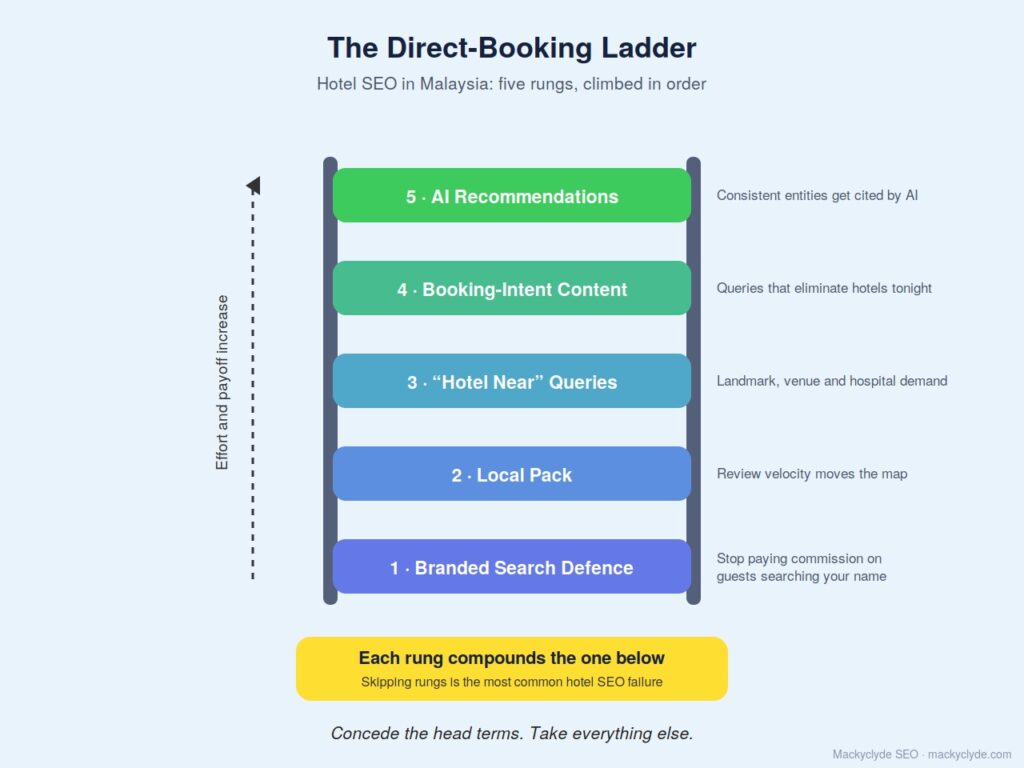
Skipping rungs is the most common failure we see in hotel SEO audits. A property buys blog content (Rung 4) while OTA pages outrank its own homepage for its own name (Rung 1). The blog cannot pay back while the foundation leaks.
Rung 1: Defend Your Branded Search
Quick Answer: Branded defence means your own website, Google Business Profile and social profiles fill the first screen for your hotel’s name and its common misspellings, so travellers who already chose you do not get intercepted by an OTA taking 15 to 25 per cent commission on the way to checkout.
This rung has the best economics in all of hotel SEO because the guest has already decided. The work:
- Title tag pattern. Homepage: “[Hotel Name] | Official Site | 4-Star Hotel in Bukit Bintang, Kuala Lumpur”. The words “Official Site” measurably help travellers pick you over the Agoda listing one position down.
- Cover the branded long-tail. “[name] promo code”, “[name] review”, “[name] breakfast”, “[name] parking”, “[name] check in time”. Each deserves an answer on your own domain, usually as FAQ entries on the relevant page. If you do not answer “promo code”, a coupon site will, and it will send your guest to an OTA.
- Misspellings and old names. Rebranded properties should keep the old name in about-page copy and schema
alternateName. Travellers search what they remember. - Own your knowledge panel. Claim the Google Business Profile, verify, and fix the details OTAs get wrong about you.
What done looks like: search your hotel name in an incognito window and count the first five results. You should own at least three, plus the knowledge panel.
Common mistake: the booking engine lives on a third-party subdomain with a generic title tag, so the one page where money changes hands ranks for nothing and looks untrustworthy in results. Brand it or canonicalise it.
Multi-property brands fight this rung at scale, where one template mistake repeats across every property page.
Key takeaway: Before spending a ringgit on growth, stop paying commission on guests who searched for you by name.
Rung 2: Win the Local Pack
Quick Answer: The local pack (the map with three listings) is the highest-value free real estate in Malaysian hotel search. Google ranks it on proximity, prominence and relevance. You cannot move your building, so the work is prominence (reviews, engagement) and relevance (categories, attributes, content).
The mechanism, straight from Google’s own local ranking documentation: proximity is where the searcher stands, relevance is how well your profile matches the query, prominence is how well-known and well-reviewed the property is. Reviews feed prominence directly, which is why review velocity moves map rankings even when nothing else about your listing changes. A hotel collecting five fresh reviews a week will, over months, outrank a better-located competitor coasting on a five-year-old review base.
The operational checklist:
- Primary category set precisely: “Hotel”, “Serviced accommodation”, “Resort hotel” or “Capsule hotel” are different competitive sets. Serviced apartments picking “Hotel” out of habit compete against the wrong pack.
- Attributes filled honestly: free parking, pool, EV charger, wheelchair access, free breakfast. These map to filterable guest queries and to the amenity claims AI engines cross-check later (Rung 5).
- Review velocity system, not a one-off blast: a post-stay WhatsApp or email ask, steady week after week. Respond to every review, especially the bad ones, because response rate is engagement Google can see and future guests read the replies more than the reviews.
- Photo freshness. Upload monthly. Properties with recent photos get more profile engagement, and engagement is a prominence input.
- Free booking links. Google shows free booking links in the hotel module when your rates are connected through a channel manager or connectivity partner. If your channel manager supports Google Hotel Center, switch it on; it is commission-free placement most Malaysian independents still have not claimed.
What done looks like: track your pack position for “hotel near [your landmark]” and “[your suburb] hotel” weekly from a few map points, not just from the front desk.
Common mistake: stuffing the business name field (“Hotel Name Best Cheap Hotel Bukit Bintang”). It works briefly, then gets suspended, and a suspended profile during peak season is a revenue incident.
Key takeaway: Reviews are the ranking lever you fully control. Build the velocity system in week one; it is the slowest signal to compound and the hardest for competitors to copy.
Rung 3: Own the “Hotel Near” Queries
Quick Answer: Every landmark, venue, hospital and transit hub near your property is a standing search query: “hotel near KLCC”, “hotel near Axiata Arena”, “hotel near Prince Court”. A dedicated, genuinely useful page for each one captures demand OTAs serve with thin auto-generated filter pages.
This is the most underused rung in Malaysia. Concert announcements at Bukit Jalil or Axiata Arena create query spikes that OTA filter pages absorb by default, because almost no KL hotel publishes a real page for them. Convention traffic around KLCC and MITEC behaves the same way. So does medical travel: Malaysia is the second-largest medical tourism destination in ASEAN, and companions of patients search “hotel near [hospital name]” with long stays in mind.
Page spec that separates a landing page from a doorway page:
- Real, specific content: exact walking time, the covered route when it rains, Grab fare range, the LRT/MRT station and exit, parking reality, early check-in policy for event days.
- An embedded map, photos of the actual route, and internal links to the two room types event guests actually book.
- One page per landmark with unique content. Ten near-identical pages swapping the landmark name is doorway spam under Google’s policies and will eventually be treated as such.
Serviced apartments run this rung with a different query set: “monthly stay”, “serviced apartment near [business district]”, relocation and project-team searches with 30 to 90 night values per booking. HOMA wasn’t properly targeting the various key accommodation topics like Long term rental or Accommodation near specific international school within Phuket and we had to create new dedicated service pages to capture those intents better.
Each new service & landmark page ranks top five for its “hotel near X” & “Long term rental Phuket” query and shows assisted bookings in analytics within one quarters.
Key takeaway: List every bookable reason someone stands within 2km of your property, then build one honest page per reason. Event venues and hospitals first; they carry the highest intent.
Rung 4: Content That Books Rooms, Not Traffic
Quick Answer: Hotel content earns its keep when it answers a query someone types the week they book: connecting rooms, pet policies, halal kitchens, surau availability, EV charging, airport transfers. Itinerary-style travel content ranks but rarely books; treat it as support, not strategy.
The Malaysian long-tail is full of booking-decision queries that OTA filters answer badly: “hotel with connecting rooms kuala lumpur”, “muslim friendly hotel langkawi”, “pet friendly hotel genting”, “hotel with surau near klcc”, “hotel with ev charging penang”. Each maps to a real amenity and a real objection. A page that answers one properly, with photos, the exact policy, and a rate check button, converts at booking-page rates because the reader is not researching a destination, they are eliminating hotels.
Two rules keep this rung honest:
- Every content page ends at a room. One click from any article to the relevant room page with a rate check. Content that dead-ends is publishing, not marketing.
- Language follows money. Malaysian guests search in English, Bahasa Melayu and Chinese. Translate the pages closest to the booking first (rooms, offers, amenity pages) with proper hreflang (en-MY, ms-MY, zh), and only then consider translated articles. A beautifully translated blog in front of an English-only booking flow leaks at the worst step.
The trap on this rung is traffic vanity. “Top 10 things to do in Penang” will outrank and out-traffic every amenity page you own, and convert a fraction as well, because it attracts travellers who have not chosen a city, let alone a hotel. We would rather a client rank for eleven amenity queries at 30 searches a month each than one itinerary keyword at 5,000.
Key takeaway: Write for the guest who is eliminating hotels tonight, not the one daydreaming about destinations. Small keywords, booking intent, one click to a room.
Rung 5: Get Recommended by ChatGPT, Gemini and AI Overviews
Quick Answer: AI assistants recommend hotels by retrieving short passages about candidate properties and cross-checking claims across your Google profile, OTA listings, review sites and website. Consistent entities with liftable, self-contained descriptions get recommended. Contradictory ones get silently skipped.
Here is the mechanism worth understanding. When someone asks an assistant for “a family hotel in Penang near the airport with a pool”, the engine does not read your website top to bottom. It retrieves chunks: a paragraph here, an amenity list there, a review summary from a third source. Then it reconciles them. If your site says rooftop pool, your OTA listing says no pool (because someone never updated it after renovation), and your Business Profile says nothing, the engine has a contradiction, and contradictions lower its confidence enough to recommend the property next door instead. The guest never knows you were considered.
So Rung 5 work is mostly consistency engineering plus liftability:
- Entity audit across every surface: name (one casing, everywhere), star rating, amenity claims, location description, even whether you are a “hotel” or “serviced apartment”. Fix the contradictions at the source, including the OTA extranets nobody has logged into since 2023.
- A liftable canonical description on your site: 40 to 70 words that fully describe the property (type, location, star class, signature amenities, who it suits) written so an engine can quote it whole. Reuse it, verbatim, in your profiles.
- Schema: Hotel type with address, geo, amenityFeature, checkinTime, plus FAQPage on policy questions. Schema is how you state facts unambiguously to machines.
- Answer-shaped pages: the amenity and landmark pages from Rungs 3 and 4 are exactly what engines lift, provided each opens with a direct answer instead of brand throat-clearing.
This layer is where our practice concentrates, and it is the reason we put entity work before content in every hotel engagement, including the audits we have run for hospitality operators in Malaysia and Thailand. Our GEO and AI search optimisation service page covers the discipline in full.
If you want to see this applied to your own property before committing to anything: we run a free AI visibility snapshot showing how ChatGPT, Gemini and Google currently describe your hotel, where your listings contradict each other, and which contradictions to fix first. It uses the same SEO audit process we ran for Tune Hotels. No retainer required to see it.
Key takeaway: AI engines do not reward the loudest hotel, they reward the most consistent one. Fix contradictions first; they are cheaper than content and move recommendations faster.
Technical Foundations Most Hotel Sites Get Wrong
Quick Answer: Hotel websites carry technical problems most industries never face: booking engines generating infinite parameter URLs, three-language architectures without hreflang, and image-heavy galleries that wreck mobile speed for guests who overwhelmingly book on phones.
The recurring findings from our hospitality audit work, in rough order of damage:
- Booking engine crawl bloat. URLs like
?checkin=2026-08-01&checkout=2026-08-03&adults=2multiply into thousands of near-duplicate pages. Canonicalise search and calendar states to the room page, and keep crawlers out of the booking funnel’s parameter space. - Broken cross-domain analytics. The booking engine sits on
book.hotelname.comor a vendor domain, GA4 is not configured for cross-domain measurement, and the payment gateway shows up as the top “referral”. Result: management thinks SEO produces no bookings because attribution dies at the most important click. Fix this before judging any channel. - hreflang across EN/BM/中文. Wrong or missing hreflang means Google shows the English page to a BM searcher or, worse, treats translations as duplicates. Use en-MY, ms-MY, zh, with self-referencing tags.
- Gallery weight. Compress to WebP, lazy-load below the first image, and test on a mid-range Android over 4G, because that is your guest, not the fibre line in the sales office.
- Renovation and rebrand migrations. Hotels rebuild websites more often than most businesses, and an unmanaged rebuild deletes years of rankings in a weekend. If a rebuild is coming, scope the SEO migration before growth work, not after the traffic drops.
Key takeaway: Run the technical audit before the content plan. Half the hotel sites we assess are leaking more revenue through attribution and crawl problems than their content gap costs them.
Measure What Pays: Direct Bookings, Not Rankings
Quick Answer: A hotel SEO programme reports in four layers: direct booking revenue and count (the pay-off), booking-engine sessions from organic and profile actions (the pipeline), local pack positions and non-branded clicks (the leading indicators), and a monthly Commission Payback Test check against the retainer.
Leading vs lagging metrics for a Malaysian hotel SEO programme, with realistic first-movement timelines. Source: Mackyclyde measurement framework for hospitality engagements; timelines are typical ranges, not guarantees.
| Metric | Type | Typically moves by |
|---|---|---|
| Branded impressions and CTR (Search Console) | Leading | Month 1 to 2 |
| GBP actions: calls, direction requests, website taps | Leading | Month 2 to 3 |
| Local pack position for tracked queries | Leading | Month 3 to 5 |
| Non-branded clicks to landmark/amenity pages | Leading | Month 4 to 6 |
| Organic sessions entering the booking engine | Lagging | Month 4 to 6 |
| Direct bookings attributed to organic + profile | Lagging | Month 5 to 9 |
Then close the loop on economics monthly. The [Commission Payback Test] is the check: divide the retainer by the OTA commission on one average booking to get the break-even direct booking count, and compare it to what the programme attributed this month. At a RM350 ADR and two-night average stay, roughly RM126 of commission is avoided per direct booking, so a RM3,500 retainer needs 28 shifted bookings a month. Under one a night. When the attributed number crosses break-even, everything above it is margin recovered from the OTAs, permanently, because the rankings do not reset when the retainer renews.
Key takeaway: Insist on the four-layer report from month one. If an agency reports rankings without booking-engine attribution, they are reporting effort, not outcome.
Costs, Timeline, and When Not to Bother
Quick Answer: Hotel SEO in Malaysia runs RM1,500 to RM3,000 a month for single-property local SEO, RM3,000 to RM5,000 for a full programme, and RM4,000 to RM8,000 and above where GEO is included or the location is contested. Expect foundations in months 1 to 3, visible movement in 4 to 6, and compounding bookings from month 7.
Typical monthly retainers for hotel SEO in Malaysia by scope and typical market quotes for hospitality scopes, retrieved July 2026.
| Scope | Typical monthly retainer | Usually suits |
|---|---|---|
| Local SEO + Google Business Profile, single property | RM1,500 to RM3,000 | Boutique hotels, guesthouses, serviced apartments |
| Full programme (Rungs 1 to 4) | RM3,000 to RM5,000 | Independent city hotels, small resorts |
| Full programme + GEO (Rungs 1 to 5) | RM4,000 to RM8,000 | Properties in KL, Penang, Langkawi, JB |
| Multi-property or chain programmes | RM8,000+ | Chains, hotel management groups |
What the first nine months should deliver. Source: Mackyclyde engagement framework; a compressed version of the metric timelines in section 09.
| Phase | Months | The work | What you should see |
|---|---|---|---|
| Foundations | 1 to 3 | Technical fixes, analytics attribution, GBP rebuild, branded defence, review system live | Branded results owned, clean booking attribution |
| Visibility | 4 to 6 | Landmark pages, first amenity content, entity consistency fixes | Local pack movement, first non-branded bookings |
| Compounding | 7 to 9 | Content expansion, GEO liftable passages, BM/中文 money pages | Booking growth, first trackable AI citations |
And the honest part. Three situations should not buy this yet. A property that opened last month and needs occupancy this quarter should spend on Google Hotel Ads and OTA placement first, because SEO cannot rescue this quarter. A small homestay in a low-demand location gets more from a free, well-run Business Profile plus Meta creatives than from any retainer. And a hotel mid-rebuild should finish the migration safely before buying growth on top of a moving site. SEO is the best margin decision in hospitality marketing only when the runway exists to let it compound.
Key takeaway: Budget RM3,000 to RM5,000 and nine months of patience for a serious single-property programme. If either is unavailable, run ads now and come back; the ladder will still be here.
Frequently Asked Questions About Hotel SEO in Malaysia
What is hotel SEO?
Hotel SEO is the work of making a property visible for the searches that lead to direct bookings: branded queries, Google’s local pack, “hotel near” searches, amenity long-tails, and AI assistant recommendations. Its purpose is shifting bookings from 15 to 25 per cent commission OTA channels to the hotel’s own commission-free booking engine.
How much does hotel SEO cost in Malaysia?
Hotel SEO in Malaysia costs roughly RM1,500 to RM8,000 a month. Single-property local SEO sits at RM1,500 to RM3,000, a full programme covering technical, content and local work runs RM3,000 to RM5,000, and scopes that add GEO or cover contested locations like KL and Langkawi reach RM8,000 and above.
How long before hotel SEO produces bookings?
Branded and Google Business Profile improvements move within 1 to 3 months, local pack and landmark-page visibility within 4 to 6 months, and attributed direct-booking growth typically shows from month 5 to 9. Programmes usually reach commission break-even within the first year on the Commission Payback Test.
Do I still need OTAs if my hotel invests in SEO?
Yes. OTAs provide international reach no independent channel replaces, particularly for first-time guests. The goal is shifting the channel mix: repeat guests, event travellers and high-intent local searchers move to direct booking, while OTAs keep filling remaining inventory. Every shifted booking saves the full commission.
Can we run hotel SEO in-house?
Partly. A trained team member can run review velocity, profile updates and photo freshness in a few hours a week, and should. Technical fixes, entity consistency across OTA surfaces, multilingual architecture and GEO usually justify a specialist, either as a retainer or a one-off audit your team executes.
Is GEO different from hotel SEO?
GEO (generative engine optimisation) is the newest layer of hotel SEO, not a replacement. Classic SEO earns rankings in Google; GEO earns recommendations inside ChatGPT, Gemini and AI Overviews by making a property’s information consistent everywhere and quotable in self-contained passages. The two share foundations, and hotels now need both.
Sources reviewed for this article (5)
- Google Business Profile Help, "How to improve your local ranking on Google" (proximity, prominence, relevance). Retrieved 23 July 2026.
- Google Hotel Center documentation, free booking links eligibility via connectivity partners. Retrieved 23 July 2026.
- New Straits Times, Visit Malaysia 2026 coverage (47 million arrival target). Retrieved 23 July 2026.
- US-ASEAN Business Council, Visit Malaysia 2026 launch briefing (Malaysia as second-largest ASEAN medical tourism destination). Retrieved 23 July 2026.
- Google Search Central, spam policies on doorway pages. Retrieved 23 July 2026.
Editorial standards
Every claim in this article traces to a source listed above where applicable. Spot an error? Tell us at [email protected].