
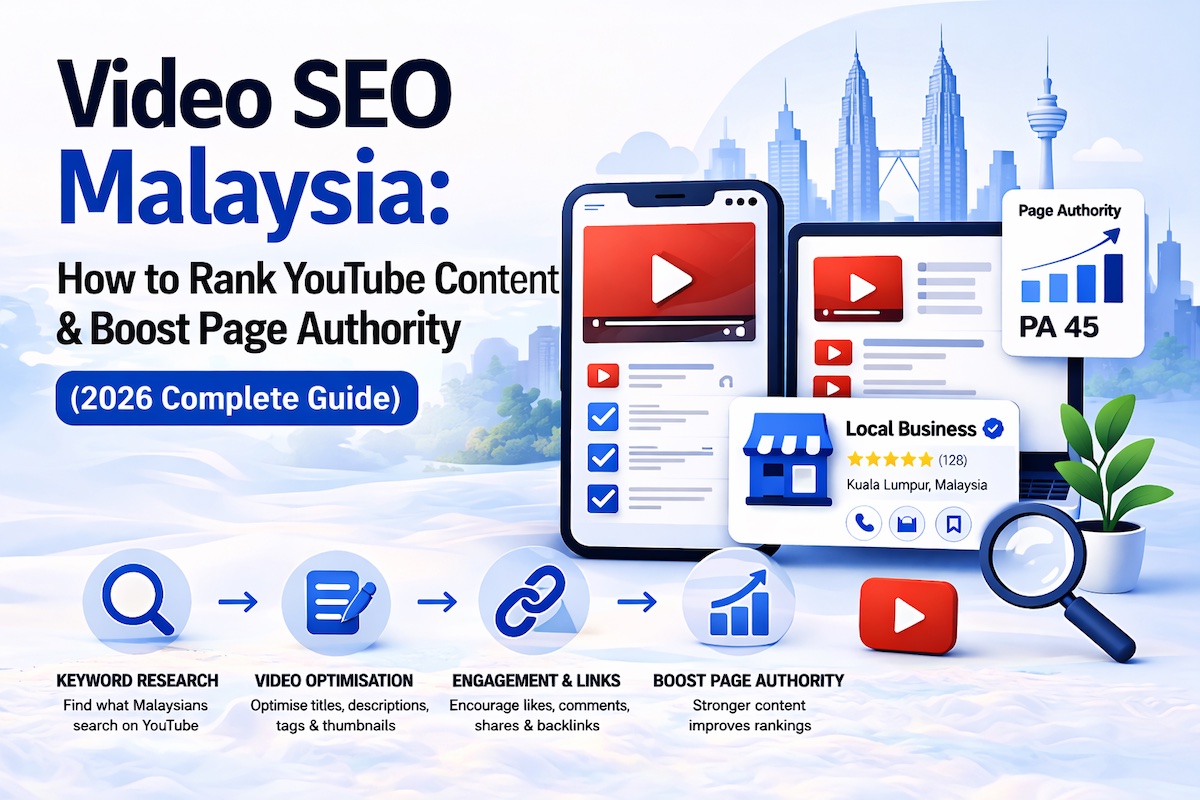
Key Takeaways
- YouTube is the second-largest search engine in the world, and Malaysian users are among the highest video consumers in Southeast Asia. Ignoring video SEO means leaving significant organic visibility on the table.
- Ranking YouTube content requires the same keyword discipline as traditional SEO: search intent, topical relevance and structured metadata all matter.
- Embedding videos strategically on your web pages can improve dwell time, reduce bounce rate and contribute to stronger page authority signals.
- AI Overviews are now surfacing YouTube videos directly in Google search results, creating a new ranking opportunity for optimised video content.
- A combined YouTube-plus-web strategy, where video and page content reinforce each other, outperforms either channel used in isolation.
Why Video SEO in Malaysia Deserves a Dedicated Strategy
Malaysia has one of the highest YouTube penetration rates in Southeast Asia. Data from Statista places Malaysia among the top countries for online video consumption per capita, and Google’s own research confirms that YouTube is where Malaysian purchase research happens, particularly in automotive, finance and consumer tech – three categories that align directly with businesses investing in SEO.
Despite this, most Malaysian brands treat video as a social media deliverable rather than an SEO asset. The video launches, gets shared once on Instagram Stories, and becomes invisible. The result is a missed opportunity: video content that ranks on YouTube generates independent traffic, while embedded video on your web pages sends positive engagement signals to Google.
This article covers how to approach video SEO as a technical discipline, including YouTube ranking factors, structured data for video, the role of video in AI Overviews, and how to use embedded video strategically to strengthen page authority.
Discover Technical SEO fundamentals with our guide.
How YouTube’s Search Algorithm Actually Works
YouTube’s algorithm is a recommendation and relevance engine that weighs a defined set of signals to determine which videos surface for any given query. Understanding those signals is essential to video SEO.
Relevance Signals: What YouTube Reads
YouTube cannot watch your video. It reads the text surrounding it. Every piece of metadata you provide is an input the algorithm uses to categorise and rank your content.
Title
Your video title is the single most influential on-page signal. It should contain your primary keyword naturally, ideally toward the front. For a Malaysian business targeting local search, specificity matters: “How to Fix Crawl Errors in Google Search Console (Malaysia 2025)” will outperform “SEO Tips for Beginners” because it matches the exact language a local audience uses.
Description
YouTube allows up to 5,000 characters in the description field. A well-written description should include your primary keyword in the first two to three sentences, expand into related terms and subtopics naturally, and include timestamps for longer videos. Treat this as a compressed version of a blog post about the video’s content.
Tags
Tags help YouTube understand topical context, particularly for niche or technical subjects. Use a mix of broad category tags and specific long-tail variations.
Chapters and Timestamps
Adding timestamps to your description creates chapters that appear as interactive segments in both YouTube and Google search results. This improves user experience and signals that your content is structured and navigable.
Closed Captions and Transcripts
Auto-generated captions are useful, but manually uploaded transcripts are better. A clean transcript gives YouTube a full word-for-word record of your content, increasing the number of search queries your video can rank for.
Engagement Signals: What YouTube Measures
Relevance metadata puts your video into contention. Engagement signals determine whether it stays there.
Click-Through Rate (CTR)
If YouTube surfaces your video and users do not click, the algorithm interprets this as a quality signal against you. CTR is influenced by thumbnail design and title clarity. A thumbnail that communicates the video’s value at a glance, combined with a title that matches the searcher’s intent precisely, is an important improvement most channels can make.
The first 60 seconds of any video are critical: state clearly what the viewer will learn and why they should stay.
Watch Time and Audience Retention
YouTube prioritises content that keeps people watching. A ten-minute video with 70 percent retention will outrank a ten-minute video with 30 percent retention, even if the lower-retention video has more views.
Saves, Shares and Playlist Adds
These signals indicate that a viewer found the content valuable enough to act on beyond a passive watch. They carry more weight than likes.
YouTube SEO and AI Overviews: The New Visibility Opportunity
Google’s AI Overviews, previously called Search Generative Experience (SGE), now regularly feature YouTube videos as source citations within the AI-generated answer panel. Research published by Search Engine Land in 2025 confirmed that YouTube content is appearing in AI Overviews, particularly for how-to queries, product comparisons and informational searches.
A well-optimised YouTube video can now appear in three distinct places on a single Google search results page: the organic video carousel, the standard web results (if embedded on a ranking page), and the AI Overview panel. That is three separate opportunities for visibility from a single piece of content.
How to Optimise for AI Overview Inclusion
AI Overviews favour content that demonstrates clear expertise and gives a direct, structured answer to the query. For video, this translates into specific optimisations:
Lead with the answer
If your video targets the query “how to optimise a Google Business Profile in Malaysia,” the first 90 seconds should deliver a clear answer before expanding into depth. AI systems extract the clearest, most direct answers available.
Use structured descriptions
A video description written in numbered steps or clear sections is easier for AI systems to parse than a block of unformatted text. This mirrors how you would structure a page to target a featured snippet.
Build topical authority on your channel
A channel with focused videos on a single topic is more likely to appear in AI Overviews for related queries than a general channel with one video on the topic.
Cross-reference your web content
Embedding the video on a well-optimised, authoritative page and linking between the page and the video description creates a reinforcing signal that both Google and YouTube recognise.
Explore Generative Engine Optimisation services for web and video SEO.
How to Use Embedded Video to Strengthen Page Authority
Embedding YouTube videos on your website pages is more than content enrichment. Done correctly, it influences measurable page-level signals.
Dwell Time and Engagement Rate
When a user lands on your page and watches an embedded video, their session time increases. A user who reads a 1,500-word blog post and watches a four-minute video spends longer on that page than a user who only reads. Google interprets longer, more engaged sessions as a quality signal for the page.
The caveat: the video must be genuinely relevant to the page content. An embedded video inserted purely to inflate dwell time but unrelated to the surrounding text will not produce the same effect. Relevance is required.
Video Schema Markup: Telling Google What the Video Contains
Adding VideoObject structured data to any page that embeds a video tells Google’s crawlers what the video is, who created it, how long it runs, and what it covers. This enables Google to surface your page in video-rich results, which appear with a thumbnail preview.
The critical fields in VideoObject schema are:
name: The video title

description: A plain-language summary of the video content

thumbnailUrl: A high-resolution thumbnail image URL

uploadDate: The ISO 8601 date the video was published

duration: In ISO 8601 duration format (for example, PT4M30S for four minutes, thirty seconds)

contentUrl or embedUrl: The URL of the video file or the embed URL

publisher: Your organisation schema details
Without this markup, Google must infer this information from surrounding context. With it, you directly instruct Google’s systems about your content.
Learn more about structured data and schema markup.
Page Relevance and Topical Depth
A page that covers a topic in multiple formats, text and video, signals topical completeness. Content that demonstrates depth and multiple angles of coverage on a subject is treated as more authoritative than single-format content.
For a Malaysian B2B company, this is relevant on high-value service pages. A technical SEO service page that includes an embedded explainer video on crawl budget optimisation, backed by proper schema implementation, gives that page an advantage over a competitor page that is text-based alone.
A Practical Video SEO Workflow for Malaysian Brands
Here is a repeatable workflow you can apply to each video you produce:
1. Keyword research before scripting
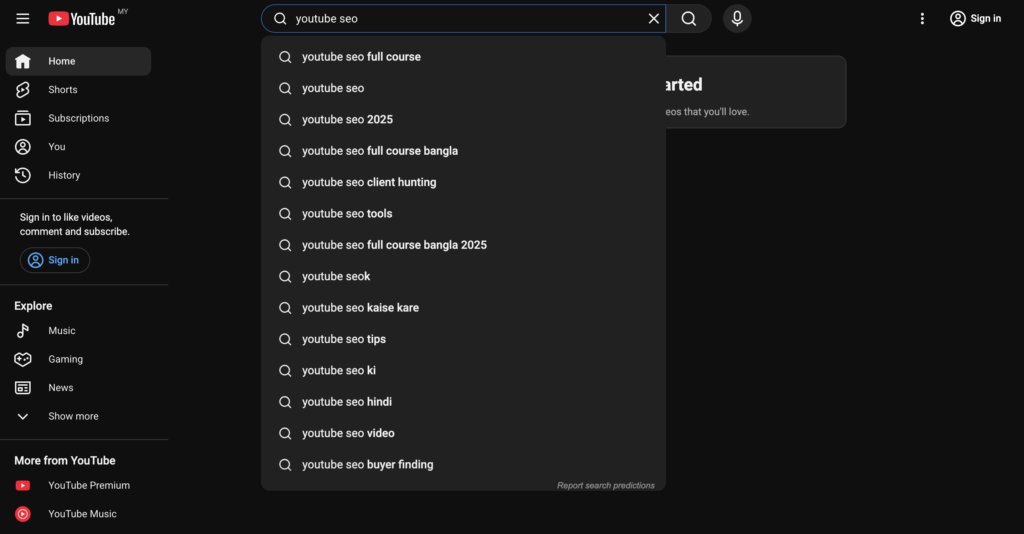
Identify the exact search query you want the video to rank for on YouTube and Google. Use YouTube’s autocomplete, Google Keyword Planner, or TubeBuddy. Confirm there is search volume for the term in the Malaysian market specifically.
2. Script to the keyword
Build your script around the target keyword. Mention it naturally within the first 30 seconds, and repeat it in context throughout the video. Since YouTube processes your transcript, keyword presence in spoken content contributes to relevance.
3. Optimise metadata on upload
Title, description, tags, category and end screens should all be completed before the video goes public.
4. Upload a manual transcript
Do not rely on auto-generated captions for SEO-critical content. Upload an SRT file or use YouTube Studio’s transcript editor to ensure accuracy.
5. Create a companion page
Publish a blog post or update an existing page that covers the same topic as the video. Embed the video within the page, write enough supporting text that the page has standalone value, and implement VideoObject schema.
6. Link between assets
Include the companion page URL in your video description. Add a link to the video or YouTube channel from relevant internal pages.
7. Monitor performance in both platforms
Track YouTube Studio analytics (impressions, CTR, average view duration) and Google Search Console data for the companion page (impressions, clicks, average position for video search). Review monthly and adjust based on retention drop-off points.
Frequently Asked Questions
Does embedding a YouTube video on my website slow down page load speed?
It can, if implemented carelessly. Loading the full YouTube embed script on page load adds third-party resource weight. The recommended approach is lazy loading, where the embed only loads when the user scrolls the video into view. Alternatively, use a façade pattern: display a static thumbnail image that loads the actual embed only on click. Both approaches preserve Core Web Vitals performance while delivering the SEO benefits of an embedded video.
Do I need to host video on my own server to get SEO benefit, or does YouTube embedding count?
YouTube embedding is widely supported for VideoObject schema. Self-hosting gives you more control over the video file URL and removes dependency on a third-party platform, but for most Malaysian brands, the discoverability advantage of YouTube outweighs the control benefit of self-hosting. A hybrid approach, YouTube as the primary platform with schema-marked embeds on your pages, is practical and effective.
How long should a YouTube video be to rank well?
There is no single optimal length. The right length is whatever the topic requires to address the search intent completely. Top-ranking YouTube videos for competitive how-to queries typically run seven to fifteen minutes, but this is a correlation, not a ranking factor. A four-minute video with high audience retention will outrank a twelve-minute video with low retention. Serve the viewer first.
Can YouTube videos appear in Google’s AI Overviews for Malaysian search queries?
Yes. Well-structured, authoritative video content that directly answers a query can be surfaced in the AI panel. The optimisation principles are the same: structured metadata, clear answers early in the video, topical authority on the channel, and cross-referencing with authoritative web pages.
What is the difference between a video sitemap and VideoObject schema?
These are complementary, not interchangeable. A video sitemap submitted via Google Search Console tells Google where video content exists on your site and provides basic metadata. VideoObject schema, implemented in the page’s structured data, provides rich contextual information that enables video rich results in search. Implement both for maximum coverage and rich result eligibility.
How do I know if my video SEO is working?
Track four metrics across both platforms. On YouTube: impressions, CTR and average view duration. On Google Search Console: filter by “Video” search type to see impressions and clicks for video results specifically. On your web analytics platform (GA4): monitor session duration and scroll depth on pages with embedded video versus pages without. If engagement metrics improve after embedding and schema implementation, the strategy is delivering results.
Every piece of video content your business produces is either a compounding SEO asset or unused content. The difference comes down to how deliberately you approach the metadata, structure and cross-channel integration from the start. Begin with keyword research, script to intent, implement complete metadata, and link between your YouTube channel and web pages. These steps compound over time, building topical authority that both YouTube and Google reward with higher rankings and greater visibility across all surfaces, including AI Overviews.
At Mackyclyde SEO, we provide SEO services that cuts across traditional SEO and AI SEO to deliver the best return on investment across organic search surfaces. Reach out if you are a business in Malaysia looking for growth in our organic channel.