Key Takeaways
- A backlink audit is not a one-time task; it is an ongoing process that protects your domain authority and supports sustainable organic growth.
- Toxic links from spammy, irrelevant, or manipulative sources can suppress your rankings, especially after a Google algorithm update.
- The disavow process requires precision. Disavowing the wrong links can do more harm than leaving them alone.
- Malaysian websites face specific link quality challenges tied to local directory spam, low-quality guest post networks, and aggressive competitor negative SEO.
- Building a clean, authoritative backlink profile is a long-term investment that compounds over time when done with a clear strategy.
Introduction
Your backlink profile is one of the most consequential, and most misunderstood, assets in your entire SEO strategy. Most Malaysian business owners and marketers are aware that backlinks matter. Fewer understand that the wrong backlinks can quietly suppress rankings, trigger algorithmic penalties, and erode the domain authority you have spent years building.
If your organic traffic has plateaued, dropped after a core update, or simply refuses to grow despite solid on-page work, your backlink profile may be carrying weight you cannot see. A structured backlink audit in 2026 is not just about identifying bad links. It is about understanding the full picture of who is vouching for your site, whether those endorsements help or hurt, and what a credible link-building strategy looks like from this point forward.
This guide walks you through the complete process: auditing your existing links, identifying toxic patterns common in the Malaysian SEO market, disavowing safely without collateral damage, and building authority that actually moves the needle.
Understanding technical SEO for better website indexing.
Why Backlink Audits Matter More in 2026
Google’s link evaluation has grown significantly more sophisticated over the past three years. SpamBrain, Google’s AI-based spam detection system, has been updated repeatedly to catch link schemes that older algorithmic signals missed entirely. What worked in 2018 (bulk directory submissions, templated guest posts on unmoderated blogs, private blog networks) now carries real algorithmic risk.
The March 2024 core update and the subsequent spam updates that followed sent a clear signal: Google is actively devaluing link networks and rewarding sites with genuinely earned, contextually relevant authority. For Malaysian websites, this matters because a significant portion of historical link-building activity in this market leaned heavily on tactics that sit in Google’s crosshairs today.
A backlink audit gives you visibility into your current risk exposure. It lets you remediate the most dangerous signals before an update hits. It helps you identify gaps in your authority strategy that a targeted link-building campaign can fill.
How to Conduct a Backlink Audit in Malaysia: Step-by-Step
Step 1: Pull Your Full Backlink Data
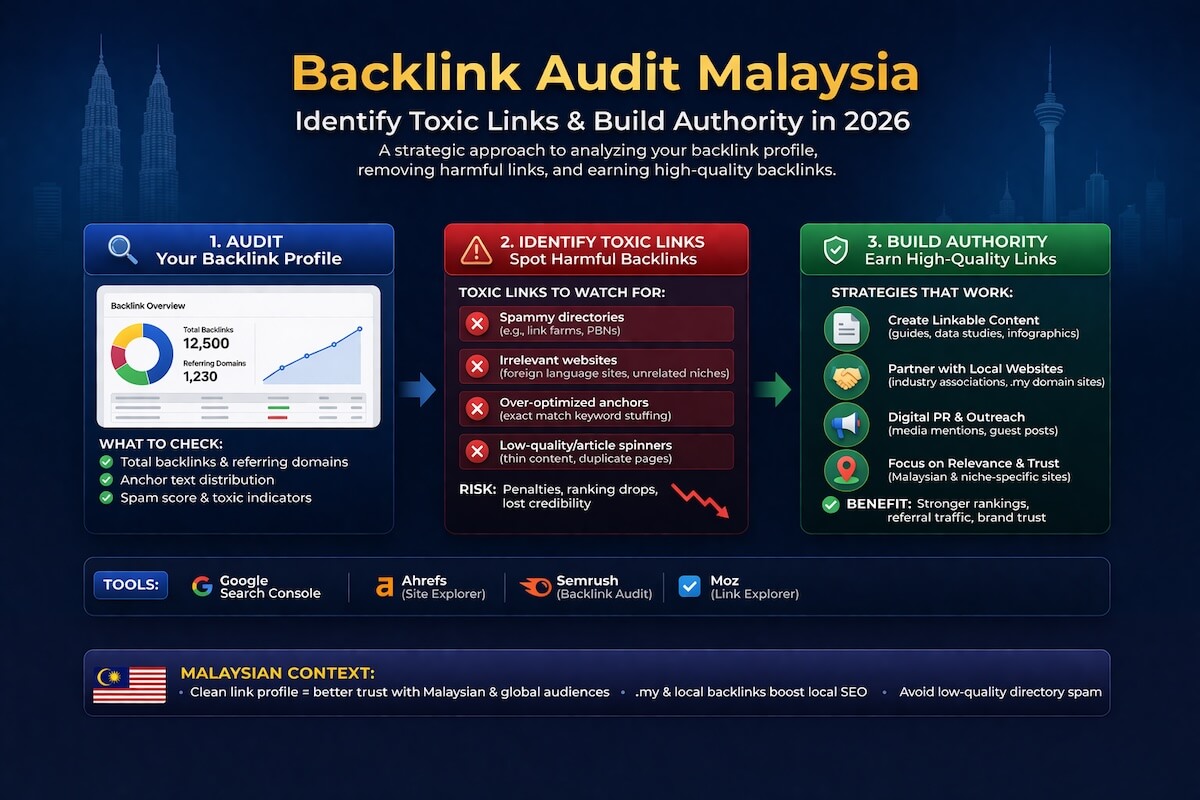
No single tool captures every backlink pointing to your site. For a credible audit, pull data from at least two of the following sources and consolidate them:
- Google Search Console (free, authoritative for what Google has actually processed)
- Ahrefs (largest crawled link index; strong coverage for Southeast Asian domains)
- Semrush (strong spam scoring tools built into the Backlink Audit module)
- Majestic (useful for Trust Flow and Citation Flow benchmarking)
Export every linking domain, the specific URL of each backlink, the anchor text used, whether the link is dofollow or nofollow, and the first and last date each link was detected. This raw dataset is your starting point.
For most Malaysian SME and mid-market websites, you will be working with anywhere from a few hundred to several thousand unique linking domains. Enterprise sites and e-commerce platforms can have tens of thousands.
Step 2: Evaluate Link Quality at Scale
Manually reviewing every link is not realistic beyond a small site. You need a tiered evaluation approach.
Start with automated scoring. Semrush’s Backlink Audit tool assigns a toxicity score to each link. Ahrefs provides a Domain Rating (DR) alongside a spam score. These scores are not gospel, but they help you triage efficiently.
Flag links for closer review if they meet any of the following criteria:
- Very low domain authority with high outbound link volume (a hallmark of link farms)
- Anchor text is exact-match commercial for keywords you rank for (e.g., “SEO agency Malaysia” repeated across dozens of unrelated sites)
- The linking page has no topical relevance to your industry or content
- The linking domain is a foreign-language site with no logical reason to reference your Malaysian business
- The linking site has no organic traffic of its own according to Ahrefs or Semrush data
- The link appears in a sitewide footer or sidebar on a low-quality domain
- The linking domain is part of a recognisable PBN pattern, where multiple domains share the same hosting IP range, WHOIS data, or template design
Step 3: Categorise Your Links
After triage, sort your links into three buckets:
Keep: Links from credible, topically relevant sources with genuine organic traffic and no signs of manipulation. These include earned press coverage, industry directory listings on legitimate platforms, partner sites, and high-quality editorial mentions.
Monitor: Links that are not clearly harmful but are borderline. These might be mid-range local directories, older forum mentions, or links from sites that have declined in quality since the link was placed. Track these over time rather than acting immediately.
Disavow Candidates: Links that are clearly manipulative, have no credible editorial justification, or come from domains that have been penalised or deindexed. These require action.
Toxic Link Patterns Specific to the Malaysian Market
The Malaysian SEO market has its own distinct patterns of low-quality link activity. Understanding these helps you identify problems faster.
Local directory spam: Many Malaysian businesses accumulated links through bulk submissions to low-quality local directories during the 2012-2018 period. Some of these directories are still live but have no real traffic, no editorial standards, and heavy outbound link profiles. Links from these sources often trigger automated spam signals.
Bahasa Malaysia/English hybrid PBN sites: A pattern common in the Malaysian market involves private blog networks that publish thin content mixing Bahasa Malaysia and English to appear locally relevant. These sites frequently feature exact-match anchor text linking to local businesses and have very low Ahrefs DR scores alongside zero organic traffic.
Competitor negative SEO: Mid-to-large Malaysian businesses in competitive niches (insurance, automotive, legal, e-commerce) occasionally face negative SEO attacks from competitors who purchase low-quality links pointing to your domain. If you notice a sudden spike in toxic-looking referring domains in your audit data, negative SEO is worth investigating.
Outdated link exchange networks: A number of Malaysian agencies and freelancers previously operated informal link exchange or link rental arrangements. These links often have unnatural anchor text patterns and come from sites that are thematically unrelated.
How to Disavow Backlinks Without Causing More Damage
The disavow tool inside Google Search Console allows you to ask Google to ignore specific links or entire domains when evaluating your site. Used correctly, it is one of the most effective remediation tools available. Used incorrectly, it can strip away legitimate authority signals.
The Disavow Process
First: attempt manual removal. Before disavowing, try to remove links directly by contacting the webmaster of the linking site. This is often impractical at scale, but for a small number of clearly harmful links, it is worth attempting. Document every outreach attempt with date, recipient, and outcome.
Second: build your disavow file correctly. The disavow file is a plain text file uploaded to Google Search Console. You can disavow at the page level (a specific URL) or the domain level (all links from an entire domain). Domain-level disavow is generally safer and more efficient when dealing with clearly spammy sites.
Format your file as follows:
# Disavowed links - [your domain] - [date]
# Sitewide spam (link farms, PBNs)
domain:spammysite.com
domain:anotherbadsite.net
# Page-level disavow
http://specificbadpage.com/your-link-page
Third: review before uploading. Have a second pair of eyes review the disavow list before submission. A mistaken disavow of a high-authority legitimate link can suppress rankings for months. Be especially careful with media sites that may have published both legitimate coverage and sponsored content, local directories that include both spam and credible listings (disavow at page level, not domain level, in these cases), and sites you have business relationships with.
Fourth: upload and wait. After uploading your disavow file, it can take several weeks to several months for Google to process the changes and for ranking effects to become visible. Do not expect immediate recovery.
Fifth: maintain and update your disavow file. This is not a one-time submission. As new toxic links are discovered in future audits, update your file accordingly.
Building a Clean, Authoritative Backlink Profile After the Audit
Removing toxic links clears the deck. It does not build authority. Once your audit and disavow work is complete, a proactive link-building strategy is what drives ranking momentum.
What Makes a High-Quality Backlink in 2026
The criteria have not changed fundamentally, but they have become harder to fake:
- Topical relevance: The linking page should be about something directly related to your business or industry. A cybersecurity company earning a link from a Malaysian tech publication is high quality. The same link from a cooking blog is not.
- Editorial justification: The best links are placed because the linking publisher chose to include them, not because money changed hands or a template was followed.
- Organic traffic on the linking domain: A link from a site with genuine readers in your target market passes real authority. Links from dormant or near-zero-traffic sites do very little.
- Anchor text naturalness: Over-optimised anchor text patterns, particularly exact-match commercial keywords repeated across many linking domains, remain a red flag. Natural profiles include branded mentions, URL links, partial match phrases, and generic terms alongside a smaller proportion of keyword-anchored links.
Practical Link Acquisition Strategies for Malaysian Businesses
Digital PR and earned media: Produce data-led content, original research, or expert commentary that Malaysian journalists and industry publications will reference. This is the highest-quality link acquisition channel available. As the piece continues to earn citations over time, the value compounds.
Expert contributions and interviews: Malaysian industry publications, news outlets like The Edge and The Star, and sector-specific platforms frequently feature expert commentary. Positioning your leadership team as accessible subject matter experts generates high-authority, editorially placed links.
Strategic partnerships and co-marketing: Links from complementary businesses, industry associations, government-linked platforms, and trade bodies carry weight because they are inherently credible and topically appropriate.
Reclaiming unlinked brand mentions: Monitor for mentions of your brand, products, or leadership team that do not include a hyperlink. Reach out to request the link be added. This is effective outreach because the publisher has already demonstrated goodwill.
Resource and tool pages: Creating genuinely useful resources like calculators, guides, glossaries, or research reports earns passive links from people who find them valuable. For Malaysian businesses, localising these resources (a Malaysian SEO benchmark report, a local market data resource) increases their appeal and link potential.
How Often Should You Run a Backlink Audit?
For most Malaysian businesses in competitive niches, a full audit every six months is appropriate. In high-competition verticals with a history of aggressive link building or known negative SEO exposure, quarterly monitoring is more prudent.
Outside of scheduled audits, set up automatic alerts in Ahrefs or Semrush for significant changes in your referring domain count. A sudden spike in new referring domains pointing to a single page is a signal that warrants immediate investigation, whether the cause is viral content success or a negative SEO attack.
Frequently Asked Questions
How do I know if my site has been penalised because of bad backlinks?
A manual penalty from Google will appear as a notification in your Google Search Console under Security and Manual Actions. Algorithmic suppression is harder to identify directly. Common indicators include a sharp traffic drop coinciding with a known Google core or spam update, a decline in rankings specifically on commercially valuable pages, and a noticeable spike in new low-quality referring domains before the drop occurred.
Should I disavow every link with a low domain rating?
No. Domain Rating or Domain Authority is a third-party metric, not a Google signal. A low-DR link from a small but legitimate local publication or niche blog is not inherently harmful. Key evaluation factors include whether the link is editorially justified, whether the linking site is real and indexed, and whether the anchor text pattern looks manipulative. Low DR alone is not a sufficient reason to disavow.
How long does it take to see results after disavowing bad links?
Results are not immediate. Google needs to re-crawl and re-evaluate your site after processing the disavow file, which typically takes several weeks to a few months. If the disavow resolves a manual penalty, you may see recovery faster after a reinclusion request is approved. Algorithmic recovery timelines vary and often align with the next major update cycle.
Is it safe to disavow links without professional help?
It is possible to run a disavow process independently, but the risk of error is real. Incorrectly disavowing legitimate authority links can suppress rankings. If you have a large or complex backlink profile, limited experience with the disavow tool, or signs of both toxic links and legitimate earned authority mixed together, working with an experienced SEO professional reduces the risk significantly.
What is the difference between a nofollow link and a toxic link?
A nofollow link uses a rel=”nofollow” attribute to signal that the linking site does not want to pass PageRank to the destination. Nofollow links are generally not harmful and typically do not need to be disavowed. A toxic link is one that appears manipulative, is placed on a spammy domain, or uses unnatural anchor text in a pattern that could be interpreted as an attempt to game rankings. Toxicity is about quality and intent, not the nofollow attribute.
Do internal links affect a backlink audit?
No. A backlink audit focuses exclusively on external links pointing to your site from other domains. Internal linking (links between your own pages) is managed separately as part of your on-page and technical SEO strategy. A strong internal linking structure does support how Google distributes authority across your site, making it a complementary activity worth reviewing alongside an external link audit.
A clean, well-monitored backlink profile forms the foundation on which every other SEO investment you make becomes more effective. Without it, even excellent on-page work and technical implementation will face invisible headwinds that prevent consistent ranking growth.