
Last week, a business owner from Petaling Jaya called me, confused. He’d been using ChatGPT to create blog posts publishing three articles a week for two months. More content than he’d ever produced before. Yet his website traffic was dropping, not rising.
“I’m doing everything right,” he said. “The AI writes well, the grammar is perfect, and I’m posting consistently. Why isn’t it working?”
The answer? His content was missing what Google values most: E-E-A-T signals. Experience. Expertise. Authoritativeness. Trustworthiness.
If you’re using AI tools to create content for your Malaysian business, you need to understand how search engines evaluate quality in 2026. Because here’s the reality: AI can help you create content faster, but it can’t replace the human expertise that Google’s algorithms are specifically looking for.
In this guide, I’ll break down exactly what E-E-A-T means, why it matters more than ever with AI content flooding the internet, and most importantly, how to use AI tools without sacrificing the quality signals that help you rank.
Understanding E-E-A-T: Beyond the Acronym
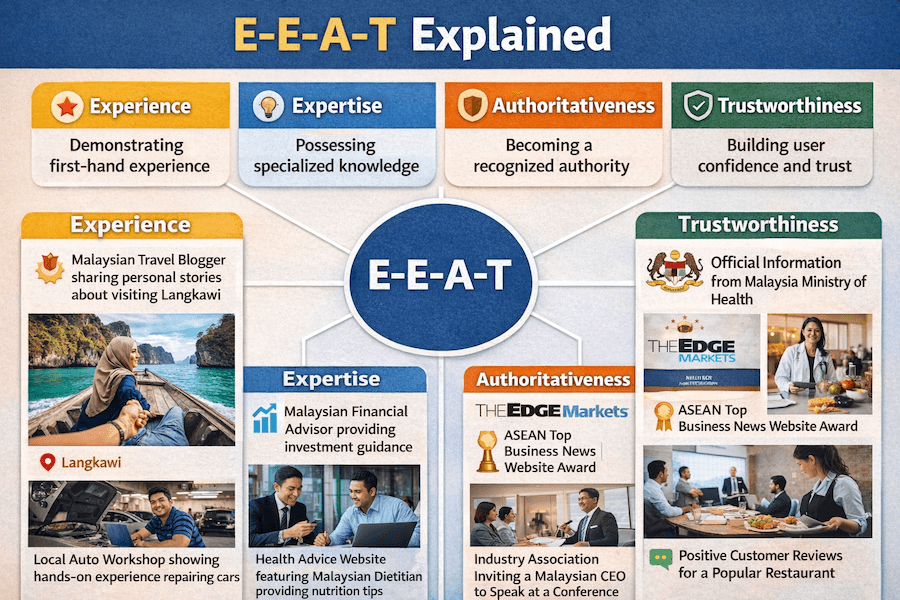
E-E-A-T isn’t a ranking factor you can tick off a checklist. It’s Google’s framework for evaluating content quality. Think of it as the lens through which search engines determine whether your content deserves to rank.
Breaking Down E-E-A-T
Experience (The Newest Addition)
This is about first-hand, real-world experience with what you’re writing about. Have you actually done the thing you’re recommending?
For example, if you’re writing about “best accounting software for Malaysian SMEs,” have you actually used these tools in your business? Can you share specific challenges you faced and how you solved them?
AI can’t provide this. ChatGPT hasn’t used accounting software. It can only synthesize information it’s been trained on. This is where human input becomes irreplaceable.
Expertise
Demonstrable knowledge and skills in your subject area. This includes credentials, certifications, proven track records, and industry recognition.
For a Malaysian accounting firm, this might mean:
- CA(M) certification prominently displayed
- Years of experience serving local businesses
- Specific knowledge of Malaysian tax regulations
- Understanding of SSM compliance requirements
Authoritativeness
Recognition by others in your field. This isn’t something you can claim about yourself, it’s proven by third-party validation.
Think:
- Backlinks from reputable Malaysian business sites
- Features in The Star or Malaysian business publications
- Speaking engagements at industry events
- Recommendations from other professionals
Trustworthiness
Accuracy, transparency, and reliability. This includes everything from having SSL security on your website to being honest about what you don’t know.
Malaysian consumers are particularly sensitive to trust signals:
- Clear contact information and business address
- Transparent pricing and policies
- Genuine customer reviews
- Accurate, well-sourced information
Why This Matters in the AI Era
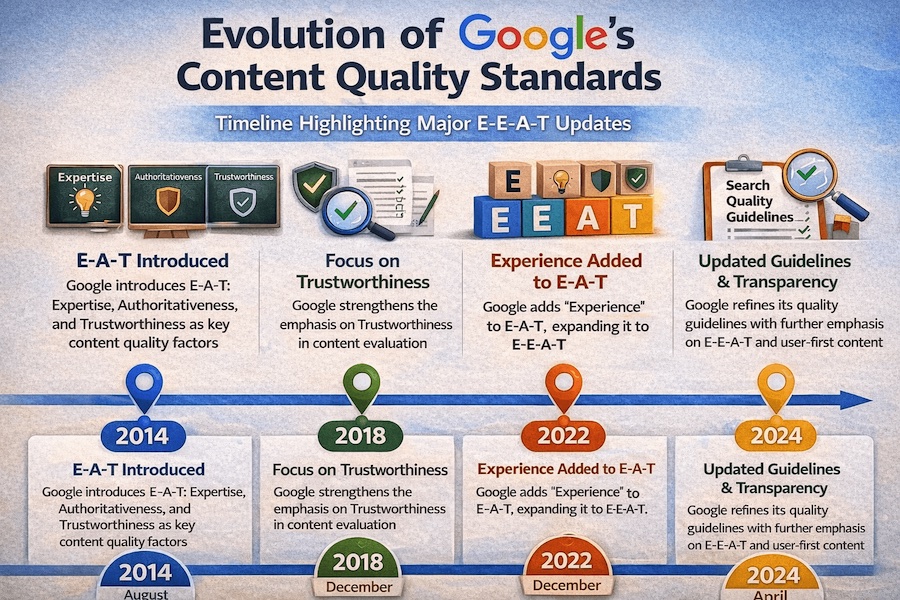
Google added “Experience” to their E-A-T framework in 2022 for a specific reason: they saw the AI content wave coming. They knew that generative AI could produce grammatically correct, well-structured content at scale. But AI can’t experience things. It can’t test products, serve customers, or navigate real business challenges.
This distinction is your competitive advantage.
The AI Content Challenge: Why E-E-A-T Is Critical Now
Here’s what’s happening: millions of AI-generated articles are being published every day. Many Malaysian businesses are using tools like ChatGPT, Gemini, and Claude to produce content quickly. The result? Search results are becoming increasingly homogenized. Everyone’s content sounds similar because it’s coming from similar AI models trained on similar data.
What AI Does Well (And Where It Falls Short)
AI Strengths:
- Research synthesis and summarization
- Grammar, structure, and readability
- Speed and consistency
- Organizing information logically
AI Limitations:
- No personal experience or unique insights
- Struggles with nuanced local context (like Malaysian market specifics)
- Can’t conduct original research
- No emotional intelligence or authenticity
- Often produces generic, surface-level content
Let me show you the difference with a real example:
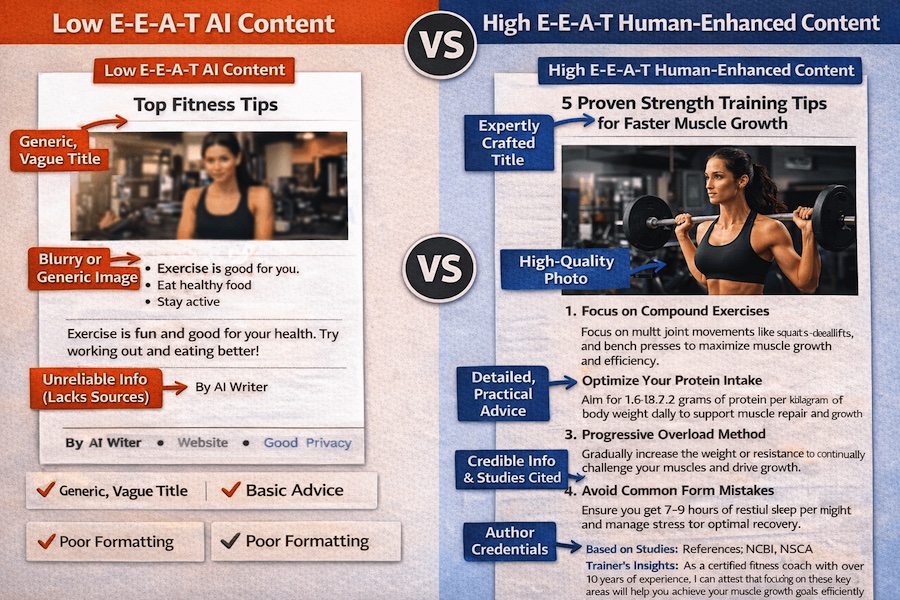
Generic AI Content: “Social media marketing is important for businesses. You should post regularly, engage with your audience, and use relevant hashtags to increase visibility.”
Content with Experience (E-E-A-T): “When we launched our café’s Instagram strategy in Subang Jaya last January, we posted daily for three weeks with zero engagement. We were using generic hashtags like #food and #coffee competing with millions of posts. Then we switched to hyper-local tags like #SubangJayaCafe and #KLCoffeeLovers, and our engagement jumped from 2% to 8% overnight. We also discovered our Malaysian audience engaged most between 8-10 PM on weekdays, probably browsing after dinner.”
See the difference? The second example demonstrates real experience. It has specific details, actual numbers, local context, and lessons learned. This is what Google’s algorithms are looking for.
Google’s Official Stance on AI Content
Let me be clear about this: Google does not penalize AI-generated content simply because it’s AI-generated.
Their official guidance is straightforward: helpful content ranks well, regardless of how it’s created. The question isn’t “Was this written by AI?” but rather “Is this helpful, accurate, and demonstrating genuine expertise?”
However and this is crucial, most AI-generated content fails Google’s helpfulness standards because it lacks the expertise signals we’re discussing. It’s generic, offers no unique insights, and doesn’t demonstrate first-hand experience.
How Search Engines Evaluate Expertise in 2025
Search engines have become remarkably sophisticated at identifying expertise. They’re not just looking at keywords anymore, they’re analyzing your content at a much deeper level.
Author and Content Creator Signals
One of the strongest E-E-A-T signals is clear author attribution with demonstrated credentials.
What Google Looks For:
A detailed author bio that includes:
- Professional credentials and qualifications
- Years of relevant experience
- Specific achievements in your field
- Links to professional profiles (LinkedIn especially)
- A professional photo (yes, this matters for authenticity)
Example of Strong Author Attribution:
Instead of “Posted by Admin,” your byline should look something like:
“Written by Sarah Lim, a certified digital marketing strategist with 10 years of experience helping Malaysian SMEs grow their online presence. Sarah has managed over 50 successful campaigns across Shopee, Lazada, and social media platforms, with a focus on the Malaysian market. She holds a Google Ads certification and regularly speaks at SME marketing workshops in KL.”
This tells both readers and search engines exactly why Sarah is qualified to write about digital marketing.
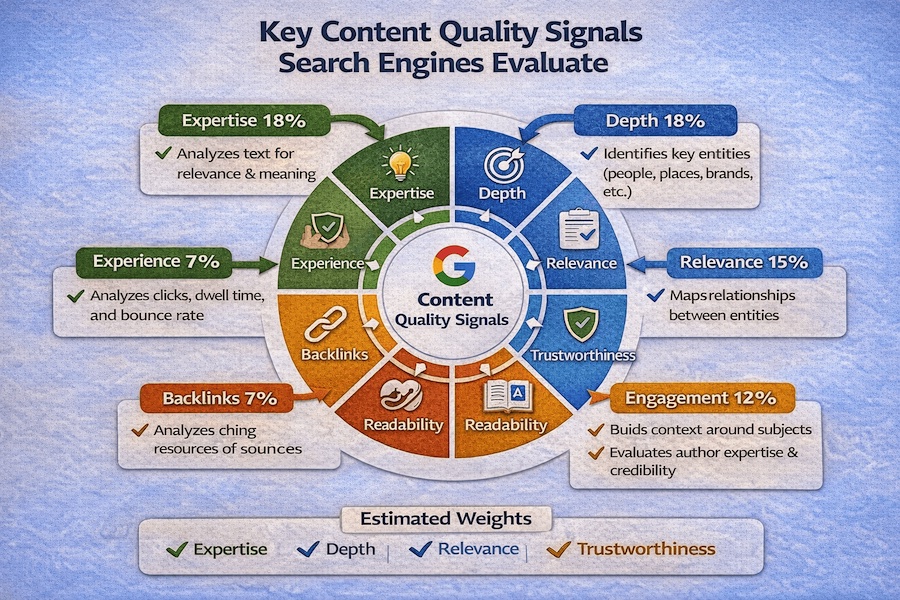
Content Quality Signals Search Engines Track
Beyond author credentials, search engines analyze how users interact with your content:
Engagement Metrics:
- How long do people stay on your page?
- Do they scroll to the bottom or bounce immediately?
- Do they click through to other pages on your site?
- Do they return to your site later?
If users quickly return to search results after visiting your page (called “pogo-sticking”), it signals that your content didn’t satisfy their needs. This hurts your rankings.
Depth and Accuracy:
- Does your content cover the topic thoroughly?
- Is your information factually correct and up-to-date?
- Do you cite credible sources?
- Do you include original insights or just rehash existing information?
Technical Quality:
- Is your page fast-loading (especially on mobile)?
- Do you use proper HTML structure (headings, semantic markup)?
- Have you implemented schema markup for author and content?
- Is your site secure (HTTPS)?
For Malaysian businesses, mobile performance is particularly critical over 80% of Malaysian internet users browse primarily on mobile devices.
The Role of Backlinks in Demonstrating Expertise
Quality backlinks remain one of the strongest indicators of authoritativeness. But in 2025, it’s not about quantity, it’s about relevance and quality.
High-Value Links for Malaysian Businesses:
- Editorial mentions in Malaysian business publications
- Features in industry-specific Malaysian sites
- Links from Malaysian government resources (.gov.my domains)
- Citations from Malaysian universities or research institutions
- Links from professional associations and chambers of commerce
One quality link from a respected Malaysian business publication carries more weight than 100 links from random directory sites.
AI-Generated Content Best Practices for E-E-A-T
Now, let’s get practical. How do you actually use AI tools while maintaining strong E-E-A-T signals?
The Right Way to Use AI Tools
Think of AI as your research assistant and first-draft writer, not your replacement. Here’s the workflow that works:
Step 1: Start with Human Insight
Before touching any AI tool, answer these questions:
- What unique experience do I have with this topic?
- What specific problems have I solved for customers?
- What Malaysian-specific context matters here?
- What data or examples can I share from my business?
Step 2: Use AI for Structure and Research
Now use AI to:
- Create an outline based on your insights
- Research supporting information
- Generate a first draft of explanatory sections
- Organize your thoughts logically
Step 3: Add Your Expertise
This is the critical step most businesses skip. Go through the AI draft and:
- Replace generic examples with your real experiences
- Add specific numbers, dates, and outcomes
- Insert Malaysian context (regulations, consumer behavior, local platforms)
- Include screenshots, data visualizations, or images from your work
- Add personality and your brand voice
Step 4: Implement E-E-A-T Signals
Finally:
- Add comprehensive author bio with credentials
- Include proper schema markup (more on this shortly)
- Link to credible sources for any claims
- Add publish and update dates
- Include relevant images with proper alt text
Adding the “Experience” Factor: Real Examples
Let me show you how to transform generic AI content into experience-rich content:
Before (Generic AI Output): “Email marketing is effective for e-commerce businesses. You should build an email list and send regular newsletters with promotions.”
After (Experience Added): “Email marketing transformed our Shopee store’s performance last quarter. We started collecting emails by offering a 10% discount on first orders. Within three months, we had 2,500 subscribers. Our first campaign promoting a Ramadan sale generated RM 15,000 in sales, a 4,200% ROI on the email software cost. The key was timing: we sent the email three days before Ramadan started, and 68% of our Malaysian subscribers opened it within 24 hours.”
The second version proves you’ve actually done this. It has specific numbers, timing details, and insights about Malaysian consumer behavior (opening rates before Ramadan).
Technical Implementation: Schema Markup
Schema markup is like giving search engines a structured summary of your content. It’s especially important for E-E-A-T signals.
Essential Schema for Author Credibility:
At minimum, implement Author schema that includes:
- Author name
- Job title and credentials
- Brief description of expertise
- Photo URL
- Links to professional profiles (LinkedIn, etc.)
You should also implement Article schema that clearly shows:
- The author who wrote it
- Publication date
- Last modified date
- The organization publishing it
Most WordPress sites can add schema using plugins like Yoast SEO or Rank Math. If you’re on a custom platform, your developer can implement this using JSON-LD markup.
For businesses that need comprehensive schema strategies across their entire site, specialized AI SEO services like MackyClyde SEO can ensure proper implementation that search engines actually recognize and value.
What Malaysian Businesses Get Wrong with AI Content
Based on working with dozens of Malaysian businesses, here are the most common mistakes I see:
Mistake #1: No Author Attribution
Your blog shows “Posted by Admin” or no author at all. This immediately signals low credibility to search engines.
The Fix: Assign real people as authors, even if they’re using AI tools. Create actual profiles with credentials, photos, and professional backgrounds.
Mistake #2: Publishing Pure AI Output
You copy AI-generated content directly to your website without adding any personal experience or local context.
The Fix: Always enhance AI drafts with:
- Your personal experiences and examples
- Malaysian-specific details
- Original data from your business
- Unique insights competitors don’t have
Mistake #3: Generic, Thin Content
Your articles could apply to any market anywhere in the world. There’s nothing uniquely Malaysian or specific to your expertise.
The Fix: Every piece of content should answer: “Why would a Malaysian business owner choose this advice over what’s available internationally?” Add local regulations, consumer behaviors, platform preferences (Shopee vs. Lazada, etc.), and pricing in Ringgit Malaysia.
Mistake #4: Ignoring Technical Signals
Your content might be good, but you’re missing:
- Author schema markup
- Slow page loading times
- Poor mobile experience
- Missing or weak author bios
The Fix: Technical E-E-A-T signals matter as much as content quality. Ensure your site is fast, secure (HTTPS), mobile-friendly, and has proper structured data.
Measuring and Improving Your E-E-A-T
How do you know if your E-E-A-T signals are working? Here are the metrics that matter:
Self-Assessment Questions
Experience Check:
- Does your content show first-hand experience with specific examples?
- Have you included actual results and data from your business?
- Are there details that only someone with real experience would know?
Expertise Check:
- Are your authors clearly identified with real credentials?
- Do author bios demonstrate relevant qualifications?
- Are claims backed by evidence or credible sources?
Authoritativeness Check:
- Do reputable sites link to your content?
- Are you mentioned in Malaysian industry publications?
- Do you have genuine customer reviews and testimonials?
Trustworthiness Check:
- Is your contact information prominent and accurate?
- Do you have clear privacy policies and terms?
- Is your site secure (HTTPS) with no security warnings?
- Is information accurate and properly sourced?
Key Metrics to Track
Monitor these in Google Analytics and Search Console:
Engagement Signals:
- Average time on page (target: 3+ minutes for long-form content)
- Scroll depth (are people reading to the end?)
- Pages per session (are they exploring more of your site?)
- Returning visitor percentage
Search Performance:
- Impressions vs. clicks (is your content being seen but not clicked? That’s a trust issue)
- Branded search volume (are people searching for your business name directly?)
- Featured snippet and AI Overview appearances
- Average ranking position trends
Authority Indicators:
- Referring domains (quality backlinks)
- Social shares and mentions
- Direct traffic growth
- Email subscription rates
If you’re seeing high impressions but low clicks, it usually means your title or meta description isn’t trustworthy. If you’re getting clicks but high bounce rates, your content isn’t meeting user expectations.
Practical Action Plan: What to Do This Week
Let’s make this actionable. Here’s what you should do immediately:
Day 1-2: Quick Author Wins
- Add detailed author bios to your top 10 blog posts
- Include professional photos for each author
- Add credentials, experience, and social profile links
- Create dedicated author archive pages
Day 3-4: Content Enhancement
- Choose your 3 best-performing posts
- Add specific examples from your business experience
- Include Malaysian context and local details
- Insert original data or customer results
- Update any outdated information
Day 5-7: Technical Implementation
- Ensure all content has author schema markup
- Add organization schema to your homepage
- Check page speed on mobile devices
- Verify HTTPS is working properly
- Make sure contact information is prominent
These aren’t massive changes, but they signal to search engines that real experts are behind your content.

Long-Term Strategy: Building Sustainable Authority
E-E-A-T isn’t a one-time fix, it’s built over months and years through consistent quality and expertise demonstration.
Focus on three core activities:
1. Consistent Expert Content Publish 2-4 comprehensive articles monthly that showcase your expertise. Quality always beats quantity. One deeply researched, experience-rich article is worth more than ten thin, generic posts.
2. Authority Building Activities Seek guest posting opportunities on Malaysian business sites, contribute expert quotes to journalists, speak at local business events, and build relationships with industry influencers. Each of these activities builds third-party validation of your expertise.
3. Community Engagement Respond to comments, engage with your audience on social media, participate in relevant Facebook groups and forums, and build genuine relationships. Authority isn’t just about what you publish, it’s about how you show up consistently in your industry.
For Malaysian businesses that want to accelerate this process with proven AI-enhanced strategies while maintaining strong E-E-A-T signals, MackyClyde SEO using AI for efficiency while ensuring human expertise remains central to content quality.
The Bottom Line
E-E-A-T isn’t going away, it’s becoming more critical as AI makes content creation easier. The businesses that will succeed in the next few years are those that understand this fundamental truth: AI can help you create content faster, but it can’t replace the human expertise, experience, and authority that search engines value.
You don’t need to choose between AI efficiency and quality. You need to use AI strategically while ensuring your content demonstrates genuine expertise.
Start with the action items I’ve outlined. Add proper author attribution this week. Enhance your best content with real experiences next week. Implement technical signals the week after. Small, consistent improvements compound into significant authority over time.
The Malaysian business owner I mentioned at the start? After implementing these E-E-A-T principles adding author credentials, enhancing AI content with his actual business experiences, and including specific Malaysian context, his traffic recovered within two months. More importantly, his engagement metrics improved dramatically because the traffic he was getting was more qualified.
That’s the power of E-E-A-T: not just more traffic, but better traffic from people who trust your expertise.