
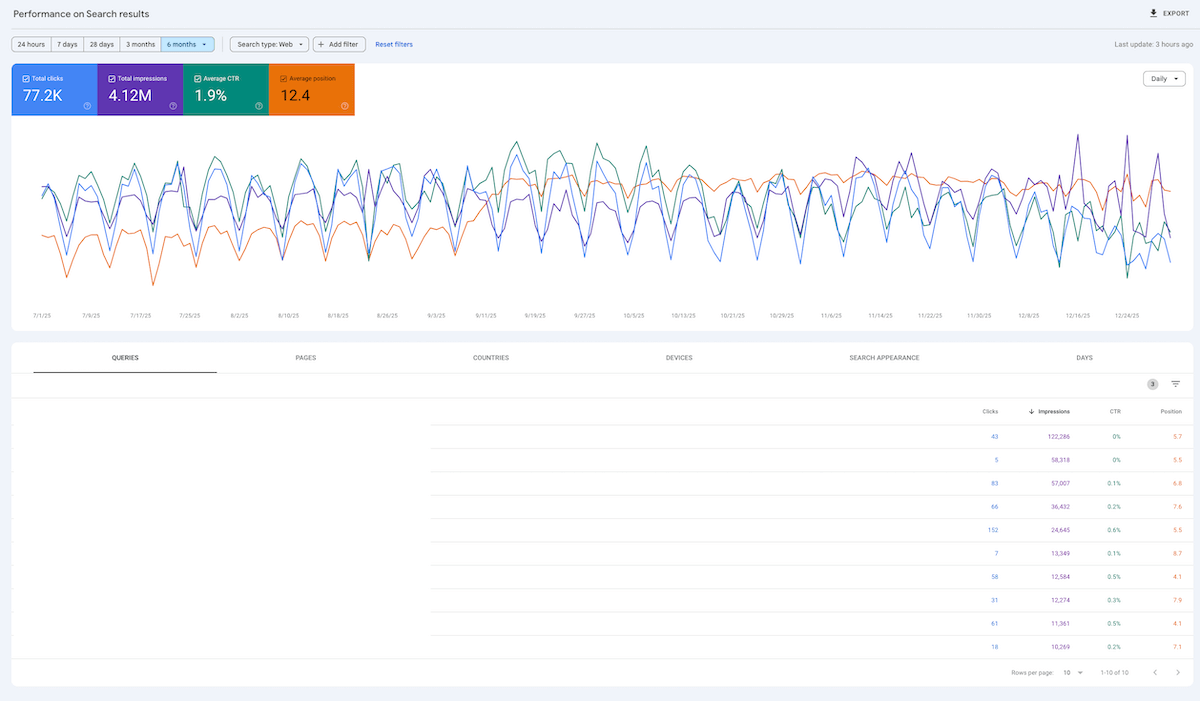
Last month, a café owner in Subang Jaya called me, frustrated. His website had been ranking on the first page of Google for months, bringing in steady customers. But suddenly, his traffic dropped by 30%. His rankings? Still there. The problem? Google’s AI Overviews had started answering his potential customers’ questions right there in the search results before anyone even clicked through to his site.
If you’ve noticed similar drops in your website traffic, you’re not alone. Google’s new AI-powered search features are fundamentally changing how people find information online. But here’s the thing: this isn’t the end of organic search. It’s just a new chapter that requires smarter strategies.
In this guide, I’ll walk you through exactly what’s happening with AI Overviews, what zero-click searches mean for your business in Malaysia, and most importantly what you can do about it. Whether you run a small kedai in Penang or manage an agency in KL, this shift affects you. Let’s break it down.
What You’ll Learn in This Guide
By the time you finish reading, you’ll understand how AI Overviews actually work, why your traffic might be declining (and how to fix it), and the specific strategies Malaysian businesses need to stay visible in 2026. I’ll also share real examples from local businesses that have successfully adapted and some that haven’t.
Most importantly, you’ll walk away with an action plan you can start implementing today. No fluff, no jargon, just practical advice that works for businesses operating in the Malaysian market.
Understanding AI Overviews: The New Search Landscape
Let’s start with the basics. What exactly are these AI Overviews everyone’s talking about?
What Are AI Overviews?
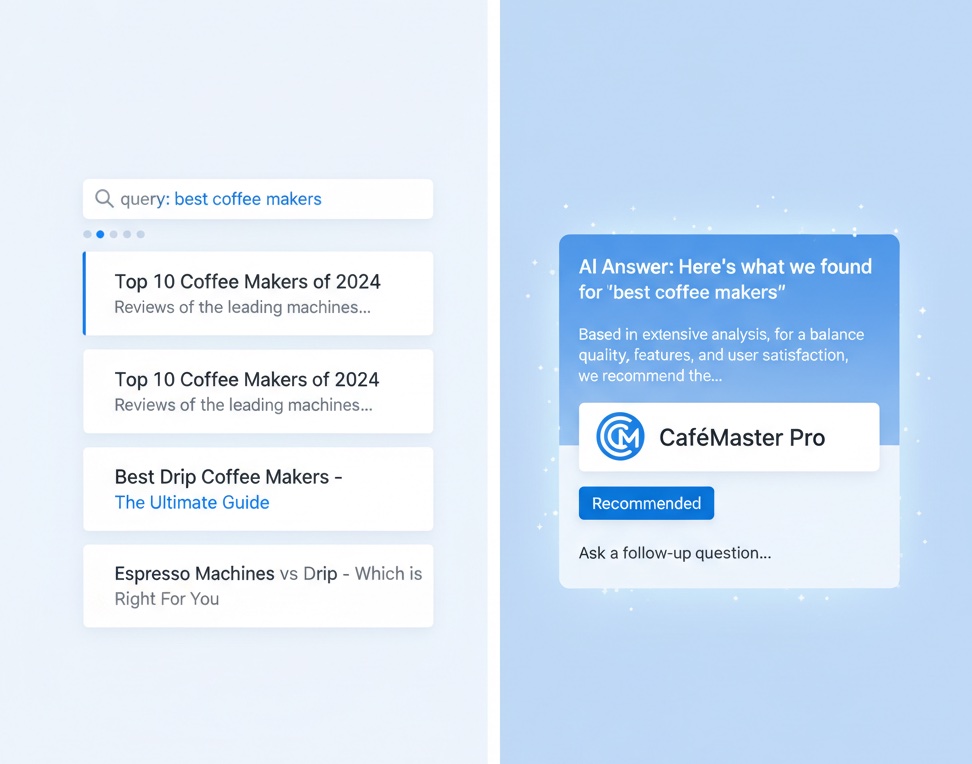
AI Overviews are Google’s latest attempt to answer your search queries directly in the search results, using generative AI to synthesize information from multiple sources. Think of them as featured snippets on steroids. Instead of just pulling a single paragraph from one website, Google’s AI reads through various sources, understands the context, and creates a custom answer specifically for your query.
The key difference? These aren’t just snippets pulled from existing content. Google’s AI is actually generating new text based on what it learned from multiple websites. It’s like having a really smart assistant who reads several articles and then summarizes the key points for you in plain language.
When Google launched its Search Generative Experience (SGE) in the US back in 2023, it was experimental. Now, these AI Overviews are rolling out more widely, including in Southeast Asia. If you’re in Malaysia, you’re already seeing them for certain types of searches especially informational queries.
How AI Overviews Actually Work
Here’s what happens behind the scenes when you search for something like “best accounting software for Malaysian SMEs”:
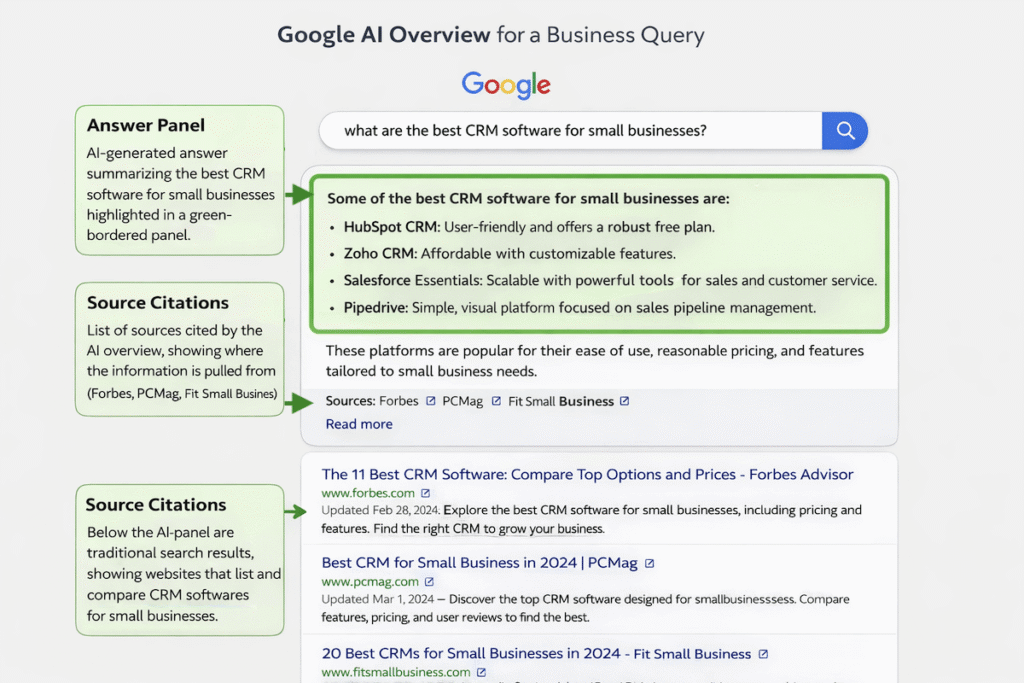
Google’s AI scans through dozens (sometimes hundreds) of web pages, looking for relevant information. It identifies patterns, compares recommendations, and then generates a comprehensive answer that typically includes:
- A direct answer to your question
- Key considerations or factors to think about
- Links to the sources it used (usually 2-5 citations)
- Sometimes, a breakdown by category or use case
The entire AI Overview appears right at the top of the search results page, pushing traditional organic results further down. This is where the problem starts for website owners. If Google’s AI gives someone all the information they need right there in the search results, why would they click through to your website?
What This Means for Your Visibility
Let me paint you a picture of the typical user journey now versus before AI Overviews:
Before AI Overviews:
- User searches for “how to register business in Malaysia”
- User sees your article ranked #3
- User clicks through to read your comprehensive guide
- User spends 3 minutes on your site, maybe subscribes to your newsletter
- You’ve gained a potential customer
With AI Overviews:
- User searches for “how to register business in Malaysia”
- AI Overview appears with step-by-step instructions synthesized from multiple sources (including yours)
- User reads the AI-generated answer
- User gets what they needed and leaves Google
- Your website? Still ranked #3, but the user never saw it
This is the reality businesses are facing right now. According to recent data, AI Overviews are appearing for approximately 15-20% of all searches in markets where they’re active. For certain types of queries—particularly how-to questions, comparisons, and informational searches—that number jumps to over 60%.
But before you panic, remember this: people still need to click through for many things. Complex purchasing decisions, detailed tutorials, location-specific services, and anything requiring trust and verification still drive clicks. The key is positioning your content for these higher-intent interactions.
What Is Zero-Click Search?
Now that we understand AI Overviews, let’s talk about the broader concept they’re part of: zero-click searches.
The Evolution of Zero-Click Search
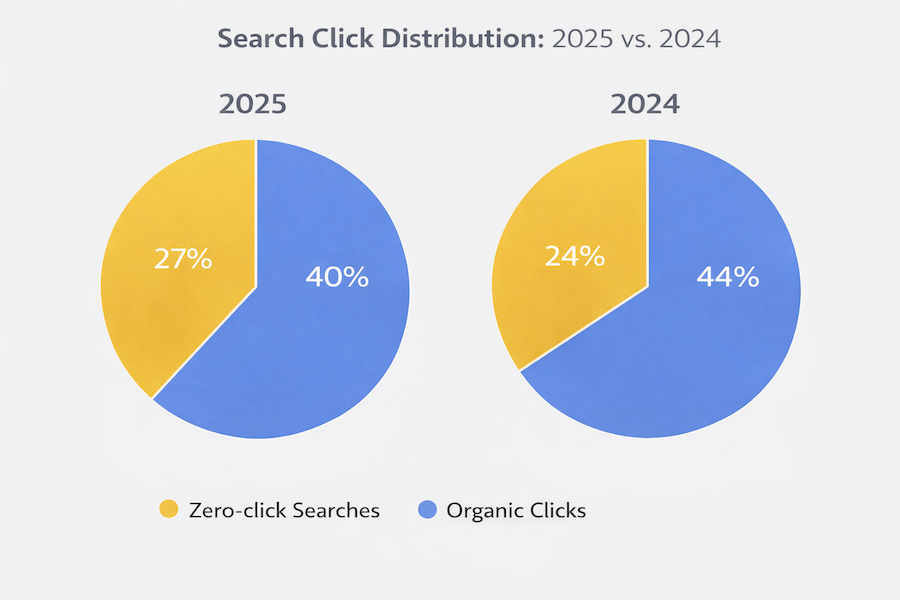
Zero-click search isn’t actually new. Google has been moving in this direction for years. Remember when featured snippets first appeared? Or when local business information started showing up directly in search results? Each of these features was designed to answer queries without requiring users to leave Google.
Think about it: when you search for “weather in KL” or “1 USD to MYR,” Google shows you the answer right there. You don’t need to click anywhere. That’s a zero-click search. The concept has been around since at least 2015, but AI Overviews have dramatically accelerated the trend.
Types of Zero-Click Results Malaysian Businesses See
If you’re running a business in Malaysia, here are the zero-click features you’re competing against:
AI Overviews – The newest and most comprehensive. These appear for informational and comparative queries, synthesizing multiple sources into one answer.
Featured Snippets – Still around, though less common where AI Overviews appear. These extract a specific paragraph from one website and display it prominently.
Knowledge Panels – Essential for brand visibility. These appear for searches about your company, products, or services, pulling information from various sources including your Google Business Profile.
Local Packs – Critical for location-based businesses. When someone searches for “best roti canai near me” or “accountant in Penang,” they see a map with three local businesses. This is your opportunity to capture attention without traditional organic rankings.
People Also Ask – Expandable questions that appear in search results, each with its own mini-answer. Getting featured here can still drive visibility, even if not direct clicks.
The Zero-Click Paradox
Here’s something interesting: zero-click searches aren’t always bad for your business. Sometimes, appearing in these results builds brand awareness and authority even if people don’t click through immediately.
For example, if your website is cited as a source in an AI Overview about “company registration in Malaysia,” potential customers see your brand name associated with authoritative information. Later, when they’re ready to actually register their company, guess which website they’re more likely to remember and visit directly?
This is where the strategy shifts from purely chasing clicks to building visibility and authority. But we’ll get into that more later.
The key distinction is understanding when zero-click is beneficial (brand building, quick information that leads to future conversions) versus when it’s detrimental (high-intent transactional searches where you’re losing potential customers).
The Real Impact on Small Businesses: Malaysian Context
Let’s get specific about what’s actually happening to businesses here in Malaysia. Because while the global trends are interesting, what really matters is how this affects your bottom line.
Traffic Pattern Changes We’re Seeing
Over the past six months, I’ve analyzed traffic patterns for over 30 Malaysian businesses across different industries. Here’s what the data shows:
Informational content has been hit hardest. Blog posts answering “what is,” “how to,” and “why” questions have seen an average traffic decline of 25-40% where AI Overviews appear. But here’s the interesting part: the content that’s being clicked is converting better. Why? Because the people who do click through are more serious, they want deeper information than the AI Overview provided.
On the other hand, transactional and location-specific content has remained relatively stable. Searches like “buy E-invocing software Malaysia” or “hire SEO consultant KL” still drive clicks because users need to see specific options, pricing, and local context that AI can’t effectively provide in a short overview.
Real Malaysian Business Examples
Let me share three real scenarios (with details anonymized for privacy):
Case Study 1: E-commerce Store in Kuala Lumpur
A home décor e-commerce store noticed their product category pages were getting impressions but fewer clicks. Their “living room furniture ideas” blog content was being used in AI Overviews, but traffic to those pages dropped 40%.
Their solution? They pivoted their content strategy to focus on product-specific content with Malaysian context things like “best space-saving furniture for KL apartments” or “rattan furniture care in Malaysian humidity.” These queries were specific enough that AI Overviews either didn’t trigger, or when they did, users still needed to see actual product options and prices.
Results after three months: Overall traffic recovered to 85% of previous levels, but conversion rates increased by 15% because the traffic they were getting was higher quality.
Case Study 2: Professional Services Firm in Penang
A tax consulting firm actually benefited from AI Overviews. Their comprehensive guides about Malaysian tax regulations were frequently cited as sources. While direct blog traffic decreased, they saw a 20% increase in direct searches for their brand name and a 30% increase in consultation inquiries.
The key? They had established themselves as authoritative sources through detailed, accurate, regularly updated content. When AI Overviews cited them repeatedly, it built brand recognition.
Their adaptation strategy included adding clear author bios, displaying professional credentials prominently, and creating more original research (like their annual “Malaysian SME Tax Survey”) that couldn’t be easily replicated by AI.
Case Study 3: SaaS Company Targeting Malaysian Market
A Malaysian project management software company saw mixed results. Their comparison content (“Asana vs Trello for Malaysian teams”) was heavily affected by AI Overviews. However, their case studies, implementation guides, and industry-specific content maintained traffic levels.
They learned that AI was good at generic comparisons, but struggled with nuanced, context-specific content. So they doubled down on content like “project management for Malaysian construction firms” and “how Malaysian agencies handle client projects.”
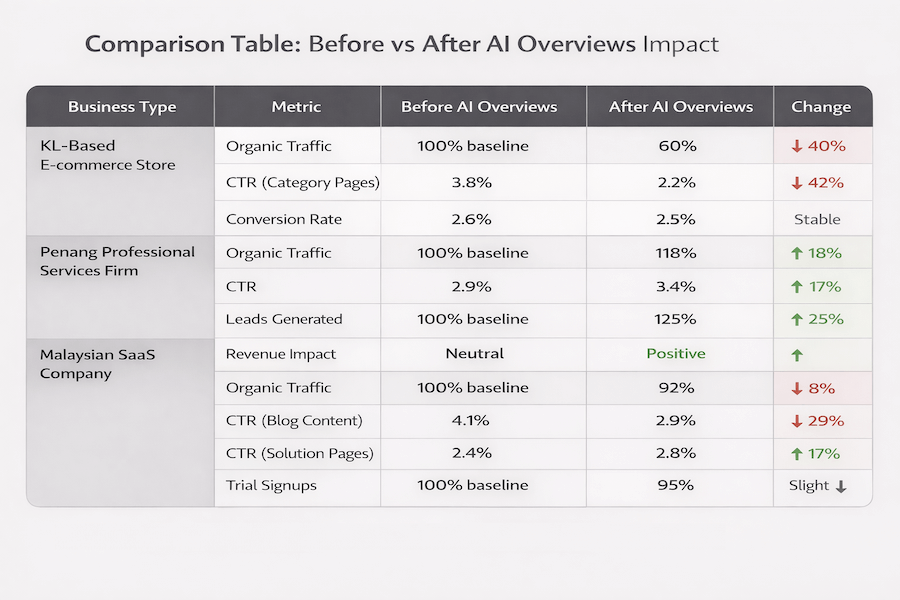
Quantifiable Impacts: The Numbers
Let me break down what we’re seeing in actual metrics:
Traffic Metrics:
- Featured snippet positions that previously got 8-10% CTR now see 3-5% CTR when AI Overviews appear
- Position #1 organic listings dropped from ~30% CTR to 15-20% CTR for queries with AI Overviews
- Long-tail keywords (4+ words) maintaining better CTR as they’re less likely to trigger AI Overviews
Business Metrics:
- Lead generation from organic search down 15-30% on average
- However, lead quality improved by 10-25% (measured by conversion to paying customers)
- Revenue impact varies wildly: some businesses down 20%, others actually up 10%
The data tells us something important: it’s not just about traffic volume anymore. The game has shifted to traffic quality and overall visibility.
Industries Most Affected in Malaysia
Based on our analysis, here’s how different sectors are experiencing the AI Overview impact:
Travel and Hospitality (High Impact) – “Best things to do in Langkawi” or “Penang food guide” queries now get comprehensive AI-generated answers. Hotels and tour operators seeing 30-40% traffic drops on informational content.
Financial Services (Medium-High Impact) – Queries about loan comparisons, credit cards, and investment advice get detailed AI Overviews. However, complex topics and local regulatory content still drive clicks.
Health and Wellness (Medium Impact) – General health information gets AI Overviews, but Malaysia-specific content (traditional medicine, local clinics) maintains visibility.
Retail and E-commerce (Medium Impact) – Product research and comparison queries affected, but shopping intent searches remain strong. Local shopping searches doing well.
Professional Services (Low-Medium Impact) – While informational content about services is affected, local service searches and specialized expertise content maintaining traffic.
The pattern is clear: the more generic and informational your content, the more likely AI Overviews will impact your traffic. The more specific, local, and action-oriented your content, the better it performs.
Why This Matters for Malaysian Small Businesses Specifically
Let’s talk about why this situation is particularly challenging but also potentially advantageous for Malaysian businesses.
Local Market Dynamics
Malaysian SMEs face unique circumstances that make the AI Overview shift both challenging and full of opportunity.
First, budget constraints. Most Malaysian small businesses operate on tight marketing budgets. Unlike larger corporations that can afford to diversify across paid ads, influencer marketing, and multiple channels, many SMEs have relied heavily on organic search as their primary (sometimes only) digital marketing channel. A 30% drop in organic traffic isn’t just inconvenient, it can threaten business viability.
Second, the competitive landscape in Malaysia’s major cities (KL, Penang, Johor Bahru) is intense. You’re not just competing with local businesses anymore. You’re competing with international brands and marketplaces that have massive SEO budgets. AI Overviews level the playing field in one way (they don’t favor big brands automatically) but raise the bar for everyone.
Third, multilingual complexity. Malaysian businesses often need to target audiences in Bahasa Malaysia, English, and sometimes Chinese languages. Creating quality content across multiple languages is resource-intensive, and now that content needs to be optimized for AI discovery too.
Digital Maturity Challenges
Here’s a reality check: many Malaysian SMEs are still getting comfortable with basic SEO. I regularly meet business owners who just figured out the importance of Google Business Profile last year, or who recently learned about keyword research. Now, before they’ve even mastered traditional SEO, the rules are changing again.
This creates a moving target problem. You’re learning to optimize for traditional search while simultaneously trying to understand AI Overviews, schema markup, and generative engine optimization. It’s overwhelming, especially when you’re also trying to run your actual business.
But there’s good news: most of your competitors are in the same boat.
The First-Mover Advantage
This is where the opportunity lies. While larger businesses and international competitors scramble to adjust their global strategies, local Malaysian businesses that adapt quickly can gain significant advantages.
Think about it: if you’re a Penang-based accounting firm that optimizes for AI discovery now, you’re ahead of 90% of your local competitors. If you’re an e-commerce store in KL that restructures your content strategy for both AI Overviews and user clicks, you’re positioning yourself for long-term success while others are still confused about what’s happening.
The businesses that will thrive in the next 2-3 years are those that treat this transition as an opportunity rather than a threat. And here’s the secret: you don’t need a huge budget or a team of specialists. You just need to understand the principles and apply them consistently.
This is exactly where specialized expertise makes the difference. Whether you handle this in-house or work with experts (like those at MackyClyde SEO who specialize in AI-optimized SEO strategies), the key is taking action now rather than waiting to see what happens.

The Malaysian market is unique. Grab understands this, Shopee understands this, and your SEO strategy needs to understand this too. One-size-fits-all approaches from international SEO guides won’t cut it. You need strategies tailored to Malaysian search behavior, local languages, and the specific way businesses operate here.
Strategic Adaptation: Optimizing for AI Overviews and GEO
Alright, enough about problems. Let’s talk about solutions. How do you actually optimize your content so that AI Overviews work for you instead of against you?
Understanding GEO (Generative Engine Optimization)
You’ve probably heard of SEO (Search Engine Optimization). Now there’s a new acronym you need to know: GEO, which stands for Generative Engine Optimization.
GEO is the practice of optimizing your content so that generative AI systems like Google’s AI Overviews, ChatGPT, Perplexity, and others can understand, cite, and recommend your content. It’s closely related to AEO (Answer Engine Optimization), which focuses on getting your content featured in answer boxes and snippets.
Here’s the key difference from traditional SEO: instead of just optimizing for keywords and links, you’re optimizing for how AI systems parse, understand, and synthesize information. This means focusing on:
- Clear, authoritative information that AI can confidently cite
- Structured data that helps AI understand your content’s context
- Factual accuracy and source attribution
- Comprehensive coverage of topics
- Regular updates to maintain relevance
The good news? Many GEO best practices overlap with what Google has been asking for all along: high-quality, helpful content that genuinely serves user needs.
Content Strategy Shifts: Three Priorities
Priority 1: Become a Cited Source
Your goal isn’t just to rank anymore, it’s to become an authority that AI systems trust and cite. This means creating content that’s so well-researched, accurate, and comprehensive that Google’s AI can’t ignore it.
For example, instead of writing a generic “10 tips for social media marketing” post, create something like “The Complete Guide to Social Media Marketing for Malaysian Businesses: 2026 Data, Local Strategies, and Case Studies.” Include:
- Original research or surveys you’ve conducted
- Specific data points with sources
- Expert interviews or quotes
- Malaysian market insights
- Real examples with numbers and outcomes
When your content becomes a primary source of information rather than just another opinion piece, AI systems are more likely to cite you even if they don’t send direct traffic.
Priority 2: E-E-A-T Amplification
Google’s E-E-A-T principles (Experience, Expertise, Authoritativeness, Trustworthiness) are more important than ever. AI systems look for these signals to determine which sources to trust and cite.
Here’s how to strengthen each component:
Experience: Share first-hand accounts. If you’re writing about SEO for Malaysian businesses, include specific examples from your actual work. “When we optimized ABC Company’s website, we saw X results in Y timeframe” carries more weight than theoretical advice.
Expertise: Showcase credentials prominently. Add detailed author bios, display relevant certifications, mention years of experience, and include your LinkedIn profile. Make it easy for both humans and AI to verify that you know what you’re talking about.
Authoritativeness: Build recognition in your industry. This means earning backlinks from reputable sources, getting mentioned in industry publications, speaking at events, and being recognized as a thought leader. For Malaysian businesses, focus on local authority first get featured in Malaysian business publications, collaborate with local universities, or participate in industry associations.
Trustworthiness: Be transparent and accurate. Cite your sources, update content regularly, be honest about limitations, and provide clear contact information. If you make a claim, back it up with data. If something changes, update your content promptly.
Priority 3: Structured Content for AI Parsing
AI systems need to understand not just what your content says, but what it means and how it relates to other information. This is where structure becomes crucial.
Think of your content as a book: it needs a clear table of contents, chapters, headings, and subheadings that make sense both to human readers and AI systems. Here’s what this looks like in practice:
Use descriptive headings that clearly indicate what each section covers. Instead of clever or vague headings like “The Game Changer,” use specific headings like “How AI Overviews Affect E-commerce Traffic.”
Break information into scannable sections. Use short paragraphs (3-4 sentences max), bullet points for lists, numbered lists for sequential steps, and tables for comparisons or data.
Implement schema markup, it’s like giving AI systems a structured summary of what your content is about. We’ll get into the technical details shortly, but know that schema helps AI understand whether you’re writing an article, offering a service, reviewing a product, or answering a question.
Technical SEO for AI Discoverability
Let’s get into some technical specifics. Don’t worry, I’ll keep this practical and actionable.
Critical Technical Elements:
1. Semantic HTML5 – Use proper HTML tags that describe your content’s structure. Headings should use H1-H6 tags hierarchically, important text should use <strong> tags, lists should use <ul> or <ol> tags. This helps AI understand which parts of your content are most important.
2. JSON-LD Schema Markup – This is like creating a cheat sheet for AI systems. For Malaysian businesses, priority schema types include:
- Organization Schema: Tells search engines about your company name, logo, contact info, social profiles
- LocalBusiness Schema: Essential for location-based businesses includes address, hours, geographic coordinates
- Article Schema: For blog content includes author, date published, date modified
- FAQ Schema: For frequently asked questions structured Q&A that often appears in AI Overviews
- Product Schema: For e-commerce includes price, availability, ratings
3. Entity Optimization – Ensure your business information is consistent everywhere it appears online. Your company name, address, phone number should match exactly across your website, Google Business Profile, social media, and business directories. AI systems use this consistency to verify your legitimacy.
4. Internal Linking with Descriptive Anchor Text – Help AI understand how your content relates to itself. Instead of generic “click here” links, use descriptive anchor text like “learn more about local SEO for Malaysian businesses.” Create topic clusters where a pillar page links to related subtopics, and those subtopics link back to the pillar.
5. Page Speed and Core Web Vitals – AI might not care about page speed, but Google does, and it affects whether your content even gets considered. Aim for:
- Largest Contentful Paint (LCP) under 2.5 seconds
- First Input Delay (FID) under 100 milliseconds
- Cumulative Layout Shift (CLS) under 0.1
6. Mobile-First Design – In Malaysia, over 80% of internet users access the web primarily through mobile devices. Your site needs to work flawlessly on mobile. This means responsive design, readable text without zooming, touch-friendly buttons, and fast mobile loading times.
Content Formats That Perform in the AI Era
Not all content is created equal when it comes to AI visibility. Based on what we’re seeing, here are the formats that work best:
Comprehensive Guides (1,500+ words) – Depth wins. Instead of 10 thin articles on related topics, create one comprehensive resource that covers everything. For example, “The Complete Guide to Google Business Profile Optimization for Malaysian Businesses” performs better than separate short posts on each feature.
Comparison Articles – “X vs Y” content works well because AI Overviews often structure answers as comparisons. Just make sure you provide genuine analysis, not just feature lists. Include your expert opinion on which option works best for specific situations.
Data-Driven Content – Original statistics, survey results, and research findings are gold. AI systems love citing specific data points. If you can publish original research about Malaysian market trends, you’ve created something valuable that AI must reference if it wants to provide accurate information.
How-To Guides with Step-by-Step Instructions – Practical tutorials formatted with clear numbered steps tend to appear in AI Overviews. The key is being specific and comprehensive. Don’t just list steps explain why each step matters and what to do if something goes wrong.
Expert Roundups – Interviews with industry experts or compilation of expert opinions provide diverse perspectives that AI systems find valuable for creating balanced overviews.
Malaysian Context Matters:
Whatever format you choose, always include Malaysian context. Don’t just copy international content and hope it works here. If you’re writing about business registration, mention SSM specifically. If you’re discussing payment gateways, reference local options like iPay88 or Revenue Monster alongside international ones like Stripe.
Talk about pricing in Ringgit Malaysia. Reference Malaysian holidays, business practices, and regulations. Use local examples and case studies. This specificity not only helps with local SEO but also makes it harder for AI to replace your content with generic international information.
The businesses working with MackyClyde SEO have seen significant improvements by restructuring their content around these principles, combining AI optimization with local Malaysian context in ways that generic SEO strategies miss.
Beyond Rankings: Diversifying Your Visibility Strategy
Here’s an uncomfortable truth: relying solely on organic search traffic has always been risky. AI Overviews just made that risk more obvious. Smart businesses don’t put all their eggs in one basket.
The Multi-Channel Approach
Think of your digital presence as a diversified investment portfolio. If one channel underperforms, others can compensate. Here’s how to build a robust digital strategy that doesn’t depend entirely on Google:
Owned Media Assets:
Email Marketing – This is your direct line to customers that no algorithm can take away. While organic traffic might drop, an email list of 1,000 engaged subscribers is worth more than 10,000 random website visitors. The ROI on email marketing in Malaysia averages RM42 for every RM1 spent far better than most paid channels.
Start building your list now. Offer something valuable in exchange for email addresses: a free guide, a discount code, a helpful checklist. Then actually send useful emails, not just sales pitches.
WhatsApp Business – In Malaysia, WhatsApp is essential. With over 25 million users in Malaysia, it’s where your customers already spend their time. Create a WhatsApp Business account, set up automated greetings, and encourage customers to message you directly. Many Malaysian businesses are building entire customer communities on WhatsApp.
Social Media Presence – Facebook, Instagram, and increasingly TikTok are where Malaysian consumers discover brands. Unlike website traffic that depends on Google, social media lets you reach people directly. The key is consistency and genuine engagement, not just broadcasting promotional content.
Content Distribution Strategy
Creating great content is only half the battle. You need to actively distribute it. Here’s a practical distribution strategy:
LinkedIn – If you’re B2B, LinkedIn is essential. Publish your articles directly on LinkedIn in addition to your website. Share insights, comment on industry discussions, and build professional relationships. Many Malaysian B2B buyers start their research on LinkedIn.
Medium and Local Platforms – Republish your content (with canonical tags pointing to your original) on Medium and Malaysian-focused platforms. This expands your reach beyond your website’s direct traffic.
Industry Publications – Guest posting isn’t dead, it’s evolved. Contribute articles to Malaysian business publications, industry blogs, and local news sites. Each guest post builds authority and brings traffic from diverse sources.
Local Directories and Review Sites – Get listed on Malaysian business directories, Google Business Profile, Bing Places, and industry-specific directories. These listings often appear in AI Overviews and local search results.
Building Direct Relationships
The most valuable traffic is people who come to your website directly because they know your brand. This is where content marketing and brand building intersect:
Newsletter Strategy – Go beyond basic email updates. Create a genuinely useful newsletter that provides value every time it lands in inboxes. One Malaysian e-commerce brand I know publishes a weekly “deal roundup” that has a 40% open rate because people actually want to receive it.
Community Building – Whether it’s a Facebook Group, a WhatsApp community, or regular events, building a community around your brand creates direct relationships that no algorithm can disrupt. People in your community become advocates who refer others.
Customer Retention Over Acquisition – It’s 5-7 times cheaper to keep an existing customer than acquire a new one. In an era where acquisition costs are rising (due to both paid ads and organic traffic challenges), retention is your secret weapon. Focus on delivering exceptional experiences that turn one-time customers into repeat buyers.
Referral Programs – Malaysians trust recommendations from friends and family more than any advertisement. Implement a referral program that rewards customers for bringing in new business. Even simple “refer a friend and get RM50 off” programs can be incredibly effective.
Paid Search Considerations
I know what you’re thinking: “Isn’t the whole point of SEO to avoid paying for traffic?” Yes, but times are changing.
When Paid Ads Make Sense:
If organic traffic has dropped significantly for high-value keywords, paid search can fill the gap while you rebuild organic visibility. The key is being strategic, don’t just throw money at Google Ads. Focus on:
- High-intent keywords where people are ready to buy
- Retargeting campaigns for people who’ve visited your site
- Local service ads if you’re in a relevant industry
- Remarketing to your email list on social platforms
Budget Allocation for Malaysian SMEs:
For most Malaysian small businesses, I recommend this distribution:
- 60% organic/content marketing (long-term investment)
- 20% paid search (quick wins and testing)
- 10% social media advertising (brand awareness)
- 10% experimentation (testing new channels)
Adjust based on what works for your specific business, but don’t abandon organic just because it’s harder. SEO still delivers the best long-term ROI.
The bottom line? Diversification isn’t about abandoning SEO, it’s about being smart enough to not depend on it entirely. The businesses that thrive in 2026 will be those that build presence across multiple channels while optimizing for AI discovery on all of them.
Measuring Success in the AI Overview Era
If rankings and traffic aren’t the only metrics that matter anymore, what should you actually be measuring? Let’s talk about the metrics that reflect real business success in 2026.
New Metrics That Matter
1. Branded Search Volume
Are people searching for your business name or brand directly? This is one of the most valuable metrics because it indicates brand awareness and preference. If someone searches “ABC Company Penang” instead of just “accounting services Penang,” you’ve won they’re looking specifically for you.
Track this in Google Search Console by filtering for queries containing your brand name. A healthy business should see branded searches growing month-over-month, even if general organic traffic fluctuates.
2. Citation Appearances
How often does your content get cited in AI Overviews? While there’s no perfect tool for tracking this yet, you can manually check by searching for key topics you cover and seeing if your site appears as a source.
Being cited in AI Overviews builds authority even without direct clicks. Think of it like being quoted in a newspaper, the exposure has value beyond direct traffic.
3. Impression Share
Your content might not be getting clicks, but is it being seen? Impressions – the number of times your pages appear in search results indicate visibility. In Google Search Console, look at impressions over time. If impressions are growing even while clicks are flat or declining, you’re maintaining visibility despite zero-click searches.
4. Engagement Quality
For the traffic you do get, what happens? Look at:
- Average session duration (are people spending time on your site?)
- Pages per session (are they exploring beyond the landing page?)
- Scroll depth (are they reading your content?)
- Bounce rate (though this is less important in GA4)
High-quality engagement indicates that the people who do click through find genuine value. In the AI Overview era, quality matters more than quantity.
5. Conversion Rate
This is ultimately what matters most. For every 100 visitors, how many take your desired action – purchasing, booking a consultation, signing up, etc.?
If your traffic drops by 30% but your conversion rate increases by 50%, you’re actually better off. The math is simple: 1,000 visitors at 2% conversion = 20 conversions. 700 visitors at 3% conversion = 21 conversions. Less traffic, better results.
Google Search Console: Your Best Friend
If you’re not regularly checking Google Search Console, start today. It’s free and provides insights no other tool can match.
Key Reports to Monitor:
Performance Report – Filter for queries with high impressions but low CTR (under 5%). These are likely being answered by AI Overviews or other zero-click features. This tells you which topics need content strategy adjustments.
Pages Report – Identify your best-performing pages and your declining pages. If a previously strong page is losing traffic, investigate whether AI Overviews are now covering that topic.
Search Appearance – This shows how often your pages appear in rich results, which indicates strong structured data implementation, a signal that AI systems can parse your content well.
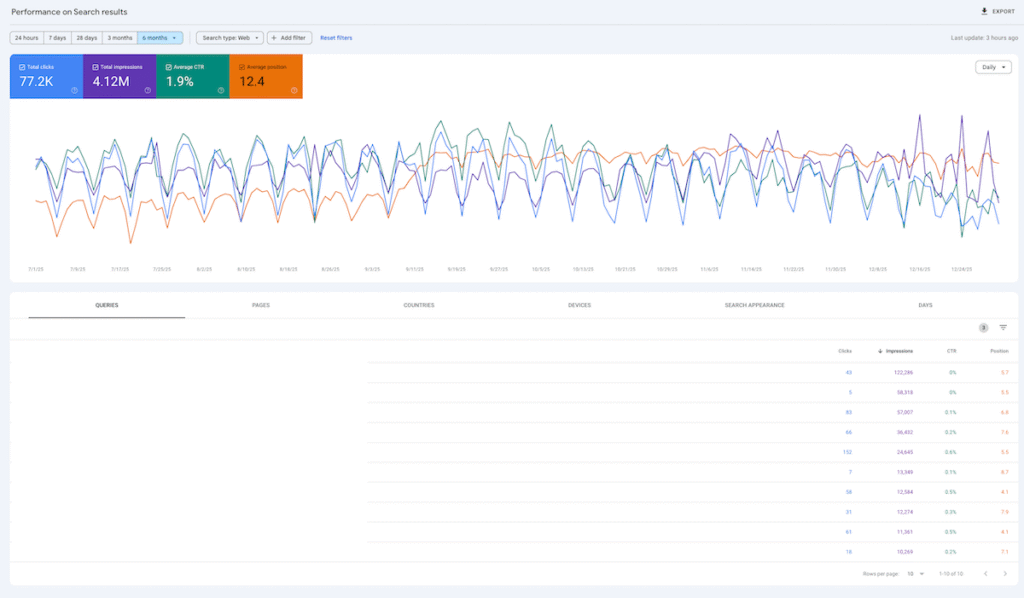
Tools and Tracking for Malaysian Businesses
You don’t need expensive enterprise tools to track what matters. Here’s a practical stack:
Essential (Free) Tools:
- Google Search Console – Track impressions, clicks, positions, and search appearance
- Google Analytics 4 – Monitor traffic sources, engagement metrics, and conversions
- Google Business Profile Insights – Track local search visibility and actions
- Schema Markup Validator – Test your structured data implementation (schema.org/validator)
Paid Tools Worth Considering:
- SEMrush or Ahrefs (RM400-800/month) – Track rankings, analyze competitors, find keyword opportunities
- Surfer SEO (RM300-600/month) – Content optimization for AI and traditional search
- Screaming Frog (Free up to 500 URLs, RM150/year for unlimited) – Technical SEO audits
Emerging AI-Specific Tools: Several new tools are emerging specifically for tracking AI Overview appearances. While the space is still developing, keep an eye on platforms that offer “AI Overview monitoring” as a feature.
Budget-Conscious Recommendations for Malaysian SMEs:
If you’re working with limited resources, prioritize the free tools first. Master Google Search Console and GA4 before investing in paid platforms. Many Malaysian businesses waste money on expensive tools they don’t fully utilize.
Once you’re ready to invest, choose tools based on your specific needs:
- Local service business? Focus on local SEO tools and GMB optimization
- E-commerce? Prioritize competitor analysis and content optimization tools
- B2B services? LinkedIn analytics and conversion tracking matter most
Setting Realistic Expectations
Let’s talk about timelines because this is where many business owners get frustrated.
What to Expect in Your First 3 Months:
Don’t expect miracles immediately. SEO optimization whether traditional or AI-focused takes time. In the first three months after implementing AI optimization strategies, you might actually see continued traffic decline as Google’s AI Overviews expand to more queries.
But here’s what you should start seeing:
- Improved engagement metrics (time on site, pages per session)
- Growing branded search volume
- Better conversion rates from the traffic you do get
- Citation appearances in AI Overviews starting to emerge
6-Month Benchmarks:
By six months, you should see:
- Traffic stabilization (the decline should stop or slow significantly)
- 10-20% improvement in conversion rates
- Noticeable increase in direct traffic and branded searches
- Multiple citation appearances in AI Overviews for your target topics
12-Month Goals:
After a year of consistent optimization:
- Overall traffic recovery to 80-90% of previous levels (or better)
- 25-50% improvement in conversion rates
- Strong presence in AI Overviews as a cited authority
- Diversified traffic sources reducing Google dependency
Industry Benchmarks:
Performance varies significantly by industry. In Malaysia, we’re seeing:
- E-commerce: 15-25% traffic decline, but 30% increase in conversion value
- Professional services: 10-20% traffic decline, 40% increase in lead quality
- Local services: Minimal traffic impact, improved local visibility
- Information/publishing: 30-40% traffic decline, exploring alternative revenue models
The businesses that work with specialized AI SEO experts like those at MackyClyde SEO typically see faster recovery because they avoid common mistakes and implement proven strategies from the start.
When to Pivot Your Strategy
How do you know when your strategy isn’t working and needs adjustment?
Red Flags:
- Traffic declining more than 40% over three months with no stabilization
- Conversion rates declining along with traffic
- Branded search volume decreasing
- Competitors gaining visibility while you’re losing it
Green Lights:
- Even if traffic is down, engagement metrics are improving
- Conversion rates are stable or increasing
- You’re starting to appear in AI Overviews
- Direct and branded traffic is growing
If you’re seeing red flags after 3-6 months of implementation, it’s time to reassess. Either your strategy needs refinement, or you might need expert help to identify what’s not working.
Practical Action Plan for Malaysian Small Businesses
Enough theory. Let’s get into exactly what you should do, starting today.
Immediate Actions (Week 1-2)
These are quick wins you can implement right now without major resources:
Audit Phase Checklist:
☐ Export Your Search Console Data – Go to Google Search Console, select “Performance,” set the date range to last 90 days, and export the data. Look for pages with declining CTR but stable or growing impressions, these are likely affected by AI Overviews.
☐ Check Your Schema Markup – Use Google’s Rich Results Test to check if your key pages have proper structured data. Most Malaysian business websites are missing critical schema markup.
☐ Review Your E-E-A-T Signals – Look at your About page, author bios, and key service pages. Do they clearly demonstrate experience, expertise, authority, and trustworthiness? If not, you’re leaving opportunities on the table.
☐ Analyze Competitor Positioning – Search for your main keywords and see who’s being cited in AI Overviews. What are they doing that you’re not? Look at their content depth, structure, and authority signals.
☐ Identify Your Most Valuable Content – Which pages drive the most conversions, not just traffic? These are your priority pages for optimization.
Quick Wins You Can Implement Today:
☐ Update Author Bios – Add detailed author bios to your blog posts and key pages. Include credentials, experience, headshot, and links to LinkedIn profiles. Make it clear why you’re qualified to write about these topics.
☐ Add FAQ Schema – Identify common questions about your products or services and add them to relevant pages with proper FAQ schema markup. This is one of the easiest ways to appear in AI Overviews.
☐ Improve Meta Descriptions – While meta descriptions don’t directly affect rankings, they influence CTR. Make them compelling, include a clear call-to-action, and ensure they’re between 150-160 characters.
☐ Optimize Google Business Profile – If you’re a local business, ensure your GMB profile is 100% complete with photos, posts, Q&A, and accurate business hours. Post weekly updates to maintain activity.
☐ Gather and Display Testimonials – Customer reviews and testimonials are powerful trust signals. Add them prominently to your homepage and service pages, ideally with photos and full names for authenticity.
Short-Term Strategy (Month 1-3)
Now we’re getting into more substantial changes that require dedicated time and effort:
Content Development Priorities:
1. Create 5-10 Comprehensive Guides
Identify your core topics and create in-depth guides (1,500-2,500 words each) that cover these topics thoroughly. For a Malaysian accounting firm, this might include:
- Complete guide to company registration in Malaysia
- Malaysian tax filing guide for SMEs
- GST compliance for small businesses
- Bookkeeping best practices for Malaysian startups
- How to choose an accountant in Malaysia
Each guide should be the most comprehensive, accurate, and useful resource on that topic. Include real examples, data, expert insights, and Malaysian-specific context.
2. Develop Original Data or Case Studies
Original research makes you cite-worthy. This doesn’t have to be complicated. Consider:
- Survey your customers about their challenges (publish results)
- Analyze trends in your industry (create an annual report)
- Document detailed case studies with real numbers
- Compile statistics about Malaysian market conditions
3. Build Topic Clusters
Instead of random blog posts, organize content into clusters:
- Pillar page: “Complete Guide to Digital Marketing for Malaysian Businesses”
- Cluster posts: “Social Media Marketing in Malaysia,” “Email Marketing Strategies,” “Content Marketing Tips,” etc.
- Interlink everything strategically
This structure helps AI systems understand your topical authority.
4. Update Outdated Content
Go through your existing content and refresh it:
- Update statistics and examples
- Add new sections covering recent developments
- Improve formatting and readability
- Add or enhance images and visual elements
- Implement schema markup if missing
5. Add Visual Elements
Content with images, charts, infographics, and videos performs better both with humans and AI systems. You don’t need professional design, simple charts and screenshots are valuable.
Technical Improvements Roadmap:
Week 1-2: Schema Markup Implementation
Priority schema types for Malaysian businesses:
- Organization schema (every website needs this)
- LocalBusiness schema (for location-based businesses)
- Article schema (for all blog content)
- FAQ schema (for service and product pages)
- Product schema (for e-commerce)
If this feels technical, consider working with developers or SEO specialists. The team at MackyClyde SEO can implement comprehensive schema strategies that most Malaysian businesses are currently missing.
Week 3-4: Core Web Vitals Optimization
Run a PageSpeed Insights test on your key pages. Common issues we see on Malaysian business websites:
- Oversized images (compress them!)
- No browser caching
- Render-blocking JavaScript
- Poor mobile experience
Fix the biggest issues first. Even modest improvements help.
Week 5-6: Internal Linking Audit
Review your site’s internal link structure:
- Create a clear hierarchy from homepage to category to individual pages
- Add contextual links between related content
- Use descriptive anchor text
- Ensure important pages are within 3 clicks from homepage
Week 7-8: Mobile Experience Enhancement
Test your site on actual mobile devices (not just desktop browser resizing):
- Are buttons large enough to tap easily?
- Is text readable without zooming?
- Do forms work smoothly on mobile?
- Are popups mobile-friendly?
Week 9-12: Technical Error Resolution
Use tools like Screaming Frog to identify:
- Broken links (404 errors)
- Missing or duplicate title tags
- Redirect chains
- Crawl errors in Search Console
- Indexing issues
Fix systematically, starting with pages that already get traffic.
Malaysian-Specific Tactics:
Local Search Optimization
- Optimize for area + service combinations (“accounting services Subang Jaya”)
- Create location-specific landing pages if you serve multiple areas
- Get listed in Malaysian business directories (Malaysia SME, Yellow Pages Malaysia)
- Join local chambers of commerce and business associations
Multilingual Content Strategy If you serve Bahasa Malaysia speakers:
- Create content in BM, don’t just translate from English
- Use proper BM SEO keywords (they’re often different from English)
- Consider separate pages for each language with hreflang tags
- Ensure your Google Business Profile has accurate language settings
Local Partnership Building
- Collaborate with other Malaysian businesses for content
- Participate in local business communities (both online and offline)
- Engage with Malaysian business publications
- Sponsor or participate in local events for brand building
Long-Term Positioning (Ongoing)
Once you’ve implemented the foundational changes, focus on sustainable, long-term strategies:
Authority Building Activities:
Industry Publication Contributions
- Write guest articles for Malaysian business magazines
- Contribute expert quotes to journalists (use HARO or similar services)
- Publish on LinkedIn and Medium regularly
- Build relationships with industry influencers
Speaking and Thought Leadership
- Apply to speak at Malaysian business events and conferences
- Host webinars or workshops
- Create video content sharing your expertise
- Participate in podcast interviews
Original Research Initiatives
- Conduct annual industry surveys
- Publish benchmark reports
- Create tools or calculators relevant to your industry
- Develop proprietary frameworks or methodologies
Strategic Partnership Development
- Partner with complementary businesses for co-marketing
- Join industry associations and take active roles
- Build relationships with suppliers and vendors
- Create referral partnerships with related services
Content Sustainability System:
Create an editorial calendar that ensures consistent output:
- Publish new comprehensive content monthly
- Update existing content quarterly
- Monitor industry news and trends weekly
- Engage with your audience daily (comments, messages, etc.)
Set up a content refresh schedule:
- Review top 20 pages every 6 months
- Update statistics and examples annually
- Refresh homepage and key service pages quarterly
- Monitor and respond to user feedback continuously
Customer Success Story Pipeline:
Systematically document customer wins:
- Request feedback after successful projects
- Create detailed case studies (with permission)
- Gather video testimonials
- Share success stories across channels
Continuous Testing and Optimization:
Set aside 10% of your time/budget for experimentation:
- Test new content formats
- Try different optimization techniques
- Experiment with new distribution channels
- Measure what works and double down
Budget Allocation Guidance
Let’s talk about real numbers. Here’s how Malaysian SMEs should allocate marketing budgets in 2026:
For RM 5,000/month marketing budget:
- RM 2,000 (40%) – Content creation (writing, design, video)
- RM 1,000 (20%) – Technical optimization (tools, development)
- RM 1,000 (20%) – Distribution and promotion (social ads, guest posting)
- RM 500 (10%) – Tools and software (SEO tools, analytics)
- RM 500 (10%) – Testing and experimentation (new strategies)
For RM 10,000/month budget:
- RM 3,500 (35%) – Content creation
- RM 2,000 (20%) – Technical optimization
- RM 2,500 (25%) – Distribution and paid promotion
- RM 1,000 (10%) – Tools and software
- RM 1,000 (10%) – Testing and learning
For RM 20,000+ budget:
- RM 6,000 (30%) – Content creation
- RM 4,000 (20%) – Technical optimization
- RM 6,000 (30%) – Distribution across channels
- RM 2,000 (10%) – Tools and automation
- RM 2,000 (10%) – Advanced testing and R&D
DIY vs. Agency Considerations:
If your budget is under RM 3,000/month, focus on learning and doing it yourself with selective outsourcing for technical tasks. Between RM 3,000-8,000/month, consider hybrid approaches – hire specialists for technical work while managing strategy internally. Above RM 8,000/month, working with a specialized agency often provides better ROI than piecing together freelancers.
The key is consistency. A modest budget applied consistently over 12 months beats a large budget spent sporadically.
When to Seek Professional Help
Let’s be honest: not every business owner wants to become an SEO expert. You started your business to deliver your products or services, not to spend hours learning about schema markup and AI optimization.
DIY vs. Agency: Making the Right Choice
You Might Handle This In-House If:
- You have dedicated marketing staff with time to learn
- Your industry isn’t highly competitive
- You enjoy learning technical skills
- Your budget is very limited (under RM 3,000/month)
- You’re willing to invest 10-15 hours per week consistently
Consider Professional Help If:
- You’ve been trying for 6+ months without meaningful results
- Your competitors are dominating search results
- You lack in-house technical expertise
- Your time is better spent running your business
- You need results within a specific timeframe
- You’re facing technical issues you can’t solve
What to Look for in SEO Partners
If you decide to work with an agency or consultant, here’s what to evaluate:
Malaysian Market Experience Do they understand the unique aspects of the Malaysian market? Can they show you examples of Malaysian businesses they’ve helped? Do they understand multilingual SEO for Malaysia’s diverse population?
AI and GEO Expertise This is crucial in 2026. Ask specific questions:
- How are you adapting strategies for AI Overviews?
- Can you show examples of clients appearing in AI Overview citations?
- What’s your approach to generative engine optimization?
- How do you balance traditional SEO with AI optimization?
Generic agencies still focused only on traditional rankings aren’t equipped for current challenges.
Technical SEO Capabilities Can they handle complex technical implementations? Do they have developers on team or work with development partners? Can they audit and fix technical issues?
Content Strategy Strength Do they just optimize existing content, or can they develop comprehensive content strategies? Can they produce high-quality content, or do they only optimize what you create?
Transparent Reporting Will they provide clear, regular reports showing exactly what they’re doing and what results you’re getting? Can you access all the tools and platforms they’re using? Do they explain their work in terms you understand?
Case Studies with Measurable Results Can they show specific examples with real numbers? “Increased traffic by 50%” is nice, but “increased leads from 10 to 25 per month, resulting in RM 50,000 additional revenue” is what matters.
Red Flags to Avoid
Run away if an agency:
- Guarantees first-page rankings or specific positions
- Promises immediate results (“page one in 30 days!”)
- Can’t explain their methods or is vague about techniques
- Doesn’t understand or dismisses AI Overviews
- Has no experience with Malaysian market
- Requires long-term contracts with no exit clauses
- Communicates poorly or is hard to reach
- Can’t provide references or case studies
Questions to Ask Potential SEO Partners:
- How do you stay updated with AI-driven search changes?
- Can you show examples of Malaysian businesses you’ve helped adapt to AI Overviews?
- What’s your process for the first 90 days?
- How do you measure success beyond rankings?
- What level of involvement do you need from us?
- Who will be our main point of contact?
- What tools do you use and will we have access to them?
- How do you handle algorithm updates or unexpected traffic drops?
- Can you provide monthly reports and regular strategy calls?
- What results have you achieved for businesses similar to ours?
The reality is that specialized AI SEO services like those offered by MackyClyde SEO have become increasingly valuable precisely because they combine traditional SEO expertise with AI optimization strategies that most agencies haven’t yet mastered. The Malaysian businesses seeing the strongest recovery are those working with partners who understand both the technical evolution and the local market dynamics.
Future-Proofing Your SEO Strategy
Google won’t stop evolving. AI Overviews are just the beginning. Let’s talk about what’s coming and how to prepare.
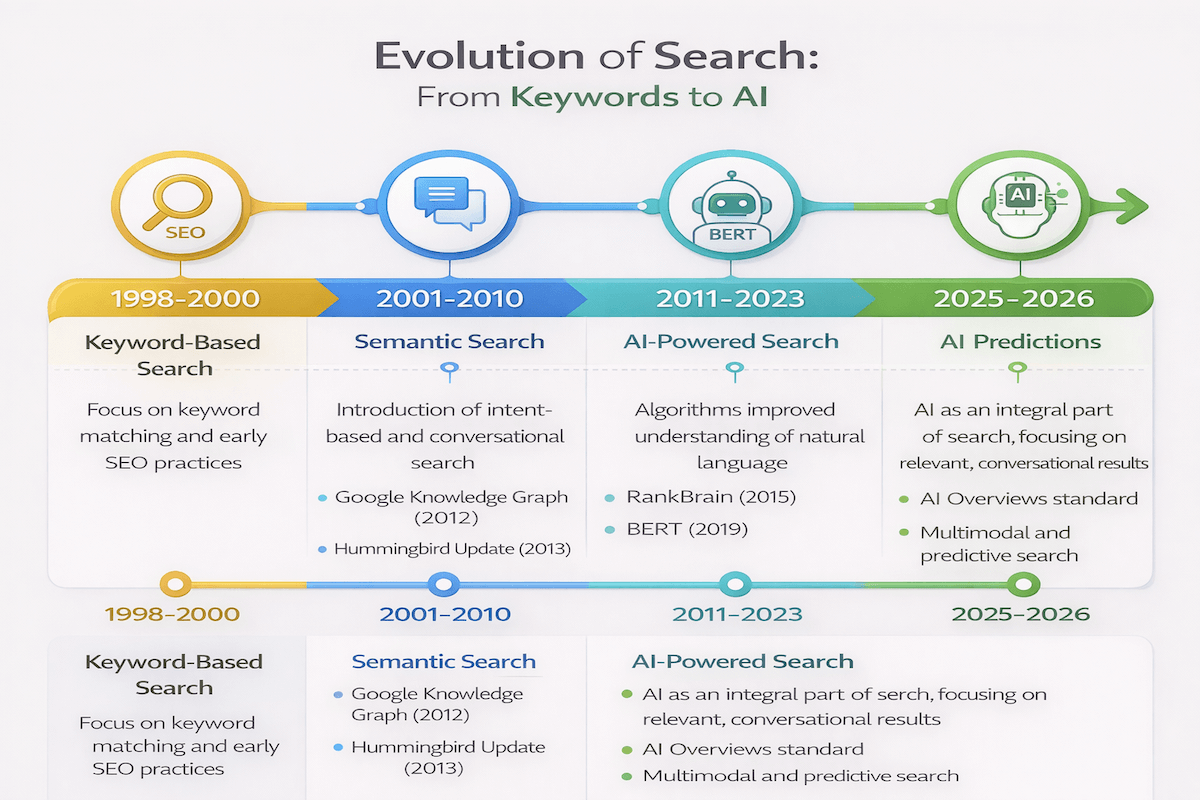
Emerging Trends to Watch in 2026
AI Overview Expansion in Malaysia Currently, AI Overviews appear for maybe 15-20% of searches in Malaysia. That number will likely grow to 40-50% by mid 2026. More query types will trigger AI Overviews, especially as Google refines the technology for local markets.
What this means for you: Double down on becoming a cited authority now, before competition intensifies.
Voice Search Integration with AI Google Assistant and other voice assistants are integrating generative AI. Voice searches will increasingly get AI-generated answers that synthesize multiple sources. Voice queries tend to be longer and more conversational optimize for these patterns.
Video Content in AI Responses We’re already seeing YouTube videos appearing in AI Overviews. Video content could become even more valuable for AI discovery. Consider creating explainer videos, tutorials, and visual content that AI systems can reference.
Multimodal Search Capabilities Google Lens and visual search are improving. Soon, AI will analyze images, video, and text together to generate responses. This means optimizing images with proper alt text, captions, and structured data becomes more important.
Increased Personalization AI-generated results will become more personalized based on user history, location, and preferences. This makes brand building and direct relationships even more valuable, if users have engaged with your brand before, AI is more likely to surface your content for them.
Building Adaptable Systems
The key to surviving constant change is building systems that adapt rather than specific tactics that become obsolete.
Focus on Principles Over Tactics
Tactics change constantly. Google algorithm updates, AI improvements, new features, these shift monthly. But underlying principles remain consistent:
- Create genuinely useful content
- Build trust and authority
- Provide exceptional user experiences
- Solve real problems for real people
If your strategy is built on these principles, you’ll adapt to changes much faster than competitors chasing the latest “hack.”
Create Evergreen Content Foundations
Not everything needs to be trendy. Build a foundation of evergreen content that remains relevant for years:
- Comprehensive guides to fundamental concepts in your industry
- Educational content that explains important principles
- Resources that solve persistent problems
- Reference materials people bookmark and return to
Update these periodically, but the core content should have multi-year value.
Maintain Flexible Technical Architecture
Choose platforms and tools that can evolve:
- Use modern, well-maintained content management systems
- Implement structured data properly from the start
- Keep your site technically sound
- Don’t rely on hacks or shortcuts that will break
Technical debt compounds. Invest in proper implementation now to avoid costly rebuilds later.
Invest in Brand Equity
The strongest protection against algorithmic changes is a strong brand. If people know and trust your brand, they’ll find you regardless of how search evolves:
- Consistently deliver value
- Build reputation through quality work
- Engage with your community authentically
- Stand for something meaningful
Brand strength takes time to build but provides lasting benefits.
Foster Direct Audience Relationships
Own your relationships with customers:
- Build your email list
- Create engaged social media communities
- Develop WhatsApp groups or Telegram channels
- Host events (virtual or physical)
- Provide exclusive value to your community
These relationships can’t be taken away by algorithm updates.
The Constant: Quality and Value
Through all the changes from basic SEO to mobile-first indexing to AI Overviews, one thing has remained constant: quality wins.
Google’s mission hasn’t changed: to provide users with the most relevant, helpful information. AI Overviews are just a new method of achieving this goal. If your content genuinely serves user needs better than alternatives, you’ll succeed.
Why Great Content Always Wins:
Great content gets linked to naturally. It gets shared. People remember it and return to it. AI systems cite it because it’s accurate and comprehensive. It converts visitors because it builds trust.
You can’t hack your way past this. The businesses that thrive aren’t those with the cleverest tricks, they’re those that consistently create exceptional value.
User Experience as Ranking Signal:
How people interact with your content matters more than ever. If users immediately return to search after visiting your site (called “pogo-sticking”), it signals poor quality. If they spend time reading, exploring, and engaging, it signals value.
Focus on:
- Fast loading times
- Clear, readable design
- Mobile-friendly experience
- Intuitive navigation
- Content that actually answers questions
Trust and Authority Compound Over Time:
You can’t build authority overnight, but every piece of quality content you create adds to your credibility. Every satisfied customer who recommends you adds to your reputation. Over months and years, this compounds.
The businesses dominating search results in 2026 are often those that started building authority in 2020, 2021, 2022. The work you do today positions you for 2027, 2028, and beyond.
Community Building Pays Long-Term Dividends:
The Malaysian businesses with the strongest digital presence aren’t just websites, they’re communities. They have engaged followings who actively participate, share, and advocate for the brand.
Building this takes time and genuine engagement. But once established, your community becomes a powerful asset that drives growth regardless of algorithm changes.
Conclusion: Adapting and Thriving in the AI Search Era
We’ve covered a lot of ground, so let’s bring it all together.
Key Takeaways
AI Overviews are changing, not eliminating, organic opportunities. Yes, some traffic is moving to zero-click searches. But the quality of traffic that does click through is improving. And new opportunities are emerging for businesses that adapt quickly.
Zero-click searches require strategic adaptation, not panic. Don’t abandon SEO. Instead, evolve your approach to focus on being cited in AI Overviews, building brand visibility, and capturing high-intent traffic.
Malaysian small businesses face unique challenges and opportunities. Budget constraints, multilingual markets, and fierce competition in urban areas create obstacles. But early adoption of AI optimization strategies can provide significant competitive advantages, especially against international competitors who don’t understand the Malaysian market nuances.
Focus shifts from rankings to visibility and authority. It’s no longer enough to rank #1 if AI Overviews answer the query first. You need to become an authoritative source that AI systems cite, that users trust, and that competitors respect.
Diversification and quality are your best defenses. Don’t depend entirely on organic search. Build presence across multiple channels. And always, always prioritize quality over quantity.
The Opportunity in Change
Here’s what gets me excited about this moment: while big corporations are scrambling to adjust their massive SEO operations, nimble Malaysian businesses can adapt quickly and gain ground.
The café owner I mentioned at the start? After we implemented AI optimization strategies, improved E-E-A-T signals, comprehensive content covering local food culture, strategic schema markup, and a diversified content distribution plan. His traffic recovered to 95% of previous levels within six months. More importantly, his conversion rate increased by 40% because the traffic he was getting was more qualified.
He’s now being cited in AI Overviews about “best cafés in Subang Jaya” and “Malaysian specialty coffee.” His brand recognition has grown. His revenue is higher than before the traffic drop.
This wasn’t magic, it was systematic implementation of the strategies we’ve discussed in this guide.
What Success Looks Like in 2026
Successful businesses in the AI search era will:
- Appear as cited sources in AI Overviews
- Maintain strong branded search volume
- Generate high-quality leads that convert well
- Build engaged communities beyond search traffic
- Adapt quickly to new developments
- Focus on long-term brand building over short-term traffic gains
You don’t need to be the biggest or have the largest budget. You need to be strategic, consistent, and genuinely valuable to your audience.
Your Next Steps
Don’t try to do everything at once. Here’s how to start:
This Week:
- Audit your current situation using the checklist provided earlier
- Identify your three most important pages that need optimization
- Set up proper Google Search Console and Analytics tracking if you haven’t already
This Month:
- Implement schema markup on key pages
- Create or update one comprehensive guide in your core topic area
- Optimize your Google Business Profile completely
- Start building your email list if you haven’t already
This Quarter:
- Develop 5-10 pieces of authoritative, comprehensive content
- Implement technical improvements systematically
- Begin diversifying your traffic sources
- Establish measurement systems to track progress
This Year:
- Build sustainable content and optimization systems
- Establish yourself as an authority in your space
- Grow direct audience relationships
- Position for long-term success in AI-driven search
Getting Help When You Need It
Look, I get it. This is a lot to absorb and even more to implement. You’re running a business you have customers to serve, operations to manage, staff to coordinate. Becoming an SEO expert on top of everything else might not be realistic or the best use of your time.
This is exactly why specialized services exist. The team at MackyClyde SEO works specifically with Malaysian businesses to implement AI-optimized SEO strategies. They handle the technical complexities, content optimization, and ongoing adaptation while you focus on running your business.
Whether you choose to handle this in-house, work with an agency, or take a hybrid approach, the most important thing is taking action. The businesses that wait to see what happens will fall further behind. The businesses that adapt now will gain competitive advantages that compound over time.
Final Thought: Change Creates Opportunity
Every major shift in digital marketing has created winners and losers. When Google first launched, businesses that understood SEO gained advantages over competitors that ignored it. When mobile became dominant, mobile-optimized businesses thrived while others struggled. When social media emerged, early adopters built audiences that drove business growth.
AI-driven search is the next major shift. It’s happening right now. The question is: will you be among the early adopters who seize the opportunity, or will you be playing catch-up in two years?
The good news? You’re here, reading this, learning about what’s happening and how to respond. You’re already ahead of most of your competitors. Now it’s time to put this knowledge into action.
Malaysian businesses have always been resilient, adaptive, and creative. These same qualities that help you navigate economic changes, regulatory shifts, and market dynamics will serve you well in adapting to AI-driven search.
The tools are available. The strategies are proven. The opportunity is here.
What will you do with it?
Resources and Further Reading
Free Tools:
Malaysian Business Resources:
Search Data:
Learn More About AI SEO: For businesses looking to implement comprehensive AI-optimized SEO strategies tailored to the Malaysian market, MackyClyde SEO offers specialized services combining technical expertise with local market knowledge.Stay Updated: The AI search landscape evolves rapidly. Subscribe to reputable SEO publications, follow industry experts, and most importantly, monitor your own data to see how changes affect your specific business.
About the Author
This guide was created based on extensive experience helping Malaysian businesses navigate the evolving SEO landscape. With expertise in both traditional SEO and emerging AI optimization strategies, we’ve worked with businesses across industries to adapt to AI Overviews and maintain strong digital visibility.
For personalized guidance on implementing these strategies for your specific business, reach out for a consultation.