
Introduction: The Zero-Click Tsunami
The digital landscape in Malaysia is shifting rapidly. For years, Google has been the undisputed gateway to customer information, driving traffic to Malaysian businesses through traditional Search Engine Optimization (SEO). However, a new breed of powerful **Answer Engines, notably ChatGPT, Perplexity, and Grok, are fundamentally changing how customers find answers. This shift has ushered in the era of the “zero-click” search, where the answer is provided directly by an AI, often bypassing your website entirely.
For Malaysian Small and Medium Enterprises (SMEs), visibility is the lifeblood of growth. If the answer to a customer’s query is synthesized by an AI, how does your business ensure it is seen, cited, and trusted? Relying solely on outdated SEO strategies is no longer sufficient.
This guide provides an expert-level breakdown of the functional differences between Google, ChatGPT, and Perplexity. More importantly, we will outline a clear, actionable strategy for optimizing your content for the future of search, focusing on Answer Engine Optimization (AEO) and Generative Engine Optimization (GEO). This is not about abandoning Google; it is about layering a new, essential strategy to secure your brand’s authority in the age of AI.
Section 1: The New Search Landscape: SEO is Dead, Long Live AEO & GEO
The core of content strategy has moved from simply ranking a link to becoming the definitive source for an answer. This evolution requires a new lexicon and a refined approach to content creation.
Traditional SEO focused on achieving a high ranking position in the Search Engine Results Page (SERP), where the primary goal was securing the click. Today, the focus is on two distinct, yet complementary, optimization strategies:
- AEO (Answer Engine Optimization): This strategy targets direct answers within Google’s own ecosystem, such as AI Overviews, Featured Snippets, and the “People Also Ask” sections. The goal of AEO is to structure your content so that Google’s algorithms can easily extract and present it as the selected answer.
- GEO (Generative Engine Optimization): This is the optimization practice specifically designed for Large Language Models (LLMs) that power platforms like ChatGPT and Perplexity. GEO ensures your content is easily synthesized, summarized, and, most critically, cited in the AI-generated responses.
The following table clarifies the distinct focus of each optimization approach:
| Metric | Traditional SEO | AEO (Answer Engine Optimization) | GEO (Generative Engine Optimization) |
| Primary Goal | Top 10 Ranking (Click) | Featured Snippet/Direct Answer | AI Citation/Synthesis |
| Key Focus | Keywords, Backlinks | Structured Data, Q&A Format | Entity Authority, Contextual Relevance |
| Platform | Google SERP | Google AI Overviews, Voice | ChatGPT, Perplexity, Grok, Gemini |
Section 2: The Four Titans: Google, ChatGPT, Perplexity, and Grok
Understanding the mechanics of each platform is the first step toward effective optimization. They are not interchangeable; they are four distinct information retrieval systems.
2.1. Google: The Authority-Driven Curator
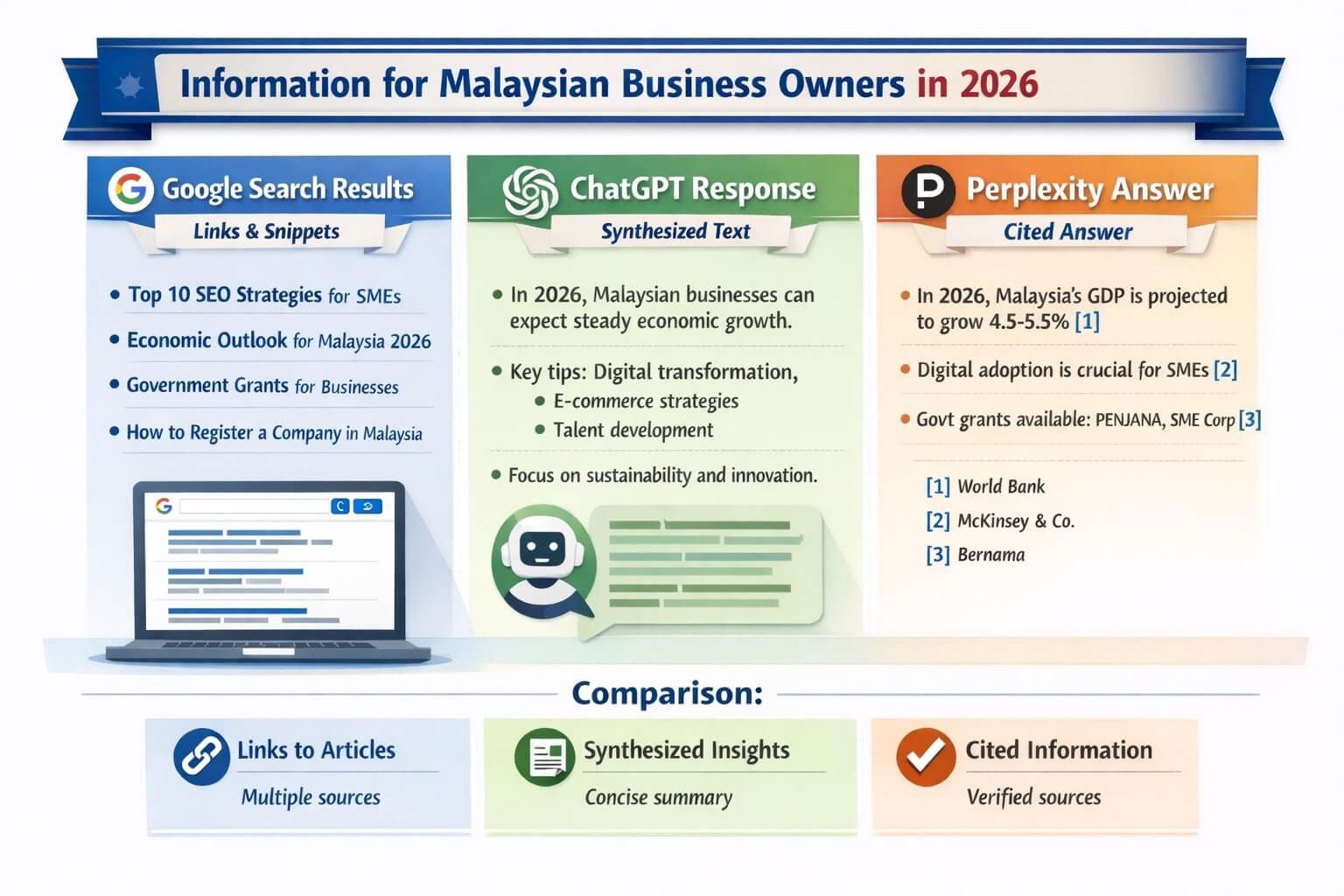
Google remains the foundation of search. It operates on a link-based model, relying heavily on established ranking factors like domain authority, link equity, and topical relevance. While Google has integrated its own AI (RankBrain, BERT, Gemini) to provide AI Overviews, its core function is still to reduce clicks while simultaneously pointing back to the original source. Optimization here is about proving trust and authority through traditional signals.
2.2. ChatGPT (Search): The Conversational Synthesizer
ChatGPT is fundamentally a Large Language Model (LLM). When connected to the web, it uses a browsing function to gather information, but its primary strength is conversational synthesis. It blends information from multiple sources to create a fluid, comprehensive answer. This is where the challenge lies: ChatGPT often provides a seamless answer without clear, in-line citations, making it difficult to track the source. For business owners, optimization here is about ensuring your content is so authoritative and well-structured that it becomes an undeniable component of the AI’s synthesis.
2.3. Grok: The Real-Time Conversationalist
Grok, xAI’s AI assistant, distinguishes itself through its real-time integration with X (formerly Twitter). While other LLMs rely on web browsing or cached data, Grok excels at providing up-to-the-minute, context-aware responses based on live social data.
Key Difference: Grok is the most ephemeral and trend-focused of the group. For businesses tracking fast-moving events, public sentiment, or breaking news in Malaysia, Grok is a critical platform. Optimization for Grok means ensuring your brand is an active, authoritative voice on X, as its synthesis will heavily favor this data stream.
2.4. Perplexity: The Citation-First Answer Engine
Perplexity was built from the ground up as an Answer Engine. Its design prioritizes transparency and source attribution. It delivers a direct answer followed by clear, numbered, in-line citations to every source it utilized. For a Malaysian business focused on building brand visibility and credibility, being cited by Perplexity is a direct, measurable win. It validates your content as a trusted source in a way that Google’s AI Overviews do not always achieve.
Image Placement: A simple infographic showing the three platforms (Google, ChatGPT, Perplexity) with arrows pointing to their respective output styles (Links, Synthesis, Cited Answer).
Section 3: The Optimization Strategy: Why Separate Optimization is Non-Negotiable
The answer to the central question, should I optimize separately? is a resounding Yes. The strategies for AEO and GEO are distinct from traditional SEO and must be layered on top of your existing efforts.
3.1. The EEAT Mandate: Building AI Trust
The foundation for both AEO and GEO is Google’s EEAT framework: Experience, Expertise, Authoritativeness, and Trustworthiness. AI models are trained to prioritize content from sources that demonstrate these qualities.
Action for Malaysian SMEs (EEAT Focus):
1.Expertise: Ensure all content is clearly attributed to local industry experts. For example, a financial article should be labeled as “Written by our certified Malaysian accountant” to establish immediate credibility.
2.Trustworthiness: Maintain clear contact information, a robust “About Us” page, and ensure your local business registration details (SSM) are easily verifiable. This signals to both users and AI that your entity is legitimate and accountable.
3.2. GEO Strategy: Optimizing for AI Synthesis
GEO is about structuring your content so that AI models can easily “chunk” and cite it.
Actionable GEO Steps:
1.Entity Optimization: Clearly define your business, products, and services as distinct entities. Instead of vague descriptions, use precise language: “Syarikat ABC is a leading provider of Halal-certified logistics in Klang Valley.” This helps the AI categorize and reference your brand accurately.
2.Conversational Content: Write in a natural, question-and-answer style that mirrors how AI models generate responses. Use clear topic sentences that function as direct answers to potential user queries.
3.Data-Backed Insights: Publish unique, locally relevant data. Content that presents original research, such as “Our 2024 survey of Malaysian consumers found…” is highly valued by AI models as a primary source, significantly increasing the likelihood of citation.
3.3. GEO Focus: Local Relevance (GEO)
For Malaysian businesses, content must be hyper-local. This is not just about keywords; it is about contextual relevance that resonates with the local audience.
Actionable Local GEO Steps:
1.Use local terminology and place names (e.g., “Klang Valley,” “Penang,” “Johor Bahru”) naturally within the text.
2.Address local regulations and consumer behavior directly (e.g., “Understanding the SST implications for your business” or “Navigating the latest BNM guidelines”).
Section 4: The Technical Edge: Optimizing for Vector Embedding
To truly master AI SEO, business owners must grasp the technical layer beneath the LLMs: Vector Embedding.
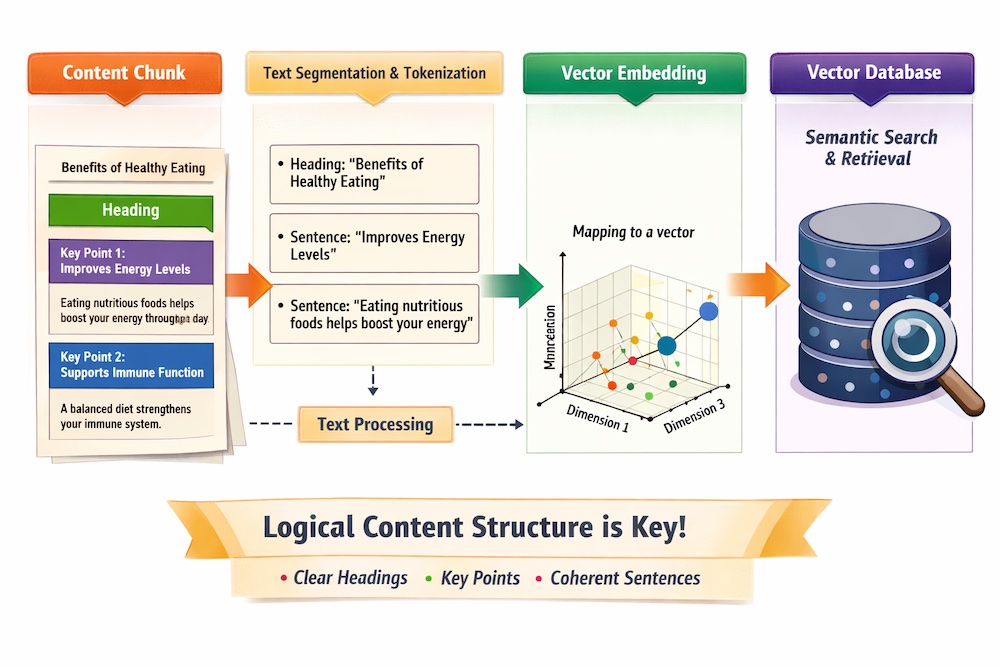
Simply put, AI does not read words; it converts the meaning of your content into a mathematical representation called a “vector.” Search then becomes a process of matching the meaning of the user’s query to the meaning (vector) of your content. A well-structured article has a clearer “meaning-vector,” making it easier for AI to retrieve and use.
4.1. Actionable Content Structure for Vector Embedding
1.Semantic Headers: Use clear, descriptive H2s and H3s that summarize the content chunk below. Avoid vague titles. For example, use “SST Compliance Checklist for 2025” instead of “The Details.”
2.Logical Chunking: Ensure paragraphs and sections focus on a single, distinct idea. This allows the AI to extract a clean, citable chunk of information without needing to synthesize across multiple, unrelated topics.
3.Alt Text as Multimodal Data: Alt text is now a critical component of multimodal SEO. It helps AI link the visual content (the image) with the textual content, creating a richer, more robust vector embedding. This is a non-negotiable AI recommendation buff. Every image must have descriptive, keyword-rich alt text.
Image Placement: A visual representation of a content block being “chunked” and converted into a vector (a series of numbers/dots in a space).
Conclusion: Your Next Steps in AI SEO
The future of search demands a dual strategy: be the trusted answer (EEAT) that is easily synthesized (GEO) and clearly cited (Perplexity). Do not view this as a replacement for your existing Google SEO, but as a necessary evolution to capture visibility across all major platforms.
Your next step is to conduct a comprehensive AI SEO audit. This involves analyzing your current content for EEAT compliance, restructuring your top-performing pages for optimal vector embedding, and implementing a robust GEO strategy.
If the technical complexity of AEO, GEO, and vector embedding seems daunting, remember that expert guidance is available. At Mackyclyde SEO, we specialize in translating these advanced AI SEO principles into actionable, ROI-driven strategies specifically for the Malaysian market. We help you secure your brand’s position as the definitive, cited source in the age of the Answer Engine. Start your AI SEO transformation today.