Key Takeaways
- Website migrations are one of the most common causes of sudden, severe organic traffic drops in Malaysia, most of which are preventable with the right pre-migration checklist.
- The migration process has three equally critical phases: pre-migration preparation, launch execution and post-migration monitoring. Skipping any phase compounds the risk.
- Redirect mapping is not optional. Every URL that carries ranking equity must be mapped to a 301 before the new site goes live.
- Google does not instantly recognise a migrated site. Budget four to twelve weeks for full re-crawling and ranking stabilisation, depending on your domain’s crawl frequency.
- A GEO (Generative Engine Optimisation) consideration layer is now necessary in 2025 and beyond. AI citation sources need to be preserved and re-established after any structural site change.
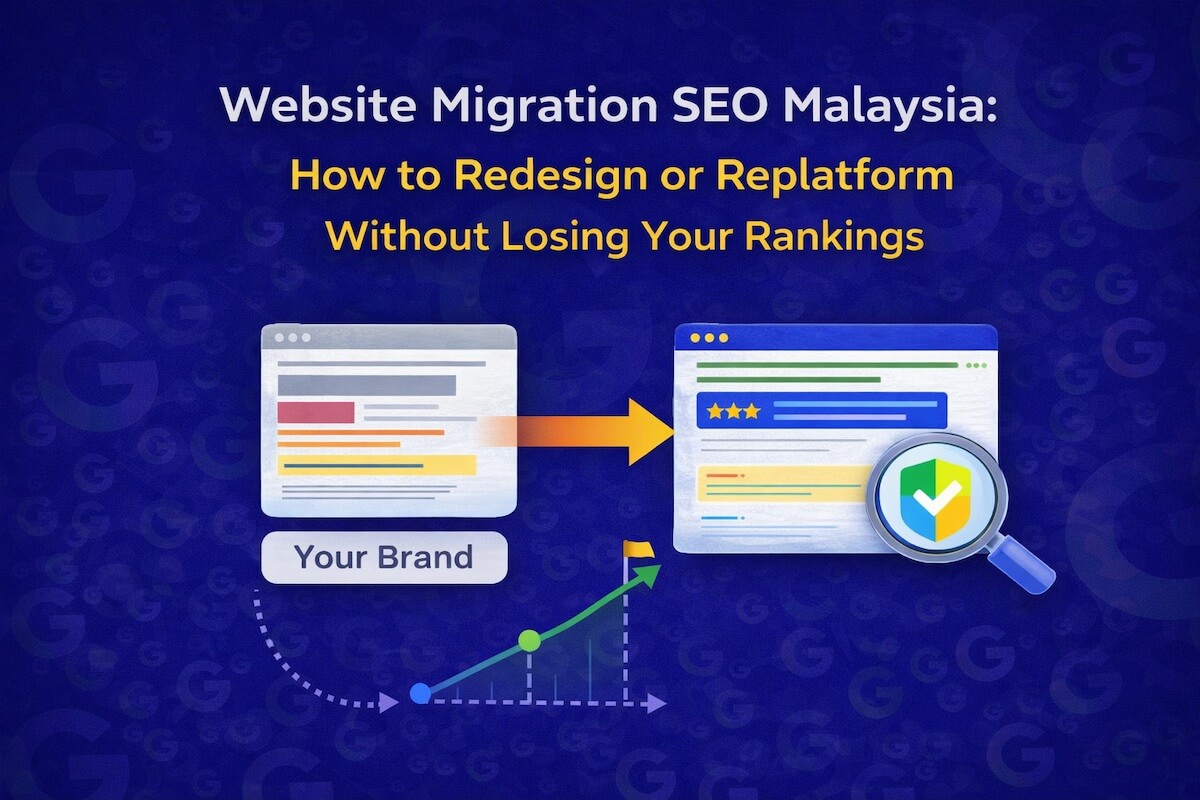
A website migration in Malaysia is the single SEO event most likely to trigger a call to an agency. The pattern is consistent: a business redesigns its site, traffic falls 40 to 70 percent within weeks, and the question that follows is always the same: “What happened?”
What happened is almost always a migration that treated SEO as an afterthought. The good news is that traffic loss from a poorly executed migration is largely preventable. The less comfortable truth is that preventing it requires deliberate, structured work before the new site launches, not after.
This guide covers the full website migration SEO process, built specifically for Malaysian businesses moving between platforms, redesigning site architecture or switching domains. Whether you are replatforming from WordPress to Shopify, restructuring your URL hierarchy or migrating from HTTP to HTTPS, the framework below applies.
What counts as a website migration (and why it puts rankings at risk)
A website migration, from an SEO perspective, is any change that materially alters how search engines discover, crawl or interpret your site. That definition is broader than most businesses expect.
The most common migration types that trigger SEO risk in the Malaysian market include:
- Domain changes: moving from a .com.my to a .com, or rebranding entirely to a new domain
- Platform changes: migrating from Joomla or custom builds to WordPress, or from WooCommerce to Shopify
- URL structure changes: restructuring from
/page-id-123to/category/page-titleor flattening deep URL hierarchies - HTTP to HTTPS: still relevant for older Malaysian business sites that have not completed this transition
- Site architecture changes: merging subsections, reorganising navigation, consolidating or splitting content categories
- Full redesigns: where the underlying CMS, URL structure and template system change simultaneously
The risk in each case is the same: Google has indexed a specific set of URLs, assigned those URLs ranking authority based on their content and their backlink profiles, and built an understanding of your site’s topical structure. Any change that disrupts those signals without proper handling tells Google it is looking at a different, unfamiliar site.
The three ways rankings disappear after a migration
Link equity evaporation. Backlinks pointing to your old URLs stop passing authority if those URLs return a 404 (not found) or 302 (temporary redirect) instead of a permanent 301 redirect. For Malaysian businesses with years of earned backlinks, this is the most damaging and the most overlooked risk.
Crawl confusion. If your new site architecture is significantly different from the old one, Googlebot may not discover all your pages on its initial crawl. Pages that are not crawled cannot rank.
Content signal disruption. If URLs change and 301 redirects are implemented but the content itself is rewritten or removed at the same time, Google loses the relevance signals it had previously associated with those pages.
Phase one: pre-migration preparation
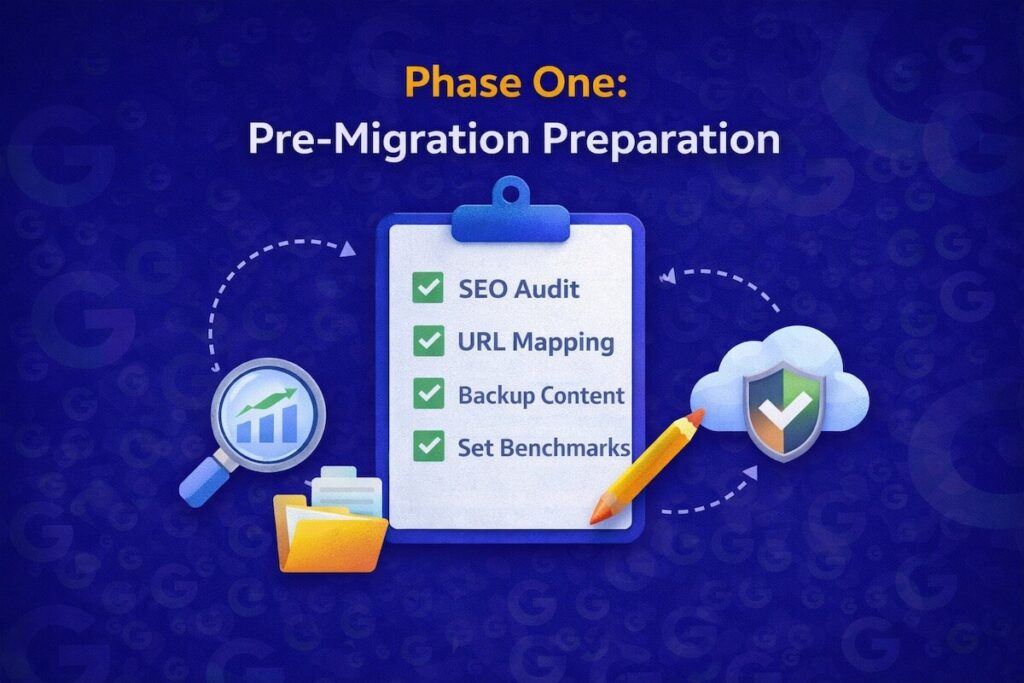
The most experienced technical SEO practitioners recognise that 80 percent of migration outcomes are determined before the new site is launched. The preparation phase is where rankings are protected or lost.
Crawl and document your existing site
Before touching anything on the new site, run a full crawl of your existing site using a tool like Screaming Frog, Sitebulb or Ahrefs Site Audit. Export every URL that returns a 200 status code (live pages).
For each live URL, record:
- The full URL
- The page title and meta description
- Organic traffic (from Google Search Console)
- Organic keywords ranking for that URL (from Ahrefs or Semrush)
- Inbound internal links
- External backlinks pointing to that URL
This becomes your migration master document. It is the baseline against which you will measure everything post-launch.
Expert note: Malaysian sites that serve both English and Bahasa Malaysia content need to document hreflang configurations during this phase. Migrations that lose hreflang tags cause language-targeting issues that are harder to diagnose after the fact.
Segment your URLs by SEO value
Not every URL on your site carries the same organic value. Before mapping redirects, segment your URL inventory into three tiers:
- Tier 1 — High value: Pages ranking in positions 1 to 20 for keywords with meaningful search volume, pages with significant backlink equity, pages driving the majority of organic traffic
- Tier 2 — Medium value: Pages with some rankings or backlinks but lower traffic contribution
- Tier 3 — Low value: Pages with no rankings, no backlinks and no organic traffic (these may be candidates for removal or consolidation rather than migration)
This segmentation allows you to prioritise redirect accuracy. Tier 1 pages require exact, tested 301 redirects. Tier 3 pages may be better handled through consolidation, redirecting them to the closest relevant page rather than migrating them individually.
Build your redirect map
A redirect map is a spreadsheet with two columns: the old URL and the destination URL on the new site. Every Tier 1 and Tier 2 URL needs an entry.
Rules for redirect mapping:
- Always use 301 (permanent) redirects, not 302 (temporary) redirects
- Map old URLs to the most topically relevant equivalent on the new site. Do not redirect everything to the homepage
- Avoid redirect chains (old URL redirecting to an intermediate URL redirecting to the new URL). Each hop loses a fraction of link equity
- Check that redirect destination URLs actually exist on the new site before launch
For Malaysian e-commerce businesses migrating platforms, product URL structures often change completely (for example, from /product?id=456 to /en/products/product-name). These are particularly high-risk because product pages accumulate backlinks and ranking history. Map every product URL individually, even if it takes significant time.
Preserve your XML sitemap and robots.txt logic
Prepare the new sitemap before launch. The new sitemap should include only URLs you want indexed and should not include old URLs. Review the robots.txt file on the new site to confirm it does not accidentally block crawling of key directories (a surprisingly common error on staging environments that get promoted to production).
Replicate and audit on-page elements
Every Tier 1 and Tier 2 page needs its metadata carried across to the new site. This includes:
- Title tags
- Meta descriptions
- H1 and H2 structure
- Schema markup
- Canonical tags
- Open Graph tags (particularly relevant if social sharing drives any referral traffic)
Do not assume your new platform will migrate metadata automatically. Most do not, or they migrate it in formats that introduce encoding errors. Manually verify a sample of your most important pages on the staging environment before launch.
Phase two: migration launch execution
With preparation complete, the launch phase is about execution precision and timing.
Choose your launch window carefully
Avoid launching on a Friday. If crawl errors or indexing problems emerge post-launch, you want your technical team available to respond immediately. A Monday or Tuesday morning launch, Malaysian time, gives you the full working week to monitor and fix issues.
Avoid launching during peak traffic periods for your business. For Malaysian retail or e-commerce sites, this means avoiding festive seasons (Hari Raya, Chinese New Year) and major sales events.
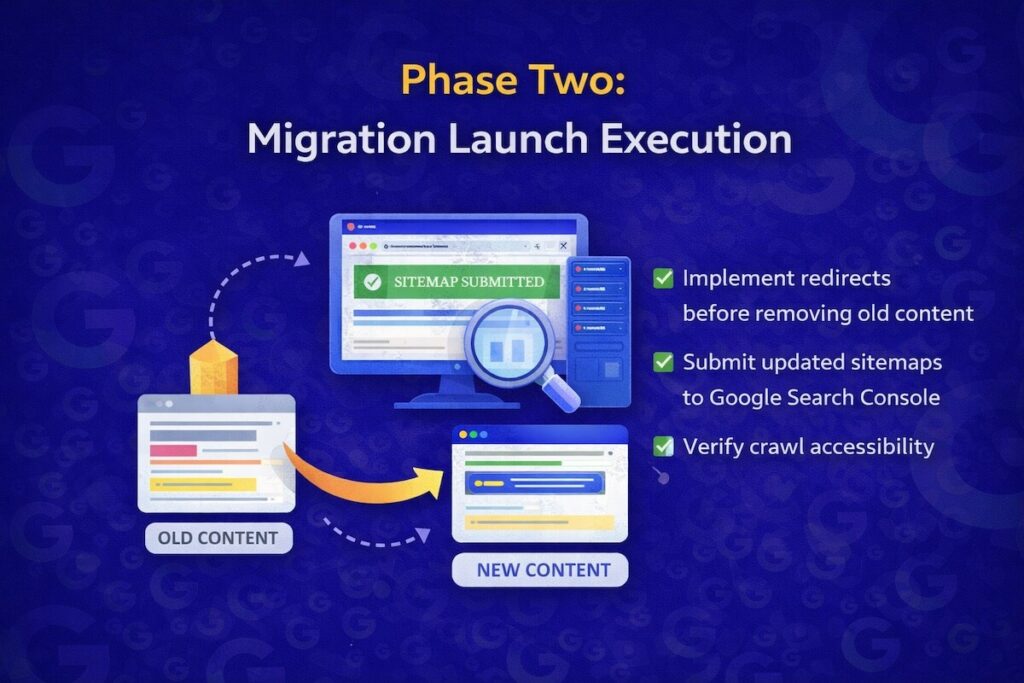
Implement redirects before removing old content
This sequencing mistake is more common than it should be. The correct order is:
- Implement all 301 redirects on the new site
- Test every redirect using a crawler or redirect-checking tool
- Verify that old URLs resolve to the correct new destination
- Only then decommission the old site or remove old content
Submit updated sitemaps to Google Search Console
Immediately after launch, submit your new XML sitemap to Google Search Console. If your domain has changed, verify the new domain in Search Console and use the Change of Address tool. This signals the migration to Google directly and prompts a re-crawl.
Verify crawl accessibility
Use the URL Inspection tool in Google Search Console to test a sample of your most important new URLs. Confirm they are crawlable, that there are no blocked resources and that Google can render the page correctly.
Phase three: post-migration monitoring
The migration is not complete at launch. The post-migration monitoring phase runs for a minimum of eight to twelve weeks and involves active tracking rather than passive waiting.
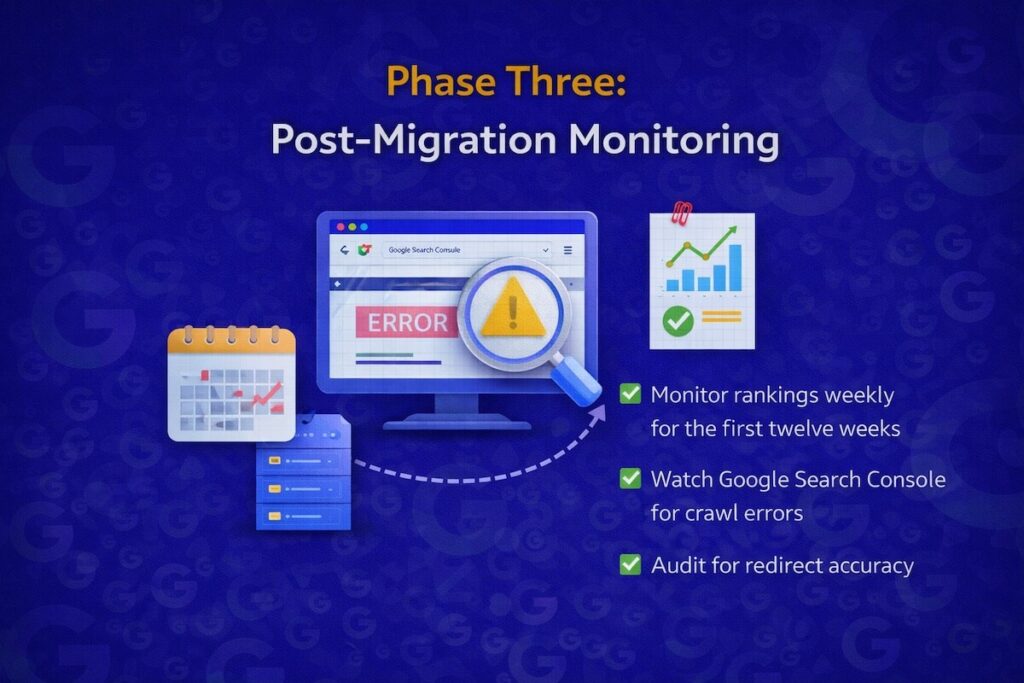
Monitor rankings weekly for the first twelve weeks
Ranking fluctuations in the first two weeks after a migration are normal and do not necessarily indicate a problem. Google is re-crawling and re-evaluating your site. Alarm points are:
- Sustained drops beyond three weeks that do not recover
- Rankings disappearing entirely for Tier 1 pages
- Pages that were ranking well but show as “Not indexed” in Search Console
Track rankings at the keyword level, not just at the overall traffic level. Traffic is a lagging indicator; keyword rankings give you earlier warning of specific pages in trouble.
Watch Google Search Console for crawl errors
Check the Coverage report in Google Search Console daily for the first two weeks, then weekly for the following two months. Look for:
- A spike in 404 errors (indicates redirect gaps)
- Sudden drops in indexed pages (indicates crawl blockage or accidental noindex tags)
- Soft 404s (pages returning a 200 status code but appearing to Google as empty or near-empty)
Each 404 spike needs to be traced back to its source URL and resolved with an appropriate redirect.
Audit for redirect accuracy
After the first crawl wave, use Screaming Frog to crawl your new site and specifically check:
- Are any internal links still pointing to old URLs instead of new URLs? (These create unnecessary redirect hops and add crawl overhead)
- Are any redirect chains present that need flattening?
Updating internal links to point directly to new URLs, rather than relying on redirects, is a cleanup task that improves both crawl efficiency and page authority flow.
GEO considerations during a website migration
This is a dimension that was not relevant three years ago but is now part of any comprehensive migration strategy, particularly for established Malaysian businesses.
Generative Engine Optimisation (GEO) refers to the practice of optimising for visibility in AI-generated responses from tools like Google’s AI Overviews, ChatGPT and Perplexity. These systems build knowledge representations of your brand and your content by reading, processing and indexing your web presence over time.
A website migration disrupts that accumulated understanding in ways that are separate from traditional search ranking signals.
What changes for AI citation after a migration
AI language models and retrieval systems cite content based on its accessibility, its structured data markup and the authority signals associated with specific URLs. After a migration:
- Schema markup that was present on old URLs needs to be re-implemented correctly on new URLs. If schema is lost or broken during migration, structured data eligibility for AI Overviews and rich results disappears.
- Content that was frequently cited by external sources (news sites, forums, review platforms) under its old URL may take time to re-establish citation frequency under its new URL.
- Brand knowledge panels in Google may temporarily show inconsistent information if domain properties change or if NAP (Name, Address, Phone) structured data is disrupted.
GEO considerations during a website migration
This is a dimension that was not relevant three years ago but is now part of any comprehensive migration strategy, particularly for established Malaysian businesses.
Generative Engine Optimisation (GEO) refers to the practice of optimising for visibility in AI-generated responses from tools like Google’s AI Overviews, ChatGPT and Perplexity. These systems build knowledge representations of your brand and your content by reading, processing and indexing your web presence over time.
A website migration disrupts that accumulated understanding in ways that are separate from traditional search ranking signals.
What changes for AI citation after a migration
AI language models and retrieval systems cite content based on its accessibility, its structured data markup and the authority signals associated with specific URLs. After a migration:
- Schema markup that was present on old URLs needs to be re-implemented correctly on new URLs. If schema is lost or broken during migration, structured data eligibility for AI Overviews and rich results disappears.
- Content that was frequently cited by external sources (news sites, forums, review platforms) under its old URL may take time to re-establish citation frequency under its new URL.
- Brand knowledge panels in Google may temporarily show inconsistent information if domain properties change or if NAP (Name, Address, Phone) structured data is disrupted.
Practical GEO migration checks
Add these to your post-migration checklist:
Verify that all schema markup types (Organisation, LocalBusiness, Product, FAQ, Article) are re-implemented on the new site and validate as error-free in Google’s Rich Results Test
Check that your brand’s structured data accurately reflects any name, address or domain changes
Monitor AI Overview appearances for your primary branded queries. If you were previously appearing in AI Overviews for your key service keywords, a three to four week absence post-migration is expected. An absence beyond eight weeks warrants investigation into schema accuracy and content accessibility.
Common website migration SEO mistakes Malaysian businesses make
Website migrations that go wrong tend to repeat the same errors across different sectors and platforms.
Staging environment robots.txt left live. Staging sites are typically set to Disallow: / to prevent indexing during development. When the staging environment is promoted to production without updating robots.txt, the entire new site is blocked from crawling. This is a catastrophic but entirely avoidable error.
Assuming the platform handles redirects automatically. Platform migration plugins that claim to “automatically migrate your SEO” handle metadata reasonably well but rarely handle redirect mapping. Always implement redirects manually based on your redirect map document.
Consolidating content during migration. Combining 30 pages into 10 while simultaneously migrating domains and changing URL structures means dealing with multiple sources of ranking risk at once. If consolidation is planned, do it as a separate project either before or after the migration proper.
Migrating without baseline data. Without a pre-migration traffic and rankings benchmark, it is impossible to distinguish normal re-crawl fluctuation from genuine ranking loss. Always document your baseline before touching the live site.
Not updating backlink sources. After migration, reach out to high-value external sites that link to your Tier 1 old URLs and request that they update their links to point to the new URLs directly. This removes redirect dependency and preserves full link equity transfer.
How long does it take to recover after a migration?
Recovery timelines are one of the most frequently asked questions, and the honest answer is that it depends on the migration’s complexity and how well it was executed.
For a clean migration with complete redirect mapping, preserved metadata and no structural issues, expect:
- Weeks 1 to 2: Ranking fluctuations and partial re-indexing
- Weeks 3 to 6: Majority of pages re-indexed; most rankings stabilising
- Weeks 6 to 12: Full ranking recovery expected for well-executed migrations
For migrations with errors (redirect gaps, missing schema, metadata loss), the timeline extends to 3 to 6 months for partial recovery, with some pages never recovering if their backlink equity was lost.
Google does not treat a migration as an emergency. It processes your new site at its regular crawl cadence. Patience combined with active monitoring is the correct posture.
Working with an SEO agency on a website migration
Website migrations are one of the highest-value engagements for an SEO agency because the cost of getting it wrong is visible immediately and the cost of getting it right is measured in preserved revenue from organic traffic.
If you are planning a migration and considering agency involvement, the most useful point of engagement is before the new site architecture is finalised, not after it is built. The structural decisions made during the site design phase (URL structure, navigation hierarchy, content consolidation plan) have major SEO implications that are significantly easier to address in a wireframe than in a built site.
An agency involvement in a migration typically covers:
- Pre-migration SEO audit and URL inventory
- Redirect map creation and review
- Staging site SEO review before launch
- Post-launch monitoring and issue resolution
- Schema markup re-implementation and validation
For Malaysian businesses with established organic traffic, the cost of professional migration oversight is almost always less than the revenue impact of a 40 to 60 percent traffic drop that takes months to resolve.
Frequently asked questions
How long before a migration should I start preparing? For a medium-complexity site (500 to 5,000 pages), start your SEO preparation eight to twelve weeks before the planned launch date. This gives sufficient time for a thorough URL audit, redirect map creation, staging site review and pre-launch testing. Rushing the preparation phase is the primary cause of post-migration ranking loss.
Can I change my domain and redesign my site at the same time? Technically yes, but it is not recommended. A domain change alone is a significant SEO event that requires careful management. Adding a full redesign with new URL structure simultaneously multiplies the risk surface. Where possible, separate the domain migration and the site redesign into two distinct projects with at least three months between them.
What is the difference between a 301 and a 302 redirect, and does it matter for SEO? A 301 redirect tells search engines the move is permanent and transfers the majority of link equity from the old URL to the new one. A 302 redirect tells search engines the move is temporary and does not transfer link equity. For a migration, always use 301 redirects. Using 302 redirects accidentally (which is a common platform default) results in the old URLs retaining their rankings while the new URLs fail to inherit authority.
Will my Google Business Profile be affected by a domain migration? Your Google Business Profile listing is tied to your business entity, not your domain. However, your website URL listed in GBP needs to be updated to reflect the new domain. Additionally, if your NAP details (Name, Address, Phone) are embedded in schema markup on your site, verify the schema is re-implemented correctly post-migration to maintain consistency signals for local SEO.
How do I know if my migration caused a rankings drop or if it is just normal fluctuation? Compare rankings at the keyword and URL level using your pre-migration baseline document. A widespread drop across your highest-traffic Tier 1 pages within days of launch, combined with 404 spikes in Search Console, indicates a migration problem rather than normal fluctuation. Normal post-migration fluctuation tends to affect all pages moderately; migration errors tend to cause severe drops on specific pages that correspond to redirect gaps or metadata loss.
Does migrating platforms affect how Google’s AI Overviews cite my content? Yes, and this is an increasingly important consideration. AI Overviews draw on structured data, content accessibility and citation history. After a migration, allow four to eight weeks for re-crawling and AI citation re-establishment. If AI Overview appearances do not recover within this window, audit your schema markup for errors and verify that your key pages are fully indexed and accessible to Googlebot.
A website migration handled with the right preparation becomes an opportunity to improve your organic foundation. A new platform or restructured architecture can substantially improve crawlability, page speed and user experience. The goal of this framework is to ensure the SEO value you have built carries forward into whatever comes next.
At Mackyclyde SEO, we help with SEO site migration that ensures you don’t permanently lose traffic because of the migration.