
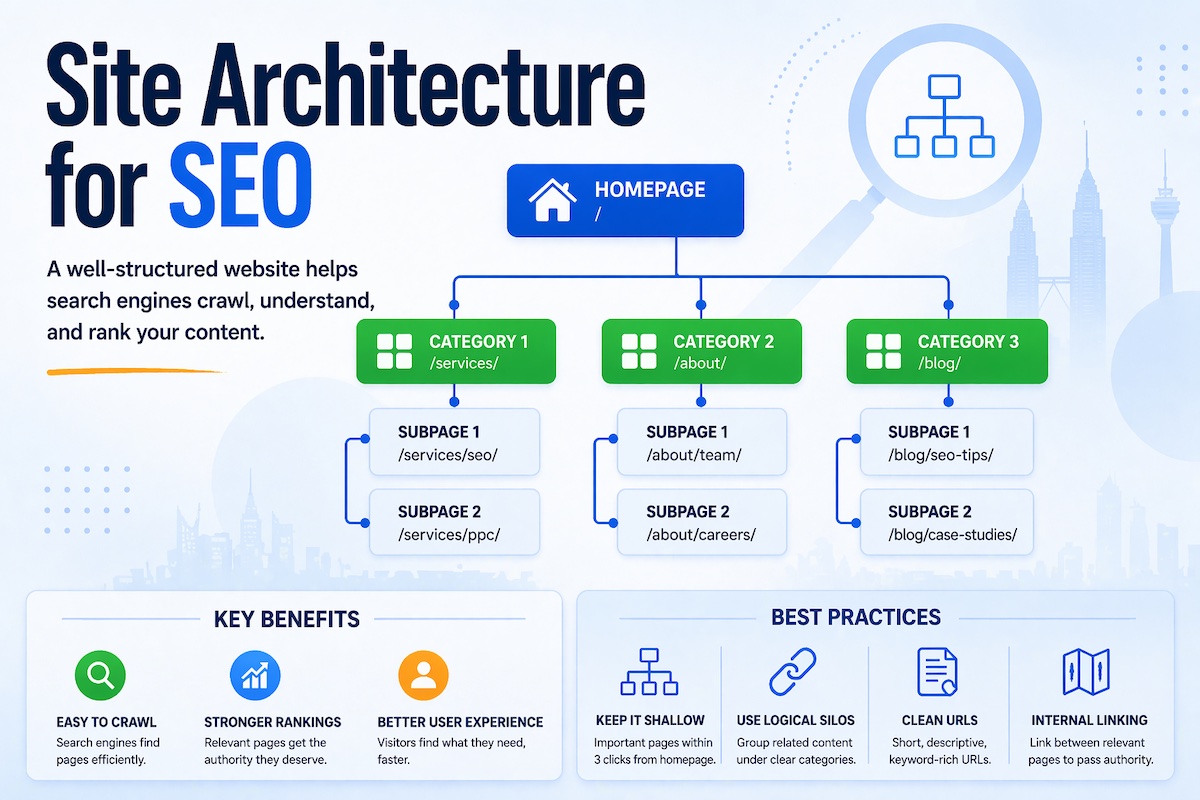
Key Takeaways
- Site architecture directly determines whether Google can crawl, index and rank your pages efficiently.
- A flat, logical URL and folder structure reduces crawl depth and distributes link equity to pages that matter most.
- Malaysian business websites often miss localisation signals at the architecture level, not just the content level.
- Internal linking is the most underused lever in site architecture. It connects topical clusters and guides both bots and users.
- Fixing architecture problems compounds over time. Better crawlability leads to faster indexing, which accelerates ranking gains across the whole site.
What Site Architecture Actually Means for SEO
Most SEO conversations start with keywords and content, leaving architecture to developers before launch. That assumption costs businesses rankings they have already earned.
Site architecture is the system of decisions governing how your pages are organised, how they link to each other, and how easily both search engine crawlers and human visitors can navigate your entire site. It includes your URL structure, navigation hierarchy, internal linking logic, category depth, and how page authority flows from your most powerful pages to those you want to rank.
Get it right and every new piece of content lands in a structure that helps it rank faster. Get it wrong and you publish into a fragmented site where crawl budget is wasted, link equity leaks, and Google cannot determine what your site is about.
For Malaysian businesses in competitive verticals like insurance, automotive, e-commerce, and SaaS, this is not theoretical. Poor architecture measurably reduces organic performance.
Why Malaysian Business Websites Face Specific Architecture Challenges
Multilingual and Multiregional Complexity
Many Malaysian businesses serve audiences in English, Bahasa Malaysia, and sometimes Mandarin. When language versions are bolted onto a site after launch rather than built into the architecture from the start, the result is often duplicate content, inconsistent hreflang implementation, and confused URL structures.
The most common pattern: the English site sits at the root domain, a Bahasa Malaysia version lives at /ms/ or a subdomain like ms.example.com, and the Mandarin version either does not exist or is hosted on a completely separate domain. Subfolders (/en/, /ms/) consolidate authority on the root domain, which is why technical SEO practitioners recommend them over subdomains for multilingual Malaysian sites. Subdomains split authority and require separate crawl budget allocation.
Guide for hreflang implementation for Malaysian websites
Overly Deep Page Hierarchies
Many Malaysian SME and mid-market sites grew without strategic planning. A product was added here, a promo landing page created there, a blog launched as an afterthought. The result is pages buried four, five, or six clicks from the homepage.
Google’s crawlers prioritise pages closer to the root. Pages at depth five or beyond may be crawled infrequently or not at all, regardless of how well-optimised the content is.
No important page should sit more than three clicks from the homepage. This is a reliable benchmark for most businesses. If your most commercially valuable service pages require navigation through three tiers and a dropdown submenu to reach them, they are too deep.
Cannibalisation Through Unplanned Category Structures
E-commerce sites and service businesses with broad offerings frequently create overlapping category structures. When two or more pages target the same keyword intent without clear content hierarchy, they compete against each other. Google struggles to determine which page to rank.
This pattern is especially common in Malaysian e-commerce, where the same product appears under a brand-level category, a product-type category, and a promotional landing page, each with near-identical meta titles.
The Principles of a Crawlable Site Architecture
Flat Hierarchy, Logical Depth
Allow Google to reach any important page within a small number of crawl hops from the homepage. A flat hierarchy does not mean disorganised. It means every tier has a clear purpose and the number of tiers stays minimal.
A service business in Malaysia might structure its architecture like this:
Homepage
├── Services
│   ├── Technical SEO
│   ├── Content & On-Page
│   ├── Local SEO
│   └── Authority Building
├── Industries
│   ├── E-Commerce
│   ├── Automotive
│   └── SaaS & Technology
├── Case Studies
├── Blog
│   ├── Technical SEO
│   ├── Local SEO
│   └── Content Strategy
└── Contact
Every page is reachable within two to three clicks. The Blog section uses topic-based subfolders that mirror the service taxonomy, creating topical clusters that reinforce each other through internal linking.
Crawl Budget and How to Protect It
Crawl budget is the number of pages Googlebot will crawl on your site within a given timeframe. For small sites under a few hundred pages, this is rarely a bottleneck. For mid-size and enterprise Malaysian sites with thousands of pages, including product catalogues, filtered views, and session-parameter URLs, crawl budget becomes a genuine constraint.
Pages that waste crawl budget include:
- Paginated pages beyond page two or three of category listings, unless they contain unique content
- URL parameters generated by faceted navigation filters (size, colour, price range) that create hundreds of near-duplicate URLs
- Staging or development pages accidentally included in the sitemap
- Redirect chains that make crawlers traverse multiple hops before reaching the final URL
Fix these through robots.txt directives, canonical tags, parameter handling in Google Search Console, and sitemap hygiene. These tasks are unglamorous but among the highest-leverage technical SEO actions available.
[INTERNAL LINK: “how to fix crawl budget waste” → Technical SEO audit article]
URL Structure as a Taxonomy Signal
Your URL structure functions as a taxonomy. Every folder and subfolder tells search engines about the relationship between pages. A URL like mackyclyde.com/blog/technical-seo/site-architecture-malaysia communicates that this is a blog post, it belongs to the technical SEO topic cluster, and it is specifically relevant to Malaysia.
Rules for Malaysian business URL structure:
- Use hyphens, not underscores, to separate words
- Keep URLs lowercase and static; avoid dynamic parameters for canonical pages
- Reflect the content hierarchy accurately; do not put blog posts in the root domain without a subfolder
- Keep URLs short and descriptive, avoiding both truncation that loses meaning and padding with stop words
- For Bahasa Malaysia pages, use the
/ms/subfolder at the root level and mirror the English URL pattern exactly
The Role of XML Sitemaps
An XML sitemap lists the URLs you want indexed and provides metadata about update frequency and page priority. Sitemaps do not guarantee indexing, but they accelerate discovery and improve reliability for new pages and large sites.
Common sitemap errors on Malaysian business sites:
- Including redirect URLs (301s) in the sitemap; include only the final destination URL
- Including pages blocked by
robots.txt, which creates a contradiction confusing crawlers - Not using a sitemap index for sites with multiple sitemaps (separate sitemaps for pages, posts, products, and images)
- Forgetting to submit language-specific sitemaps for multilingual sites
Internal Linking: The Architecture Decision Most Sites Get Wrong
Internal linking is where site architecture theory becomes daily editorial practice. Every time you publish a new page, you decide which existing pages it links to and which pages should link back to it. Most sites make these decisions based on habit or convenience rather than coherent strategy.
A well-structured internal linking system accomplishes three critical outcomes:
It distributes PageRank. Links pass authority. Your homepage typically has the most external links pointing to it, holding the most PageRank. Linking from the homepage to your most important service pages passes authority to those pages. Linking from those pages to supporting blog content continues the distribution downward.
It establishes topical relevance. When a page about Technical SEO for Malaysian e-commerce links to your Technical SEO service page, it reinforces the topical relationship. Search engines use anchor text and surrounding content to understand what the linked page addresses.
It guides user journeys. A visitor reading a blog post about site architecture should find your SEO audit service naturally through a contextual link, not by returning to the homepage and navigating through the menu.
Building a Topic Cluster Through Internal Links
A topic cluster is a group of content pages organised around a central pillar page. The pillar covers a broad topic comprehensively. Cluster pages cover specific subtopics in depth and link back to the pillar, while the pillar links out to each cluster page.
For a Malaysian SEO agency, a Technical SEO pillar page would link to cluster articles covering site architecture, Core Web Vitals, crawl budget, schema markup, and mobile optimisation. Each article links back to the pillar, creating topical signals that help Google understand your site’s expertise depth on Technical SEO.
Conversion Architecture: Structuring for Business Outcomes
Crawlability gets pages indexed. Conversion architecture determines whether those pages produce leads, enquiries, or sales. The two require separate thinking and strategy.
Navigation as a Conversion Funnel
Your main navigation is not just a wayfinding tool, it is a statement of priority. Users and search engines take signals from what appears in primary navigation. If your most commercially valuable service is buried in a dropdown, you deprioritise it both for ranking and for conversion.
Malaysian B2B service businesses should structure navigation with the buyer journey in mind:
- Problem-aware visitors need access to educational content quickly; a Resources or Blog section in the top navigation serves this purpose
- Solution-aware visitors need clear service categories they can browse without guesswork
- Decision-ready visitors need a Contact or Get Started option visible without scrolling
Landing Page Architecture for Local SEO
Malaysian businesses with multiple locations or service areas need a dedicated page for each, structured consistently and targeting location-specific keywords. A single “Contact Us” page with a list of addresses does not serve local SEO.
The architecture for a multi-location business looks like this:
/locations/
├── /locations/kuala-lumpur/
├── /locations/petaling-jaya/
├── /locations/johor-bahru/
└── /locations/penang/
Each location page should contain unique, locally relevant content, an embedded Google Map, local schema markup, and internal links to relevant service pages. These pages collectively support Google Business Profile rankings and drive local organic traffic.
Local SEO guide for Multi location businesses in Malaysia.
Page Speed as an Architecture Variable
Site architecture includes decisions about page templates and their technical components. A bloated page template that loads heavy JavaScript, uncompressed images, and third-party scripts on every page degrades Core Web Vitals across the entire site.
Architecture-level decisions that affect speed include:
- Whether to use server-side rendering or client-side rendering (important for JavaScript-heavy sites)
- How images are served (WebP format, lazy loading, correct sizing)
- Whether third-party scripts are loaded conditionally or universally
- How CDN (Content Delivery Network) caching is configured, which matters especially for Malaysian sites serving geographically dispersed users
Core Web Vitals optimisation for Malaysian websites
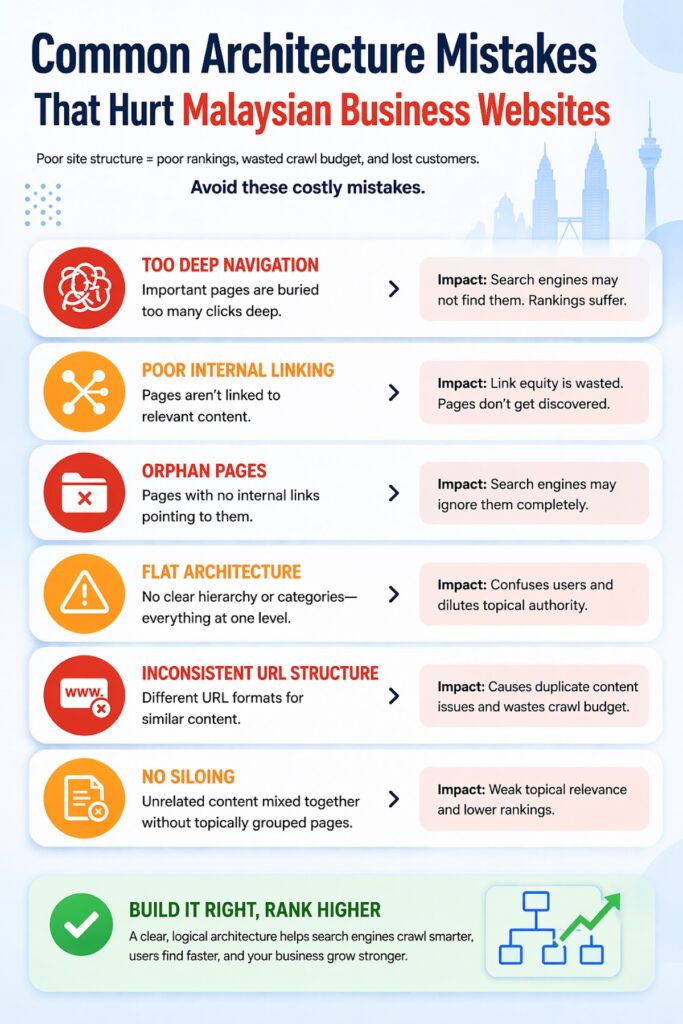
Common Architecture Mistakes That Hurt Malaysian Business Websites
Orphan pages. Pages with no internal links pointing to them are difficult for crawlers to find and receive no link equity from the rest of the site. These accumulate from campaigns, old service pages, and retired blog posts. Identify them through crawl audits and either integrate them into your linking structure or remove them.
Redirect chains. When a URL redirects to a second URL that redirects to a third, each hop bleeds PageRank and slows crawl time. Audit redirects regularly and resolve chains to point directly to the final destination.
Inconsistent canonical tags. If the same content is accessible at multiple URLs (with and without trailing slashes, HTTP vs HTTPS, www vs non-www), canonical tags tell Google which version is authoritative. Inconsistent or missing canonicals lead to indexing confusion.
Navigation links in JavaScript only. If your navigation is rendered entirely through JavaScript and Googlebot does not execute the script correctly, it may not follow those links at all. Critical navigation should be accessible in rendered HTML.
Missing breadcrumb navigation. Breadcrumbs serve user experience and SEO by reinforcing URL hierarchy and providing an additional internal linking structure. They often appear in Google search results as rich snippet enhancements, improving click-through rate.
How to Audit Your Current Site Architecture
Start with a crawl using Screaming Frog, Sitebulk, or Ahrefs Site Audit. Export the full crawl and sort by depth to identify any important page sitting beyond depth three.
Then open Google Search Console and navigate to Coverage. Pages listed as “Discovered, currently not indexed” or “Crawled, currently not indexed” often signal architecture problems: the pages are too deep, lack content substance, or suffer crawl budget issues from the surrounding site.
Cross-reference your sitemap against what is actually indexed. Pages you expect to be indexed but are not, and pages you do not want indexed but are, both indicate architectural drift from your intended structure.
Finally, check which pages receive the most internal links. If the answer is your homepage and blog index but not your service pages, you have a link equity distribution problem.
Frequently Asked Questions
How often should a Malaysian business review its site architecture?
A full architectural audit is worth doing annually and after any major site redesign or CMS migration. Smaller audits, checking for orphan pages, redirect chains, and new crawl errors, should be part of a monthly technical SEO routine. Architecture is not static; it drifts as sites grow.
Does site architecture matter more for large sites or small sites?
It matters for both, but the consequences scale with site size. A ten-page site with messy structure will underperform but still get crawled. A ten-thousand-page e-commerce site with the same structural problems will have significant portions of its catalogue going unindexed. If you are planning to grow your site, getting architecture right before scaling is far easier than retrofitting it later.
Should I use subfolders or subdomains for my Bahasa Malaysia content?
For most Malaysian businesses, subfolders are the stronger choice. Content at example.com/ms/ benefits from the domain authority of the root domain. Content at ms.example.com is treated as a separate site by Google, requiring independent authority building. Subdomains make sense in specific cases like very large-scale multiregional setups, but they are the exception rather than the default.
What is crawl budget and do I need to worry about it?
Crawl budget is the number of URLs Googlebot will crawl on your site within a set period. For sites under a few hundred pages with clean architecture, this is rarely a constraint. For sites with thousands of pages, faceted navigation, large product catalogues, or many URL parameters, crawl budget management becomes important. If Google Search Console shows a large number of pages discovered but not indexed, crawl budget efficiency is worth investigating.
How does site architecture affect local SEO specifically?
Local SEO depends heavily on location-specific pages that are clearly signalled in the URL structure, internally linked from relevant service pages, and individually optimised with local schema markup. A single homepage claiming to serve all of Malaysia is far less effective than a structured set of location landing pages, each targeting the specific search intent of users in that city or region.
Can internal linking fix a bad site architecture?
Internal linking can partially compensate for architectural issues like orphan pages and poor crawl depth, but it is not a substitute for structural fixes. A page buried at depth six that receives strong internal links will outperform an orphan at the same depth, but it will still underperform compared to a well-architected page at depth two or three. Fix the architecture first, then use internal linking to amplify it.