
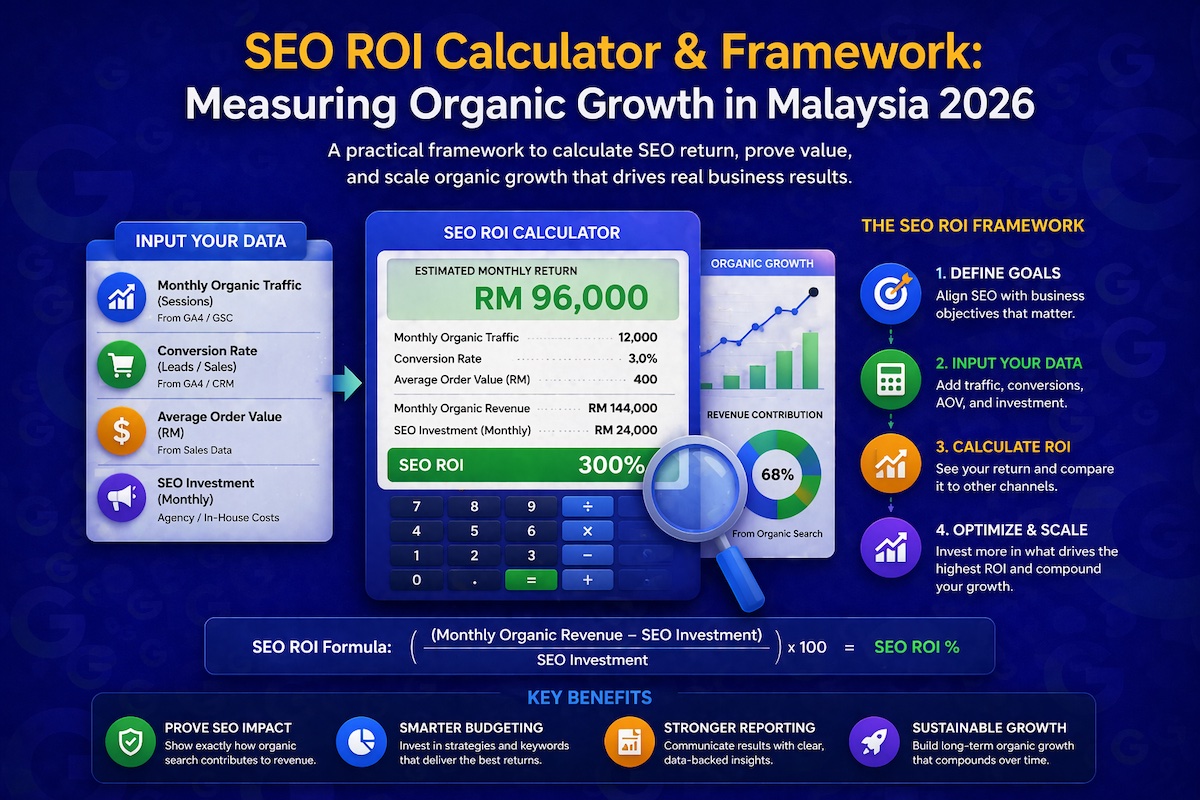
Key Takeaways
- SEO ROI is measurable when you connect organic traffic to actual revenue, not just rankings or clicks.
- Malaysian businesses need a localised framework that accounts for ringgit-denominated conversion values, multi-language search behaviour and regional buying cycles.
- A reliable SEO ROI calculation requires three core inputs: organic traffic value, lead-to-close rate, and average customer value.
- Vanity metrics like keyword rankings and impressions only matter when they are linked to a conversion path you can track.
- The 2026 measurement landscape includes AI-influenced search journeys, meaning attribution models need updating to capture dark traffic and zero-click conversions.
Measuring SEO ROI is the question at the centre of every serious conversation between a business owner and their agency. Traffic is up, rankings improved, but the finance team wants to know what those results are actually worth in ringgit. For Malaysian businesses operating across competitive sectors like automotive, insurance, e-commerce and SaaS, that question demands clarity.
The difficulty is not that SEO results are unmeasurable. Most businesses measure the wrong things or measure the right things in the wrong order. This article provides a practical framework and step-by-step calculator approach for quantifying organic growth in a way that connects directly to business outcomes, built specifically for the Malaysian market context heading into 2026.
Why Standard SEO Metrics Do Not Tell You Enough
Most SEO reports lead with rankings, impressions and organic sessions. These numbers are not useless, but they are incomplete. A page ranking number one for a keyword with 500 monthly searches in Kuala Lumpur is worth considerably less than a page ranking fifth for a keyword that drives RM 40,000 in monthly revenue.
The gap between vanity metrics and business value is where most SEO programmes lose credibility internally. When a CMO cannot explain to a CFO why a 30% increase in organic traffic produced only a 6% increase in qualified leads, confidence erodes and budgets get cut.
The Three Metric Tiers Every Business Needs
Organising your SEO metrics into three tiers makes reporting far cleaner and more defensible.
Tier 1: Activity Metrics These measure what SEO work is being done: crawl health, indexed pages, backlinks acquired, content published. They matter for diagnosing problems but carry no direct business weight on their own.
Tier 2: Performance Metrics These measure how organic search is responding: organic sessions, keyword visibility, click-through rate, time on page, pages per session. They tell you whether the work is producing search traction.
Tier 3: Business Outcome Metrics These are the numbers your board cares about: organic leads generated, cost per organic lead, revenue attributed to organic, customer acquisition cost from SEO versus paid. This tier is where ROI lives.
Most agencies report heavily on Tier 2. The businesses that get real value from SEO push their measurement all the way to Tier 3.
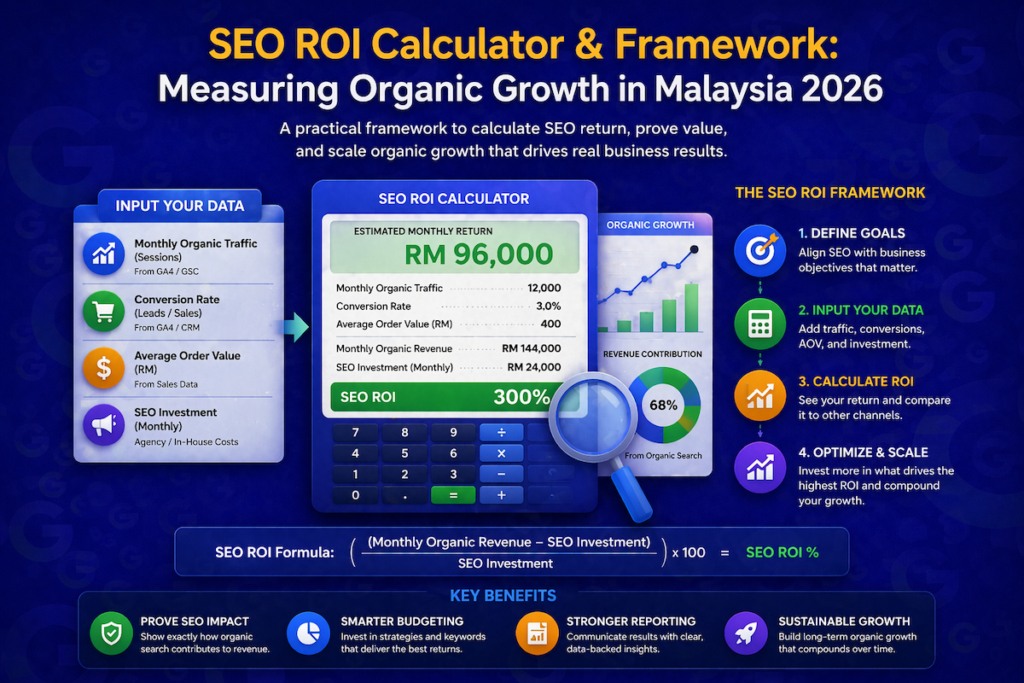
The SEO ROI Formula: A Framework Built for Malaysian Businesses
The core formula is straightforward:
SEO ROI (%) = [(Revenue from Organic SEO – SEO Investment) / SEO Investment] x 100
Simple in principle. The complexity lies in calculating each component accurately. Here is how to build each input correctly.
Step 1: Calculate Your Monthly Organic Revenue Attribution
You need organic-attributed revenue specifically, not just total revenue during the period.
In Google Analytics 4, segment conversions by the “Organic Search” channel grouping. If you are running a multi-touch attribution model, decide whether you are using first-click, last-click or data-driven attribution, and apply it consistently. For most Malaysian SMEs and mid-market businesses, a last-click model is the starting point because it is the most straightforward to configure. For longer B2B sales cycles common in insurance or enterprise SaaS, a linear or time-decay model gives a more honest picture.
If you have offline conversions, such as a phone call from an organic landing page that converts to a signed contract in person, capture that too. Use call tracking software that ties back to organic sessions, or build a CRM source field that records “how did you find us” at the point of sale.
Malaysian-specific note: Many Malaysian businesses still have a significant portion of their conversion journey happen via WhatsApp. If a user lands on your page from organic search and then clicks your WhatsApp button, that conversion will not be recorded in GA4 unless you have event tracking set up for WhatsApp click events. This is a common attribution gap that inflates cost-per-lead figures for paid channels and undersells organic performance.
Get help with fixing conversion tracking gaps.
Step 2: Establish Your Average Customer Value
Your SEO ROI calculation is only as accurate as your understanding of what a converted customer is worth.
For e-commerce businesses, multiply average order value by average purchase frequency per year.
For service businesses, lead generation companies or B2B organisations, use average contract value or lifetime customer value (LCV). If you do not yet have reliable LCV data, use 12-month revenue per customer as a conservative proxy.
Formula: Average Customer Value = Average Contract or Order Value x Repeat Purchase Rate (or 1 for single-transaction businesses)
Step 3: Calculate Lead-to-Close Rate from Organic Traffic
Not every organic visitor becomes a lead, and not every lead closes. Your model needs both conversion rates.
- Visitor-to-lead rate: organic sessions divided by organic leads in a given period
- Lead-to-close rate: organic leads divided by closed customers from that cohort
If you cannot isolate the lead-to-close rate specifically for organic-sourced leads, use your overall sales close rate as a starting point. Refine it over time as your CRM data matures.
Step 4: Plug the Numbers into the Calculator
Here is a worked example using realistic Malaysian business figures:
This is a strong result but not unrealistic for a well-optimised mid-market business in a competitive Malaysian sector. The calculation gives you a specific, defensible number to present to stakeholders, rather than a chart of keyword rankings.
Adjusting Your Framework for 2026 Measurement Realities
The way users interact with search results is changing. Two shifts in particular affect how Malaysian businesses should think about SEO attribution heading into 2026.
Zero-Click Searches and AI Overviews
Google’s AI Overviews (previously Search Generative Experience) are now appearing for a growing share of informational queries in Malaysia. When a user gets their answer directly in the search results without clicking through to your site, that is a zero-click event. Your organic ranking contributed to brand awareness but generated no measurable session in GA4.
This does not make SEO less valuable. The current session-based measurement model becomes incomplete.
To account for this, track branded search volume as a proxy for brand awareness growth. If your branded search queries are rising in Google Search Console, your content is building recognition even when it is not generating clicks. Assign a qualitative value to this in your reporting, and use it as supporting evidence when direct attribution is difficult to establish.
Dark Traffic and Direct Sessions
A portion of what appears as “direct” traffic in GA4 is actually unattributed organic traffic, specifically users who clicked a link from a mobile app, a chat thread or a newsletter that stripped UTM parameters. For Malaysian businesses with a high mobile usage rate, this is a meaningful measurement gap.
A practical fix: analyse the pages that receive unexplained direct traffic. If they are deep content pages, blog posts or service landing pages that would not normally attract direct navigation, a portion of that direct traffic is likely dark organic traffic. Adjust your organic attribution upward by a conservative percentage based on that analysis.
Seasonality in the Malaysian Market
SEO ROI calculations must be seasonality-adjusted for Malaysian businesses. Organic traffic patterns in Malaysia are influenced by Hari Raya, Chinese New Year, Merdeka campaigns, and year-end sale periods. A B2C e-commerce brand measuring SEO ROI in October versus December will see very different numbers, and neither tells the full story.
Use a rolling 12-month average for organic revenue attribution rather than a single month, and annotate your reporting with key seasonal events so stakeholders understand the context behind traffic fluctuations.
Building a Reporting Framework Your Stakeholders Will Actually Use
An SEO ROI framework that exists only in a spreadsheet serves no one. It needs to become a regular reporting artefact that non-technical stakeholders can read and act on.
The monthly SEO business review: what to include
A business-facing SEO report should contain five sections.
1. Revenue and lead summary Organic leads generated, organic revenue attributed, cost per organic lead versus last month and versus paid channels.
2. Traffic quality summary Not total sessions, but engaged sessions, conversion rate by landing page, and average session duration for organic visitors. Quality signals matter more than volume.
3. Visibility trend A rolling keyword visibility chart showing whether your coverage of target topics is growing. This is where Tier 2 metrics earn their place as a predictor of future Tier 3 outcomes.
4. Investment vs. return A single-row table showing SEO spend, organic revenue, and ROI percentage for the period. This belongs at the top of the report, not buried at the end.
5. Key actions and their expected impact What work is planned for next month and what business outcome it is expected to influence. This keeps SEO accountable to forward-looking business logic, not just backward-looking performance data.
Common Measurement Mistakes Malaysian Businesses Make
Even businesses committed to measuring SEO well tend to make recurring errors. Recognising them early saves months of inaccurate reporting.
Attributing all organic revenue to the current period’s SEO work. SEO is a compounding investment. Revenue flowing in during month six was seeded by work done in month one. Your ROI calculation should reflect the cumulative investment to date, not just the most recent month’s retainer, when you are presenting a full programme ROI picture.
Using traffic as the headline metric in board reports. Traffic is a means, not an end. Lead volume and cost per lead are what matter to a growth-stage business. Report traffic as context, not as the primary measure of success.
Ignoring the contribution of SEO to assisted conversions. A user who first discovers your brand through an organic blog post, then converts via a retargeting ad two weeks later, is partly an organic acquisition. Multi-touch attribution in GA4 captures this. Last-click models do not.
Comparing SEO ROI to paid ROI on a one-month basis. Paid search returns are near-instant but stop the moment you stop paying. SEO returns accrue over time and persist after the direct investment period. The correct comparison is lifetime ROI, not monthly ROI.
Frequently Asked Questions
How long does it take for SEO to show a measurable ROI for a Malaysian business?
For most mid-market Malaysian businesses starting from a low organic baseline, meaningful ROI typically becomes measurable between months four and six. Highly competitive sectors like insurance or financial services may take nine to twelve months. The first three months are usually infrastructure and content investment with limited return, which is why the cumulative ROI calculation matters more than the monthly snapshot.
What is a good SEO ROI benchmark for a Malaysian business?
There is no universal benchmark, but a well-run SEO programme for a mid-market Malaysian business should realistically target a 300% to 800% ROI within the first twelve months, with that figure growing in subsequent years as the compounding effect takes hold. Businesses in high-value sectors like B2B SaaS, insurance or automotive finance often see higher figures due to large average customer values.
Should I include content production costs in my SEO investment figure?
Yes. If you are paying for content writing, design, video production or internal resource time that is dedicated to SEO, include it. Your SEO ROI calculation is only credible if the investment figure is complete. Leaving out content costs inflates the ROI number and sets unrealistic expectations internally.
How do I track WhatsApp conversions from organic traffic in Malaysia?
Set up a GA4 event that fires when a user clicks your WhatsApp link or button. You can do this via Google Tag Manager by creating a trigger for clicks on your WhatsApp click-to-chat URL. Once that event is configured, you can see it in GA4 broken down by traffic source, which lets you attribute WhatsApp-initiated contacts back to organic sessions.
What is the difference between SEO revenue attribution and SEO revenue influence?
Attribution means you can directly trace a revenue event back to an organic search interaction in your analytics data. Influence means SEO contributed to the decision to purchase but the direct conversion path went through another channel. Both matter. Attribution drives your ROI calculation. Influence justifies your SEO investment in the broader context of the customer acquisition mix.
Can e-commerce businesses calculate SEO ROI more accurately than service businesses?
Generally yes, because the conversion event is a completed transaction with a known ringgit value that happens entirely online. Service businesses with offline sales cycles need to do more work to close the attribution loop, typically through CRM integration and consistent lead source tracking at the point of sale.
Sustainable competitive advantages from SEO flow from precise knowledge of what your organic presence is worth and from investment decisions made on that basis.