Key Takeaways
- Schema markup is structured data that helps both traditional search engines and AI-powered answer engines understand your content with precision.
- Malaysian businesses are underutilising schema, creating a significant competitive gap you can close right now.
- The right schema types vary by industry, and implementing the wrong ones can dilute your structured data signals.
- AI search engines like Google’s AI Overviews, Perplexity and ChatGPT rely heavily on structured, machine-readable content to surface answers, making schema more critical than ever in 2026.
- Implementation without validation is wasted effort. Every schema deployment needs testing through Google’s Rich Results Test and Schema Markup Validator.
What Schema Markup Actually Does (And Why Most Malaysian Sites Get It Wrong)
Schema markup is a standardised vocabulary of tags, drawn from Schema.org, that you embed in your webpage’s HTML to tell search engines exactly what your content represents. Not just what the words say, but what the entities are: a business, a product, a review, a FAQ, a person, an event.
Most websites communicate through natural language. Schema communicates through structured, machine-readable data, and that distinction matters enormously in 2026.
Here is where Malaysian businesses consistently miss the point: they treat schema as a ranking trick, something you add to squeeze out a star rating in search results. That framing is too narrow and increasingly outdated. Schema markup is now a foundational signal for AI search systems, not just a cosmetic enhancement for traditional SERPs.
When Google’s AI Overviews pull a concise answer from your page, when Perplexity cites your business as an authoritative source, when ChatGPT surfaces your FAQ response in a conversation thread, structured data is frequently the mechanism that made your content machine-readable enough to be selected. Without it, even well-written content can be invisible to these systems.
For Malaysian businesses competing across Bahasa Malaysia and English search queries, schema also provides a language-agnostic layer of meaning. Your LocalBusiness schema communicates your location, operating hours and service area to crawlers regardless of which language your page is written in.
What’s Changed: Schema Markup and AI Search in 2026
AI Search Has Restructured the Reward System
The emergence of generative AI search, particularly Google’s AI Overviews rolling out more aggressively across Southeast Asian markets, has changed what schema markup is competing for. Traditionally, the reward was a rich result: a star rating, a FAQ accordion, a product price snippet beneath your blue link.
Those rewards still exist and still drive click-through rate improvements. But the more significant reward in 2026 is entity inclusion in AI-generated answers.
AI systems build answers by pulling from sources they can parse with confidence. Structured data reduces ambiguity. A page with properly implemented FAQPage schema, for instance, gives AI systems pre-packaged question-and-answer pairs they can extract and reformulate without needing to interpret prose. A page with LocalBusiness schema gives AI assistants verified address, category and review data they can surface in response to “best [service] near me” queries.
Schema markup has shifted from being a SERP enhancement to being an AI discoverability signal.
Google’s Handling of Structured Data in the Malaysian Market
Google’s rich result eligibility has always been documentation-driven, but enforcement has tightened. In 2025 and into 2026, Google became more aggressive about penalising misleading structured data, specifically:
- Aggregate
Ratingschema on pages without genuine user reviews FAQschema for questions that do not appear as visible content on the pageProductschema on non-transactional pages
Malaysian site owners who implemented schema carelessly for cosmetic gains are finding those rich results revoked and, in some cases, manual actions applied. The standard now is that every schema claim must be substantiated by visible on-page content.
New Schema Types Gaining Traction
Several schema types have moved from niche to mainstream relevance in 2026:
SpeakableSpecification – Marks sections of your page as suitable for text-to-speech output, originally intended for smart speakers but now relevant to AI assistants reading content aloud.
DefinedTerm and DefinedTermSet – Useful for glossary-style content, helping AI systems recognise your site as an authoritative definitional source within your niche.
HowTo – Step-by-step procedural content that AI systems extract cleanly for instructional queries.
Certification – For regulated industries like insurance, financial services and medical practices, this schema type signals compliance and professional accreditation.
SpecialAnnouncement – Post-pandemic, this type remains relevant for businesses with time-sensitive service changes or promotional periods.
Core Schema Types Every Malaysian Business Needs
LocalBusiness Schema (Non-Negotiable for Any Physical or Service-Area Business)
If your business serves customers in Malaysia, either from a physical location or across a defined service area, LocalBusiness schema is your highest-priority implementation. It consolidates the signals that determine local pack inclusion, Google Maps accuracy and AI assistant responses to location-based queries.
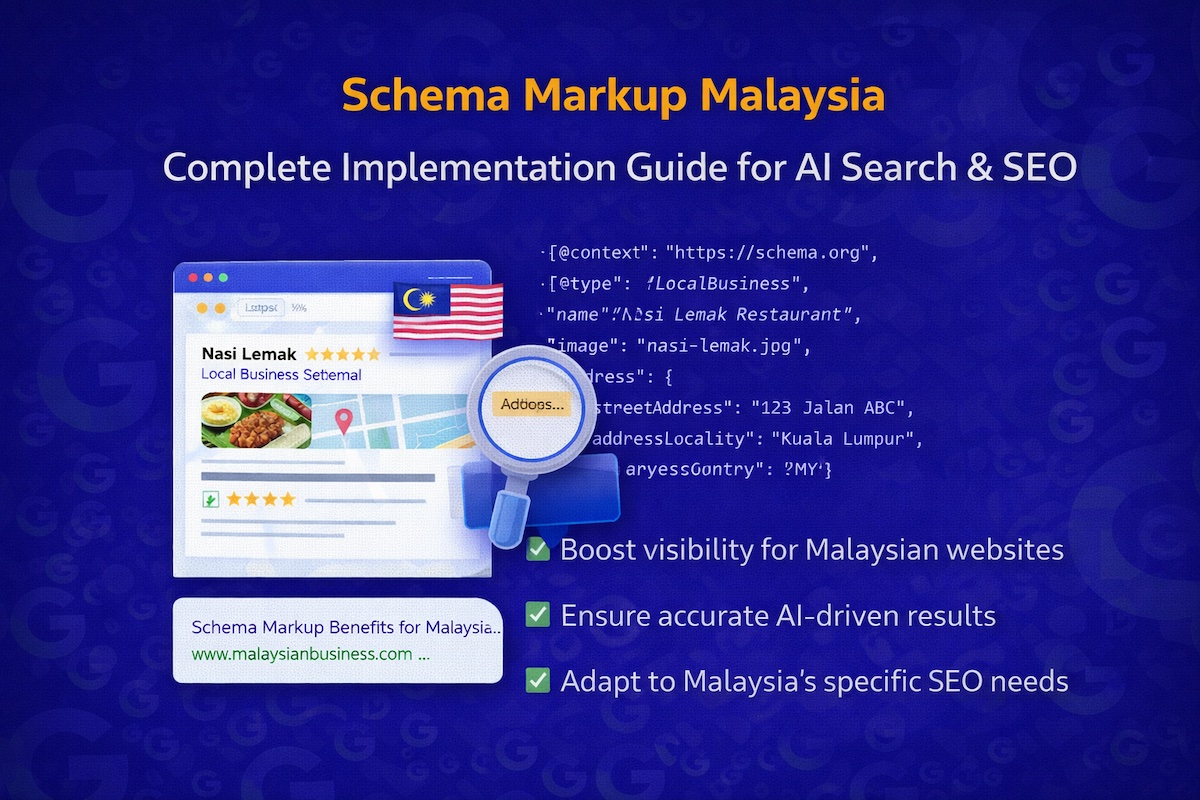
A well-structured LocalBusiness implementation in JSON-LD format includes:
{
  "@context": "https://schema.org",
  "@type": "LocalBusiness",
  "name": "Your Business Name",
  "url": "https://yourdomain.com.my",
  "telephone": "+60-3-XXXX-XXXX",
  "address": {
    "@type": "PostalAddress",
    "streetAddress": "Unit X, Jalan XX",
    "addressLocality": "Kuala Lumpur",
    "addressRegion": "Wilayah Persekutuan",
    "postalCode": "50000",
    "addressCountry": "MY"
  },
  "openingHoursSpecification": [
    {
      "@type": "OpeningHoursSpecification",
      "dayOfWeek": ["Monday","Tuesday","Wednesday","Thursday","Friday"],
      "opens": "09:00",
      "closes": "18:00"
    }
  ],
  "geo": {
    "@type": "GeoCoordinates",
    "latitude": "3.1390",
    "longitude": "101.6869"
  },
  "priceRange": "$$",
  "aggregateRating": {
    "@type": "AggregateRating",
    "ratingValue": "4.8",
    "reviewCount": "40"
  }
}
Critical point for Malaysian implementations: use "addressCountry": "MY" and include your Malaysian postal code accurately. Mismatches between schema data and your Google Business Profile create conflicting signals that suppress local visibility.
For businesses operating across multiple Malaysian cities, use a separate LocalBusiness schema block on each location-specific landing page rather than one consolidated schema on a single page.
FAQPage Schema: Still One of the Highest-ROI Implementations
FAQPage schema remains one of the most impactful implementations for Malaysian sites, for two distinct reasons.
First, FAQ accordions in traditional search results increase your SERP footprint, sometimes doubling the vertical space your result occupies. More screen real estate means more visibility without needing to outrank competitors.
Second, and more importantly in 2026, FAQ schema provides AI systems with structured question-answer pairs that can be extracted cleanly. When an AI Overview or a generative search system needs to answer a user question, pages with FAQ schema give it pre-formatted content to work with. That is a meaningful advantage.
The implementation rule is strict: every question and answer in your FAQ schema must exist as visible text on the page. Do not add schema for Q&A content that lives only in the markup.
{
  "@context": "https://schema.org",
  "@type": "FAQPage",
  "mainEntity": [
    {
      "@type": "Question",
      "name": "How much does SEO cost in Malaysia?",
      "acceptedAnswer": {
        "@type": "Answer",
        "text": "SEO pricing in Malaysia typically ranges from RM2,000 to RM15,000 per month depending on the scope of work, industry competitiveness and the agency's experience. Project-based audits can range from RM3,000 to RM10,000."
      }
    }
  ]
}
Article and BlogPosting Schema for Content Publishers
Every blog post and editorial article on your Malaysian business site should carry Article or BlogPosting schema. This communicates authorship, publication date, modification date and editorial hierarchy to search crawlers, which feeds directly into E-E-A-T assessment.
Key properties to include:
authorwith aPersontype linked to an author bio pagedatePublishedanddateModifiedin ISO 8601 formatpublisherwith anOrganisationtype including your logoheadlinematching your H1 exactlyimagepointing to a real, indexed image on your page
The dateModified property deserves particular attention. Google uses content freshness as a quality signal, and keeping dateModified current when you update articles communicates active content maintenance.
Product and Offer Schema for E-Commerce
Malaysian e-commerce operators leave significant search visibility on the table by skipping Product schema. A fully implemented product schema can trigger price snippets, availability badges and review stars, all of which compress the user’s decision-making process before they even reach your site.
For 2026, the most important product schema properties are:
offerswithprice,priceCurrency(use"MYR"for Malaysian Ringgit),availabilityandpriceValidUntilaggregateRatinglinked to genuine reviews collected on-sitebrandas anOrganisationorBrandtypeskufor inventory-level specificity that Google appreciates for Shopping integration
BreadcrumbList Schema for Site Architecture Communication
BreadcrumbList schema does something subtle but structurally important: it communicates your site’s hierarchy to search engines in a machine-readable format. For Malaysian sites with category-heavy architectures, for instance an automotive marketplace or a multi-category e-commerce store, breadcrumb schema reinforces topical clustering signals and helps Google understand page depth and content relationships.
{
  "@context": "https://schema.org",
  "@type": "BreadcrumbList",
  "itemListElement": [
    {
      "@type": "ListItem",
      "position": 1,
      "name": "Home",
      "item": "https://yourdomain.com.my"
    },
    {
      "@type": "ListItem",
      "position": 2,
      "name": "Services",
      "item": "https://yourdomain.com.my/services"
    },
    {
      "@type": "ListItem",
      "position": 3,
      "name": "SEO Audit",
      "item": "https://yourdomain.com.my/services/seo-audit"
    }
  ]
}
Implementation Methods: Choosing the Right Technical Approach
JSON-LD: The Google-Recommended Standard
JSON-LD (JavaScript Object Notation for Linked Data) is the implementation method Google explicitly recommends, and it should be your default approach. It sits in a <script> tag in your page’s <head> or <body>, entirely separate from your HTML content. This separation makes it easier to maintain, test and update without touching page content.
For WordPress sites, which power a substantial portion of Malaysian business websites, plugins like Yoast SEO, RankMath and Schema Pro generate JSON-LD automatically for common schema types. However, plugin-generated schema frequently misses advanced properties. Treat plugins as a starting point, not a complete solution.
Microdata and RDFa: When You Need Them
Microdata and RDFa embed schema properties directly into your HTML markup. They are harder to maintain, more prone to errors and less readable for developers. The only meaningful use case for these formats in 2026 is when your CMS architecture makes injecting a separate JSON-LD block technically difficult. For most Malaysian businesses, this situation is rare.
Implementation Through Google Tag Manager
For sites where direct code access is restricted, deploying schema via Google Tag Manager is a legitimate approach. Set your schema JSON-LD block as a Custom HTML tag firing on the relevant page triggers. The trade-off is that GTM-injected schema loads after initial page parse, which can create a brief delay in crawler recognition. For most schema types this delay is inconsequential.
Validation and Quality Control
Google’s Rich Results Test
Every schema implementation must be validated through Google’s Rich Results Test at search.google.com/test/rich-results. This tool confirms whether your markup is eligible to generate specific rich result types and flags critical errors versus warnings.
The distinction between errors and warnings matters:
- Errors prevent the rich result from appearing entirely
- Warnings mean the schema is valid but missing recommended properties that would improve the result
Target zero errors and minimise warnings on all priority pages.
Schema Markup Validator
The Schema Markup Validator at validator.schema.org checks your markup against the broader Schema.org specification rather than just Google’s rich result requirements. Use this in addition to Google’s tool, not instead of it.
Google Search Console Rich Results Report
Once your schema is live, monitor the Rich Results report inside Google Search Console. This report shows which pages are generating valid rich results, which have errors and how the rich results are performing in terms of impressions and clicks. For Malaysian sites, filter by device type to identify whether mobile schema rendering differs from desktop, which is a common issue for sites using conditional loading.
Common Schema Mistakes on Malaysian Sites
1. Applying aggregate ratings without genuine reviews on-page This is the most common policy violation. If you claim ratingValue: 4.8 in your schema, there must be real reviews visible on that same page. Pulling in schema ratings without corresponding review content triggers Google’s spam detection.
2. Incorrect addressCountry codes Malaysian businesses frequently leave addressCountry blank or use "Malaysia" as a string instead of "MY" as the ISO 3166-1 alpha-2 code. The structured data validators accept the full country name, but Google’s local systems process the ISO code more reliably.
3. Duplicating schema across all pages with the same content Placing identical LocalBusiness schema on every page of a multi-page site is not harmful, but it is wasteful and can create confusion when different pages have page-specific schema that conflicts with the sitewide block.
4. Using deprecated schema properties Schema.org evolves. Properties like openingHours (string format) have been superseded by openingHoursSpecification (structured format). Running outdated schema produces warnings and, in some cases, causes rich results to be withheld.
5. Ignoring schema for non-English content Malaysian sites with Bahasa Malaysia content pages frequently implement schema only on English-language pages. Schema is language-agnostic. Your BM pages need the same structured data treatment as your English pages.
A Practical Implementation Sequence for Malaysian Businesses
Rather than implementing all schema types simultaneously, which increases error risk, work through this prioritised sequence:
Phase 1 (Week 1-2): Implement LocalBusiness schema on your homepage and all location pages. Validate through both testing tools. Cross-reference all data points against your Google Business Profile for consistency.
Phase 2 (Week 2-3): Add BreadcrumbList schema to all pages with navigational hierarchy. This is typically templated at the CMS level once done correctly.
Phase 3 (Week 3-4): Implement FAQPage schema on your highest-traffic informational pages and service pages with FAQ sections. Ensure every Q&A pair is visible on-page.
Phase 4 (Week 4-6): Roll out Article or BlogPosting schema across your content library. Begin with your 20 most-trafficked posts and work backward.
Phase 5 (Ongoing): Implement Product or Service schema on transactional pages. Monitor Rich Results report in Search Console and iterate based on error reports.
Monitoring Schema Performance Over Time
Schema markup is not a one-time implementation. Schema.org publishes updates, Google adjusts rich result eligibility criteria and your own content evolves. Build a quarterly schema review into your technical SEO maintenance cycle.
Metrics to track:
- Rich result impressions and clicks via Search Console Rich Results report
- Click-through rate changes on schema-enabled pages compared to pre-implementation baseline
- AI Overview inclusion rate (manually track by sampling high-intent queries your content targets)
- Error and warning counts in Search Console’s Enhancements section
For Malaysian businesses in insurance, automotive and financial services, AI Overview inclusion is increasingly a traffic acquisition channel in its own right. Structured data quality is one of the clearest inputs you can control to influence that inclusion.
Frequently Asked Questions
Does schema markup directly improve my Google rankings in Malaysia?
Schema markup is not a direct ranking factor in Google’s core algorithm. What it does is make your content machine-readable, which improves eligibility for rich results and increases the likelihood of AI search systems surfacing your content. Indirectly, the click-through rate improvements from rich results can send positive engagement signals that correlate with ranking improvements over time.
How do I implement schema on a WordPress site in Malaysia?
The most practical starting point is installing a schema plugin like RankMath or Yoast SEO, which handles Article, LocalBusiness and BreadcrumbList schema for common page types automatically. For advanced implementations, particularly FAQPage or Product schema with full property coverage, you will need to add custom JSON-LD blocks via a code injection field or child theme functions.php.
Can I use schema markup for Bahasa Malaysia content?
Yes, and you should. Schema markup is language-independent structured data. The properties you populate (business name, address, FAQ questions) can be in Bahasa Malaysia where that matches the page content. Google processes schema from BM-language pages the same way it processes English-language pages.
What happens if I implement schema incorrectly?
Minor implementation errors, such as missing recommended properties, result in your schema being valid but ineligible for specific rich result types. More serious errors like misleading aggregate ratings or invisible FAQ content can result in rich results being revoked or, in repeated cases, manual actions against your site. Always validate before deploying.
How long does it take for schema to show rich results in Malaysian search?
Google typically processes newly implemented schema within one to two weeks of crawling the updated page. If your page has a slow crawl frequency due to low PageRank or poor internal linking, it can take longer. You can request re-indexing through Google Search Console’s URL Inspection tool to expedite crawling after implementation.
Is schema markup relevant for AI search engines beyond Google?
Yes. Perplexity, Bing’s Copilot integration and ChatGPT’s web browsing feature all use structured data signals when parsing and attributing content. Organization, Article and FAQPage schema in particular increase your content’s machine-readability across these systems. Schema is not Google-proprietary; it is a universal web standard.
Schema markup done correctly is one of the clearest competitive separators available to Malaysian businesses in 2026. The difference between content that sits on a page and content that gets found, cited and converted across both traditional search and AI-powered discovery depends on your willingness to implement structured data with precision and ongoing attention.