Key Takeaways
- Local SEO in Malaysia is no longer optional for businesses that depend on foot traffic, phone calls, or location-specific leads. It is the primary channel driving organic discovery rooted in commercial intent.
- Google Business Profile optimisation remains a high-leverage activity in any Malaysian local SEO strategy, but it now needs to work alongside AI Overview signals and generative search results.
- Citation consistency across Malaysian directories, schema markup, and localised content each play a distinct role. Ignoring any one of them creates measurable ranking gaps.
- Local SEO in 2026 must account for multi-language search behaviour, including Bahasa Malaysia queries, mixed-language searches, and voice-driven queries on mobile.
- The businesses winning local search in Malaysia are the ones with the most complete, consistent and trustworthy local signals across the entire web, not the ones with the most backlinks.
What Is Local SEO, and Why Does It Matter for Malaysian Businesses?
When someone in Petaling Jaya searches “dental clinic near me” or a Penang resident types “best nasi lemak Gurney Drive,” they are not seeing results from a standard organic ranking algorithm. They are served through a separate, localised layer of Google’s search infrastructure that weighs proximity, relevance and prominence differently from broad keyword searches.
This separation is what local SEO addresses.
Local SEO is the practice of optimising your online presence so that your business appears prominently when people search for products or services in a specific location. It covers your Google Business Profile, the consistency of your business name across directories, the way your website communicates geographic relevance, and the signals that tell Google you are a legitimate, trusted business operating in a particular area.
For Malaysian businesses, the stakes are significant. Malaysia has high smartphone penetration rates in Southeast Asia, with mobile internet penetration above 97% of the population as of 2025. The majority of local searches happen on mobile, often with immediate purchase or visit intent. A consumer searching “car workshop Shah Alam” is ready to call or drive there, not to conduct research.
This guide covers the core components of local SEO in Malaysia, how each one works in 2026, what has changed, and what actually moves results for Malaysian businesses competing in dense urban markets and regional towns alike.
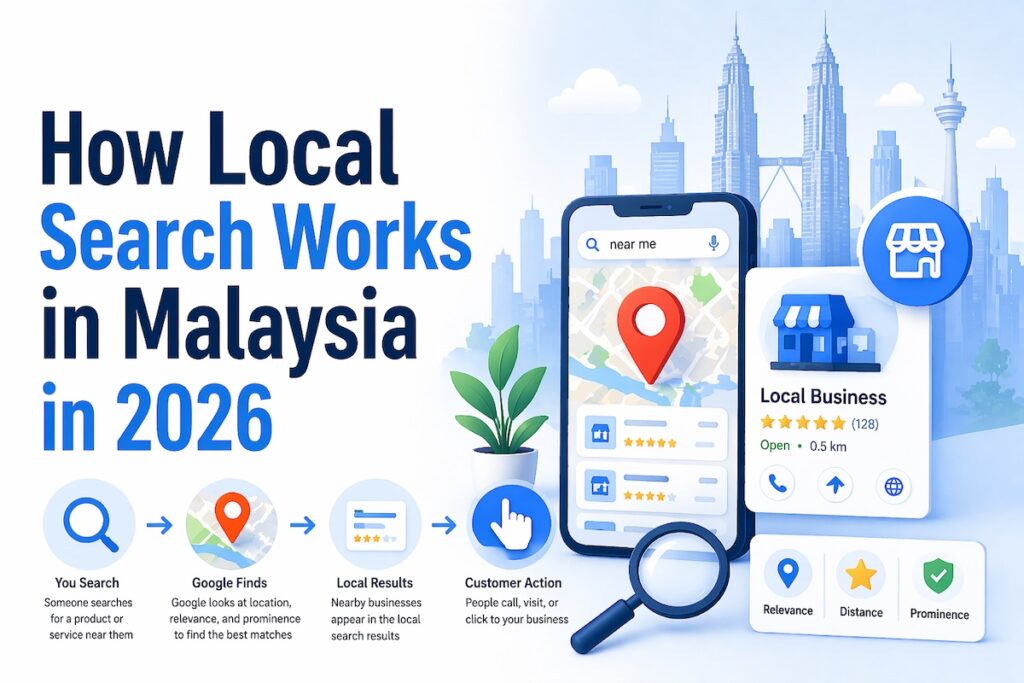
How Local Search Works in Malaysia in 2026
The Local Pack, Maps, and AI Overviews
When a user performs a local search, Google typically returns the Local Pack (the map with three business listings), standard organic results below it, and increasingly, an AI Overview generated from multiple sources above both.
The Local Pack is powered by Google Maps data and your Google Business Profile (GBP). Ranking here depends on three factors that Google has consistently emphasised: relevance, distance and prominence. Relevance measures how well your business matches the search. Distance is self-explanatory. Prominence reflects how well-known and trustworthy your business appears based on reviews, citations, links and overall online footprint.
In 2026, AI Overview inclusion has become increasingly important. Google’s generative search results now synthesise local business information into direct answers. A query like “best physiotherapy clinic in KL” may produce an AI-generated recommendation before the map pack loads. These recommendations draw from structured data on business websites, review content, high-authority directory listings, and the completeness of Google Business Profiles.
Businesses that appear in AI Overviews for local queries are not necessarily the ones ranking highest in traditional organic results. They are the ones with the richest, most consistent and most structured local signals.
How Google Interprets Malaysian Search Behaviour
Malaysian searchers use a mix of languages. A significant portion of local searches blend English with Bahasa Malaysia, use colloquial terms, or switch between both within the same query. “Kedai makan near me,” “klinik near Subang Jaya,” and “best law firm KL Sentral” are all real search patterns.
Google’s natural language processing in 2026 handles code-switching reasonably well, but businesses still need to reflect this linguistic reality in their content and metadata. A business that only targets English keywords misses a substantial share of searches. A business that only targets Bahasa Malaysia may be invisible to English-first professional audiences.
The practical implication: your GBP description, your service pages and your review responses should reflect the actual language your customers use.
Discover Bahasa Malaysia vs English SEO strategy
Google Business Profile: The Foundation of Local SEO in Malaysia
Why GBP Completeness Directly Affects Ranking
Your Google Business Profile is not a directory listing. It is a live data layer that Google uses to understand who you are, what you offer, where you operate, and how credible you are. An incomplete GBP is a ranking liability, not a neutral state.
The fields that most directly influence Local Pack rankings are business name, category, services, location (with verified service area for non-storefront businesses), hours and website link. In 2026, the fields that most directly influence AI Overview inclusion and conversion are the ones most businesses skip.
These include:
Business description. This is crawlable, indexable and used by generative AI to understand what your business does. Write it to answer the questions your customers actually ask, rather than forcing keywords. For a dental clinic, “We provide general dentistry, cosmetic treatments and emergency care for families in Cheras and surrounding areas” is more useful than “Best dental clinic Cheras affordable.”
Services and products section. These fields allow you to list individual services with descriptions and prices where applicable. A law firm that lists “Will and Trust Drafting” as a service is far more likely to surface for that specific query than one that only lists “Legal Services.”
Attributes. Relevance attributes like wheelchair accessibility, women-led status, and LGBTQ+ friendly designations influence filtering. Service-specific attributes such as outdoor seating, delivery availability, and appointment requirements directly affect match quality.
Q&A section. Many businesses do not populate this. It is publicly editable, meaning potential customers and competitors can add questions. Populating it yourself with real questions and accurate answers is both a trust signal and a keyword opportunity.
Guide to Google Business Profile optimisation Malaysia
Review Management as a Local Ranking Signal
Review quantity and recency are confirmed ranking factors. Review content feeds into both relevance matching and AI Overview synthesis.
A dental clinic with 200 reviews that consistently mention “painless,” “affordable Cheras,” and “emergency appointment” is far more likely to surface for those specific queries than a competitor with a higher overall rating but generic review text.
Review response quality also matters. Google can parse the content of your responses. Responding to reviews with relevant, location-specific language reinforces your geographic and service relevance signals.
Operationally, Malaysian businesses often struggle to generate consistent review cadence. The most effective approach is a direct post-service prompt via WhatsApp, the dominant messaging platform in Malaysia, with a direct link to your GBP review page. A two-step friction removal approach (pre-filled rating and direct link) increases review completion rates compared to email requests.
GBP Posts and Updates in 2026
GBP posts remain underused by Malaysian businesses. In 2026, their function has expanded. Google now uses recent post content as a signal for topical freshness and in some cases pulls post content directly into AI-generated local results.
Post formats that perform well for local businesses in Malaysia include promotional offers with clear expiry dates, event announcements tied to location, product or service launches with photos and pricing, and responses to seasonal events relevant to your audience (such as Hari Raya promotions for applicable businesses).
Weekly posting is recommended for competitive local categories. Monthly posting keeps your profile visible. Posting less than once a month risks your profile being treated as inactive.
On-Page Local SEO: Making Your Website Geographically Relevant
Location Pages for Multi-Location Businesses
If your business operates across multiple locations in Malaysia, you need dedicated landing pages for each one. A single page mentioning “we serve KL, Penang, Johor Bahru and Ipoh” does not create the geographic relevance signals needed to rank for queries in each market.
Each location page should contain:
- A unique H1 that includes the service and location (“Accounting Services in Petaling Jaya”)
- A distinct description of that specific location (not copy-pasted from a template)
- Location-specific details including address, phone number, operating hours, parking information, and nearest LRT or MRT station
- An embedded Google Map showing the location
- Location-specific customer reviews or testimonials
- Local schema markup (covered below)
The mistake most multi-location Malaysian businesses make is creating location pages with identical content except for the city name. Google treats this as duplicate content and typically does not rank the pages effectively. Invest in genuinely unique location content.
NAP Consistency: Why It Matters More Than Most Businesses Realise
NAP stands for Name, Address, Phone Number. Consistency of these three data points across your website, GBP, social profiles, and every directory listing is foundational to local SEO.
When Google finds conflicting NAP data (your website says “Jalan Ampang” but your GBP says “Jln Ampang”), it introduces ambiguity about which data is correct. That ambiguity reduces your authority standing in Google’s local index.
For Malaysian businesses specifically, common NAP inconsistency sources include using abbreviated road names inconsistently, keeping old phone numbers on outdated directory listings, managing franchise businesses with individually-managed social pages using different address formats, and failing to update all listings after moving premises.
A citation audit should be performed every six months for businesses in competitive local categories. Tools like Semrush’s Listing Management, BrightLocal, or manual audits against Malaysia-specific directories can surface inconsistencies causing ranking issues.
Schema Markup for Local Businesses
Structured data markup allows you to communicate directly with search engines in a machine-readable format. For local businesses, the LocalBusiness schema type is the primary implementation and also a primary data source for AI Overview content about local businesses.
The minimum viable LocalBusiness schema implementation for a Malaysian business includes:
@type (the specific business type: DentalClinic, LegalService, Restaurant, etc.)
name
address (using PostalAddress with streetAddress, addressLocality, addressRegion, postalCode, addressCountry)
telephone
url
openingHoursSpecification
geo (latitude and longitude coordinates)
priceRange
aggregateRating (if you have review schema)
Beyond the minimum, local businesses in Malaysia are adding hasMap, areaServed, and service-specific schemas like MedicalProcedure, LegalService, and FoodEstablishment to create richer entity signals.
Schema implementation can be validated through Google’s Rich Results Test. Errors in schema markup can affect rich result eligibility, so testing after any site update is essential.
Local Citations in Malaysia: Building Your Directory Presence
The Malaysian Citation Landscape in 2026
A citation is any mention of your business NAP data online, whether on a directory, a news site, a social platform, or a blog. Citations serve as external validation signals: each consistent mention tells Google that your business is real, located where you say it is, and operating in the sector you claim.
The Malaysian citation ecosystem includes both global platforms and Malaysia-specific directories that carry local relevance:
- Google Business Profile (primary, always)
- Yelp Malaysia
- Facebook Business Page
- Yellow Pages Malaysia (yellowpages.com.my)
- iMoney (financial services)
- Loanstreet (financial services)
- MyBazaar.my
- MalaysiaDirectory.com
- CTOS (B2B and financial industry)
- OpenSnap (restaurant and F&B)
- Foodadvisor.com.my (F&B)
- PropertyGuru and iProperty (real estate)
- DoctoronCall, DoctorOnDemand and KKiA listings (healthcare)
- Tourism Malaysia (hospitality and tourism)
- Fave (retail and F&B promotions)
The priority should always be industry-relevant directories first, followed by high-authority general directories, followed by local and regional directories.
Citation Building vs Citation Auditing
For most established Malaysian businesses, the greater priority is auditing and correcting inconsistent existing citations rather than adding new ones.
The process involves compiling a master NAP record (the exact format you use on your website and GBP), searching for your business name across the key directories listed above, and documenting every inconsistency. Submit correction requests or claim the listing to correct the data directly.
For new businesses or businesses that have never actively built citations, claim the top 20 directories by authority and relevance within the first month, then build incrementally to a total of 50 to 80 consistent citations over three to six months.
Local Content Strategy: Beyond the Homepage
Localised Blog Content as a Ranking Lever
Local businesses in Malaysia frequently treat their website as a static brochure. A static website limits your ranking potential in competitive local markets. The websites that consistently rank for competitive local queries have active content programmes that signal topical depth and geographic relevance.
Localised blog content serves multiple purposes: it captures long-tail local queries that your service pages cannot target, and it builds internal link equity that flows to your location and service pages.
Examples of high-performing local content topics for Malaysian businesses include “How Much Does LASIK Surgery Cost in KL in 2026?” for healthcare, “Best Commercial Kitchen Suppliers in Klang Valley” for B2B services, “How to Choose a Property Agent in Johor Bahru” for real estate, and “What to Expect from a First-Time Visit to a Malaysian Civil Court” for legal services.
Each of these captures searchers in the consideration phase for a local purchase decision. The business that answers these questions earns traffic, trust, and conversion opportunities that competitors are not capturing.
FAQ Pages and AI Overview Optimisation
FAQ content on local business websites serves multiple functions in 2026. It targets featured snippet positions for question-format queries, and it provides content that feeds into AI Overview generation for local searches.
Google’s generative results pull FAQ-style answers from local business websites when the question is specific and the answer is structured clearly. A physiotherapy clinic with an FAQ page addressing “How many sessions of physiotherapy are needed for a sports injury in KL?” has a realistic chance of being cited in an AI Overview for that query, even if broader organic rankings are competitive.
FAQ content should be kept factually accurate and updated at least annually, or after any policy, pricing or regulatory change affecting the answer.
Local Link Building: The Authority Signal Most Malaysian Businesses Overlook
Local link acquisition is distinct from general link building. The goal is geographic and topical relevance from trusted local sources, not domain authority at scale.
High-value local links for Malaysian businesses come from:
Local news and media. Coverage in The Star, Malay Mail, Sin Chew Daily, The Edge, or regional publications carries strong local authority signals. Digital PR campaigns targeting these outlets generate links that no directory can match.
Local business associations. The Malay Chamber of Commerce, SMECORP, FMM (Federation of Malaysian Manufacturers), NCCIM, and state-level chambers of commerce all maintain member directories.
University and educational institutions. Guest lectures, industry partnerships, scholarship sponsorships, or research collaborations with institutions like UM, UPM, UTM or UTAR often produce high-authority .edu.my backlinks.
Local event sponsorships. Sponsoring local events such as running races, cultural festivals, and industry conferences results in links from event pages, local news coverage, and social mentions from attendees.
Supplier and partner networks. If your business is part of a supply chain or franchise network, requesting links from supplier websites, brand directories, and partner pages leverages an often-overlooked local authority signal.
A link from The Star online edition or University of Malaya’s website carries more weight for your local SEO than multiple links from generic guest post sites. Quality and geographic relevance outweigh volume.
Tracking Local SEO Performance: What to Measure
Ranking position in the Local Pack is a useful indicator, but it is not a business metric. The metrics that actually tell you whether local SEO is working are:
GBP Insights data. Track searches (branded vs. discovery), direction requests, website clicks, and call clicks from your GBP. Discovery searches, where customers found you without searching your brand name, represent net new audience acquisition.
Tracked phone calls. Use a call tracking number on your GBP and website (different numbers to distinguish source) to attribute inbound calls to local search. This connects local SEO activity to pipeline.
Map direction requests. When customers request directions from your GBP listing, they are demonstrating intent to visit. Track this metric separately from website traffic. High direction request volume with low conversion suggests a local visibility problem.
Website traffic by location source. Segment your Google Analytics traffic by source: Google Maps, Google Search (local), Google Search (organic), and direct. Isolating local search traffic shows whether your local SEO efforts are driving qualified traffic.
Conversion tracking. Define a conversion for your business (call, form submission, appointment booking, in-store visit) and track conversion rate from local search sources. Local SEO only matters if it converts.
Review growth rate. Monitor the volume and velocity of new reviews. A stalled review count (flat for three months) suggests declining customer visibility or engagement. Review growth indicates your local presence is increasing.
Competitor benchmarking. Once quarterly, run a competitive audit for your top three competitors. Compare GBP completion scores, review counts, citation presence, and search visibility. This contextualises your own metrics within your local market.
Local SEO Checklist for Malaysian Businesses in 2026
Before publication or implementation, verify that your local SEO foundation covers:
Google Business Profile:
- Profile fully claimed and verified
- Business name, address, and phone number match across all platforms
- Category accurately reflects your primary service
- All 13 service fields populated with descriptions
- High-quality, relevant photos (at least 5)
- Hours of operation current and accurate
- Website link included
- Service radius defined (if applicable)
Citations and NAP Consistency:
- Master NAP record documented
- Listed on Google Business Profile, Yelp, Facebook, Yellow Pages Malaysia
- Industry-specific directories claimed (healthcare, real estate, legal, F&B)
- All citations audited and corrected in the past 60 days
On-Page Content:
- Location pages created for each service area
- Schema markup implemented and validated
- FAQ content written for top 10 customer questions
- Meta descriptions and title tags include location + service
- Internal linking strategy established
Review Management:
- Google review request system in place
- Monthly review monitoring protocol established
- Response template prepared for positive and negative reviews
- Review response rate above 50%
Ongoing Activity:
- GBP posts scheduled at least twice monthly
- Local content calendar established (blog posts, location guides)
- Local link prospects identified and outreach planned
- Analytics tracking configured (GBP Insights, call tracking, conversion tracking)
- Quarterly competitor benchmarking scheduled
Local SEO in Malaysia is a competitive, multi-layered discipline that requires simultaneous attention to Google Business Profile completeness, citation consistency, on-page geographic signals, content depth, and local authority building. No single element alone will move rankings, but the interaction between all five creates the foundation that allows your business to dominate local search in your market.
The businesses that win in local search in 2026 are not the ones that implement one tactic perfectly. They are the ones that implement five tactics consistently over time. Start with GBP completeness and citation consistency (the foundation), then add localised content and strategic local links. Review performance quarterly, refine based on data, and stay consistent.