

Hreflang & International SEO for Malaysian Businesses
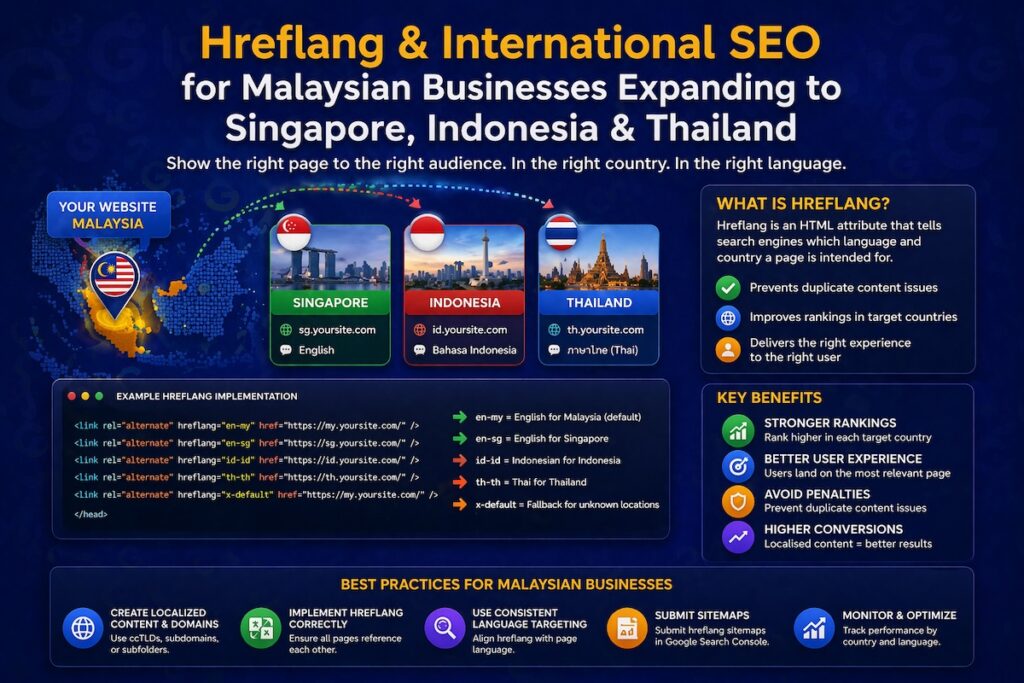
Most Malaysian businesses expanding regionally make the same mistake: they launch a single website, translate a few pages into Bahasa Indonesia or Thai, and assume Google will figure out the rest. It won’t. Without proper hreflang implementation and a deliberate international SEO structure, your Singapore landing page will compete against your Malaysian homepage, your Indonesian content will surface to Thai users, and your organic traffic will fragment across three markets instead of compounding in each one.
This post covers exactly how hreflang works, why it matters specifically for the Malaysia-Singapore-Indonesia-Thailand corridor, and how to build an international SEO architecture that sends the right signal to Google for every market, every time.
Key takeaways
- Hreflang is not a ranking signal, it is a relevance signal. It tells Google which page to serve to which user.
- Malaysia, Singapore, Indonesia and Thailand each require distinct hreflang configurations, even when content shares a language.
- A missing or broken hreflang tag does not cause a penalty, but it does cause content duplication and traffic cannibalization across your target markets.
- URL structure choices (ccTLD, subdomain, subdirectory) made before you write a single line of hreflang code will define your international SEO ceiling.
- The x-default hreflang attribute is frequently misused. It should point to a region-agnostic page, not your default homepage.
What hreflang actually does (and what it does not do)
Hreflang is an HTML attribute, an HTTP header value, or a sitemap tag that tells Google which version of a page to serve based on a user’s language and geographic location. That is its entire job.
It does not boost rankings. It does not consolidate link equity the way canonical tags do. It is not a substitute for translated content. What it does do is prevent the wrong version of your site from appearing in the wrong market, and for a Malaysian business running separate experiences for Singapore, Indonesia and Thailand, that distinction is critical.
The attribute uses a two-part code: language code (ISO 639-1) followed optionally by a region code (ISO 3166-1 Alpha-2). So en-MY means English as used in Malaysia. en-SG means English as used in Singapore. id-ID means Indonesian as used in Indonesia. th-TH means Thai as used in Thailand.
Why Malaysian businesses get this wrong
The confusion starts because Malaysia is genuinely multilingual. Your team writes in English, Bahasa Malaysia, and often Mandarin Chinese. When you expand to Singapore, English stays relevant. When you expand to Indonesia, Bahasa Malaysia and Bahasa Indonesia are close enough that teams often reuse content with minimal edits. When you expand to Thailand, suddenly you are dealing with a completely different script and user behaviour pattern.
This linguistic overlap creates a false sense of simplicity. Teams assume one English version covers Singapore, or that a Bahasa Malaysia page will rank well enough in Indonesia. Google’s crawlers do not make those assumptions, and neither should your SEO architecture.
URL structure: the decision you make before writing any hreflang tag
Before you touch a single hreflang implementation, your URL structure must be decided. This is the architectural foundation everything else sits on. Three main options exist, each with genuine trade-offs for a regional expansion strategy.
Country code top-level domains (ccTLDs)
Structure: mackyclyde.com.sg, mackyclyde.co.id, mackyclyde.co.th
ccTLDs send the strongest geographic signal to Google. A .sg domain tells Google unambiguously that this site targets Singapore. For a business serious about dominance in each individual market, ccTLDs are the most technically clean approach.
The trade-off: link equity does not consolidate across domains. Backlinks earned by your Malaysian .com.my domain do not transfer to your Singapore .com.sg. You are building three separate authority profiles from scratch. For businesses with lean link-building budgets, this is a serious constraint.
Subdomains
Subdomains give you geographic segmentation without buying separate domains. Google can still geotarget subdomains through Search Console. The downside: Google historically treats subdomains as separate entities, which means your domain authority does not flow as cleanly as it does across subdirectories.
Subdirectories
Structure: mackyclyde.com/sg/, mackyclyde.com/id/, mackyclyde.com/th/
This is the most common recommendation for growing businesses because link equity, domain authority and crawl budget all consolidate under one root domain. Your Malaysian domain’s existing authority lifts every regional subdirectory immediately. The trade-off is a weaker geographic signal compared to ccTLDs, which you compensate for through Search Console’s geotargeting settings and consistent hreflang implementation.
For most Malaysian businesses entering Singapore, Indonesia and Thailand simultaneously, the subdirectory approach offers the best balance of authority consolidation and implementation speed.
Implementing hreflang: the three methods and which to use
Once URL structure is decided, hreflang can be implemented three ways. Each is valid. The right choice depends on your technical stack and team capability.
Method 1: HTML head tags
Place hreflang tags inside the <head> section of each page. This is the most common method and works well for smaller sites or server-rendered pages.
<link rel="alternate" hreflang="en-MY" href="https://mackyclyde.com/en-my/page/" />
<link rel="alternate" hreflang="en-SG" href="https://mackyclyde.com/sg/page/" />
<link rel="alternate" hreflang="id-ID" href="https://mackyclyde.com/id/page/" />
<link rel="alternate" hreflang="th-TH" href="https://mackyclyde.com/th/page/" />
<link rel="alternate" hreflang="x-default" href="https://mackyclyde.com/page/" />
The critical rule here: every page referenced in the hreflang cluster must include a reciprocal reference to all other pages in that cluster. If your Singapore page references the Indonesian page but the Indonesian page does not reference the Singapore page back, Google ignores the entire signal.
Method 2: HTTP headers
For non-HTML files such as PDFs or dynamically generated pages, hreflang attributes can be delivered via HTTP response headers. This is less common but essential when your content is not standard HTML.
Method 3: XML sitemaps
For large sites with hundreds or thousands of pages, embedding hreflang in your XML sitemap is far more scalable than editing HTML on every page. The sitemap approach uses <xhtml:link> elements within each <url> block.
<url>
  <loc>https://mackyclyde.com/sg/page/</loc>
  <xhtml:link rel="alternate" hreflang="en-SG" href="https://mackyclyde.com/sg/page/"/>
  <xhtml:link rel="alternate" hreflang="en-MY" href="https://mackyclyde.com/en-my/page/"/>
  <xhtml:link rel="alternate" hreflang="id-ID" href="https://mackyclyde.com/id/page/"/>
  <xhtml:link rel="alternate" hreflang="th-TH" href="https://mackyclyde.com/th/page/"/>
  <xhtml:link rel="alternate" hreflang="x-default" href="https://mackyclyde.com/page/"/>
</url>
For Malaysian businesses scaling across four markets, the sitemap method is almost always the right choice operationally.
The x-default attribute: what it actually means
This is one of the most misused hreflang attributes in regional SEO implementations. Many teams point x-default to their homepage or their primary market’s page. That is incorrect.
The x-default attribute signals the fallback page for users whose language or region does not match any of your defined hreflang targets. It should point to a language-selector page or a genuinely region-agnostic version of the page.
If a user in Vietnam searches for a term you rank for, and you have no Vietnamese hreflang configured, Google should serve your x-default page, not your Malaysian or Singapore version. This reduces bounce rates in markets you have not fully localised for yet and keeps users engaged rather than serving them content that is clearly not for them.
Market-specific considerations for the Malaysia-Singapore-Indonesia-Thailand corridor
Hreflang configuration is the technical layer. But it only functions correctly when paired with genuine market differentiation. Here is what that looks like across each target market.
Singapore: English-first, precision matters
Singapore’s search environment is dominated by English content. However, using en-SG rather than en-MY or just en matters because search behaviour, currency, regulations and cultural references differ. A Malaysian business marketing car-sharing services in Singapore needs landing pages that reference SG-dollar pricing, LTA regulations and Singaporean geography, not Malaysian examples. Google’s hreflang system can only serve the right page if the right page genuinely exists.
Indonesia: language proximity is not an SEO shortcut
Bahasa Indonesia and Bahasa Malaysia share roots but diverge significantly in vocabulary, formality register and local expression. Indonesian users searching on Google.co.id will encounter content written in Bahasa Malaysia and detect the mismatch immediately, even if they can understand it. The bounce signal that follows teaches Google that your page is not the right result for that query.
Proper id-ID hreflang implementation only works if your Indonesian pages are written in authentic Bahasa Indonesia by someone who understands the local register, not translated from Bahasa Malaysia by find-and-replace.
Thailand: script and search intent both change
Thai-language SEO is a different discipline. Google Thailand users primarily search in Thai script, and search intent patterns differ from English or Bahasa markets. Implementing th-TH hreflang without Thai-script content to back it up is essentially wasted configuration. Before implementing hreflang for Thailand, you need Thai-language pages written for Thai search intent, not just translated page titles.
Common hreflang errors that kill international SEO performance
These mistakes appear most frequently in international SEO audits for Malaysian businesses expanding regionally.
Non-reciprocal hreflang tags. Every page in a hreflang cluster must reference every other page in that cluster, including itself. Missing reciprocal tags cause Google to ignore the entire hreflang set.
Pointing hreflang to 301-redirected URLs. Hreflang attributes must point to the canonical, indexable URL. If you redirect your Singapore URL to your Malaysian URL for any reason, the hreflang chain breaks.
Using hreflang on noindexed pages. If a regional page carries a noindex directive, Google will not process its hreflang signals. You cannot tell Google to ignore a page for indexing while also asking it to serve that page to specific users.
Canonical and hreflang conflicts. If your Singapore page’s canonical tag points to your Malaysian page, Google treats the Malaysian page as the authoritative version and ignores the hreflang on the Singapore page. Canonical tags and hreflang must work together.
Incorrect language or region codes. Using my as a language code is a common error. my is actually the ISO 639-1 code for Burmese, not Malay. The correct language code for Bahasa Malaysia is ms. So a Malaysian Bahasa page in Malaysia should be tagged ms-MY.
Technical SEO audit checklist for Malaysian businesses
Verifying your hreflang implementation
After implementation, verification is essential. Three tools cover the core checks.
Google Search Console’s International Targeting report shows detected hreflang errors at scale. It flags reciprocal link issues, invalid language codes and pages with conflicting signals. This should be reviewed within two to four weeks of any international implementation.
Screaming Frog’s hreflang tab crawls your site and maps the entire hreflang cluster visually, showing which pages reference which other pages and flagging any broken reciprocal relationships.
Ahrefs’ Site Audit flags hreflang-specific technical errors as part of its broader technical audit, including non-canonical hreflang URLs and missing x-default attributes.
Manual spot checks in Google Search using the site: operator combined with region-specific searches will also reveal whether the correct regional pages are surfacing in each target market.
Authority building and interlinking for Malaysian businesses
How to structure international content beyond hreflang
Hreflang solves the technical routing problem. It does not solve the content problem. For Malaysian businesses to genuinely compete organically in Singapore, Indonesia and Thailand, a few content architecture principles apply.
Build separate keyword research sets for each market. A keyword that drives high volume in Malaysia may have near-zero search volume in Indonesia. Tools like Google Keyword Planner with country filters and Ahrefs with market-specific data will give you accurate demand signals per market.
Build market-specific internal linking structures within each subdirectory or subdomain. Your Singapore content should link internally to other Singapore pages, not to your Malaysian pages. Cross-regional internal links dilute the geographic signal you are building.
Pursue market-specific backlinks. A link from a Singaporean media outlet to your /sg/ pages sends a much stronger geolocation signal than links from Malaysian sites. This is where international link-building strategy connects directly to your hreflang architecture.
Frequently asked questions
Do I need separate Google Search Console properties for each regional market?
Yes, if you are using ccTLDs or subdomains. Each ccTLD and subdomain should have its own Search Console property. Subdirectories can be verified under the root domain property, though many teams add them as separate properties for cleaner reporting. The International Targeting feature within Search Console also allows you to set geotargeting at the subdirectory level.
If my Singapore and Malaysian content is nearly identical but localised, will I get a duplicate content penalty?
Google does not issue duplicate content penalties in the traditional sense. What happens instead is that Google will attempt to consolidate what it sees as duplicate pages, potentially serving the wrong version in the wrong market. Proper hreflang implementation plus meaningful localisation differences (pricing, examples, references, calls to action) is what prevents this consolidation from working against you.
Can I use hreflang for a site that only targets one additional country?
Yes. If you are only adding Singapore to your Malaysian operation, you still need hreflang tags on both the Malaysian and Singapore pages, plus an x-default. Even with two markets, missing hreflang causes the two pages to compete in search results.
How long does it take for hreflang changes to take effect in Google Search?
Google needs to crawl and reprocess all affected pages before hreflang signals take effect. For a mid-sized site, this can take anywhere from two to eight weeks depending on crawl frequency. Submitting an updated XML sitemap containing the hreflang markup through Search Console accelerates this process.
What happens if I implement hreflang incorrectly?
Google treats incorrect hreflang as a signal it cannot use and falls back to its own geographic and language inference. This usually means serving your primary market’s content in all markets, which hurts regional organic performance but does not cause ranking drops on your existing pages.
Is hreflang necessary if I am only running paid search in my target markets?
Hreflang is specific to organic search. Google Ads manages geo-targeting through campaign settings, not hreflang attributes. However, if your paid campaigns drive users to organic landing pages that also need to rank organically in each market, those pages still benefit from correct hreflang implementation.
The right hreflang architecture reflects a genuine strategy to build a distinct, locally relevant presence in each market you enter. Getting hreflang right is one piece of a larger international SEO system that includes URL structure, content localisation, technical auditing and market-specific link-building. The decisions you make now about architecture, content and regional focus will compound across your regional expansion for years.