The complete guide to traditional SEO, AI Overviews, and AI Mode
Let’s be real. You’ve Googled your own business name before. We all have. And if you didn’t show up on page 1, that quiet panic is completely valid because if Google can’t find you, neither can your customers.
But here’s the thing most SEO guides won’t tell you upfront: Google Page 1 in 2025 is not just a list of ten blue links anymore. It’s a full ecosystem. There’s the traditional organic results, yes, but sitting above them are AI Overviews (Google’s AI-generated summaries) and the newer AI Mode, which works more like a conversation than a search engine.
For Malaysian business owners and anyone looking to upskill in this space, the good news is that getting visible across all three surfaces follows the same core principles. This guide breaks it all down in plain language, no fluff, no jargon wall.
1. What Google Page 1 Actually Looks Like in Malaysia
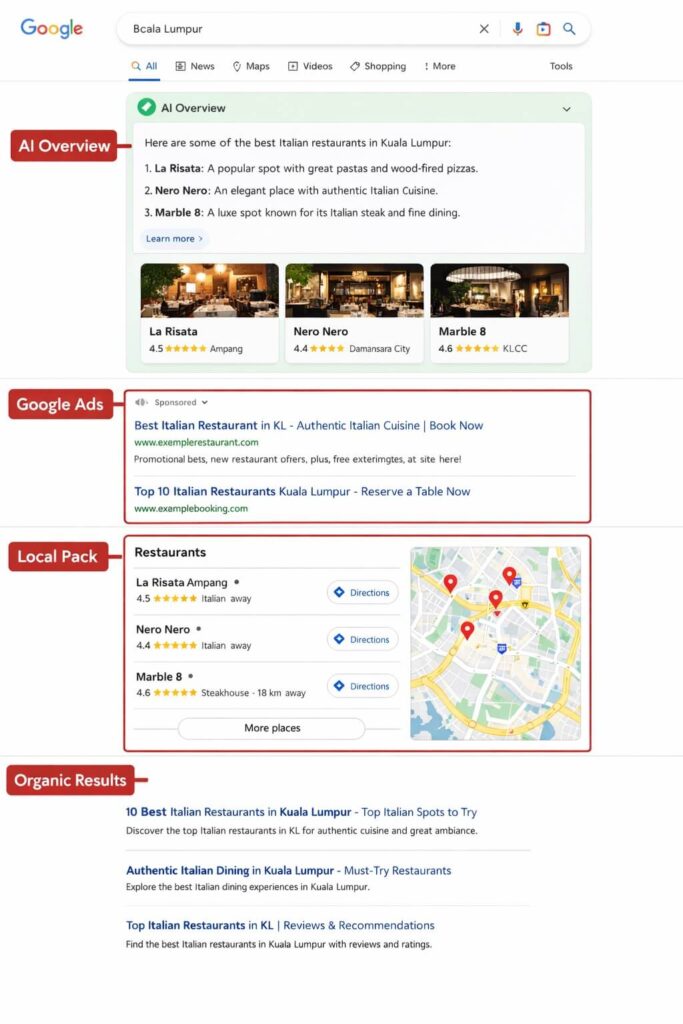
Before you can rank, you need to understand what you’re ranking for. Here’s the anatomy of a Malaysian Google results page in 2025:
- AI Overview: AI-generated summary shown at the very top for informational and research-based queries. Launched in Malaysia in 2024.
- Google Ads: Paid placements at the top and bottom. Fast but costs money every click.
- Local Pack: The map block with 3 business listings. Critical for any business with a physical location.
- AI Mode: Accessed via a tab, it’s Google’s conversational search experience for complex, multi-step queries.
- Featured Snippet: A highlighted answer box pulled from one webpage. High visibility, zero click sometimes.
- People Also Ask (PAA): Expandable question accordion. A goldmine for content ideas.
- The 10 Blue Links: Classic organic results. Still very much alive and still worth fighting for.
One thing specific to Malaysia worth noting: search behaviour here is bilingual. Queries in English and Bahasa Malaysia return different results, and mobile accounts for the majority of searches. Build everything with mobile-first thinking.
2. The Foundation: What Google Actually Wants (EEAT)
Google ranks pages it trusts. That trust is evaluated using a framework called EEAT: Experience, Expertise, Authoritativeness, and Trustworthiness.
Think of it this way. Imagine Google as a very particular relative who only recommends businesses he personally trusts, ones with a real address, actual credentials, and a track record. That’s EEAT in a sentence.
How to build EEAT signals on your site:
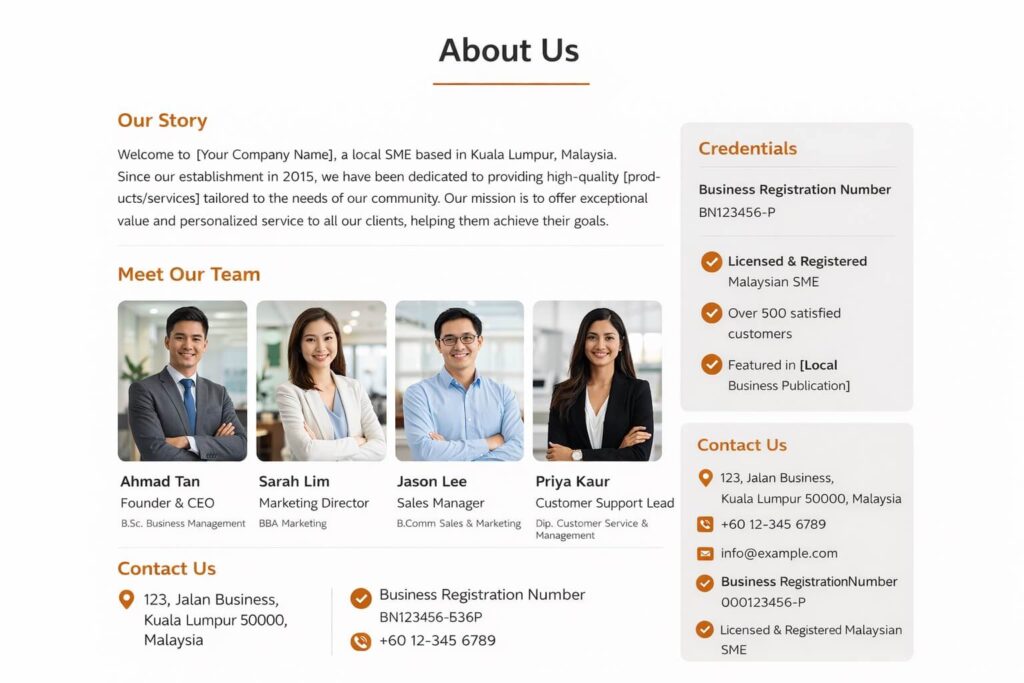
- Add a proper About Us page with real team photos, names, and credentials
- Every blog post should have an author bio with relevant experience
- Display your SSM registration number, business address, and phone number visibly
- Collect Google reviews consistently, Malaysian users heavily rely on peer validation
- Run on HTTPS. No exceptions. Google treats HTTP sites as untrustworthy.
- Cite your data sources with links to credible references (government reports, MDEC stats, etc.)
EEAT NOTE Google’s own Search Quality Rater Guidelines explicitly state that Trustworthiness is the most important dimension of EEAT. A technically perfect site with weak trust signals will still lose to a simpler, more credible one.
3. Ranking in the Traditional Blue Links
3.1 Keyword Research for the Malaysian Market
Keyword research in Malaysia has one layer most guides skip: the bilingual layer. You need to identify demand in both English and Bahasa Malaysia because search volumes and competition differ significantly between the two.
- Use Google Keyword Planner (free) or Ahrefs/Semrush for volume data
- Long-tail keywords convert better. ‘Affordable accounting services Petaling Jaya’ beats ‘accounting services’ every time
- Map your keywords by city: KL, Penang, JB, Ipoh, Kota Kinabalu all have distinct local intent
- Use People Also Ask boxes as a free keyword research tool, they tell you exactly what real Malaysians are asking
PRO TIP When you run a keyword through any AI tool (ChatGPT, Gemini, Claude), also check what People Also Ask results appear for that keyword in Malaysia. The PAA box reflects what Google’s own models consider semantically related to that query, making it perfect for GEO-aligned content planning.
3.2 On-Page SEO: The Non-Negotiables
On-page SEO is about telling Google clearly and accurately what your page is about. Keep it clean and intentional.
- Title tag: Include your target keyword naturally. Keep it under 60 characters.
- Meta description: Write for humans. This is your ad copy in the search results.
- H1 tag: One per page, should contain your primary keyword
- Headings (H2, H3): Structure your content like a logical guide, not a wall of text
- First 100 words: Mention your keyword early, it signals relevance
- Internal links: Connect your pages to each other, it distributes authority and improves crawlability
- Image alt text: Descriptive, keyword-relevant, never stuffed
3.3 Content That Actually Ranks in 2025
The bar for content has risen significantly. Generic, AI-generated content that lacks depth or local context is getting filtered out faster than ever. Here’s what works:
- Write content that fully answers the question. Google rewards completeness.
- Use local references: Malaysian pricing, Malaysian regulations, local brand examples
- Update content regularly. A 2022 post with no updates signals neglect to Google.
- Cover the topic from multiple angles, not just the obvious one
- Avoid AI-generated content that is thin, factually weak, or template-like
PRO TIP Here’s where AI actually helps: use it for research, outlining, and identifying content gaps, not for mass-producing shallow articles. The content that wins in 2025 shows real-world experience and local context that no AI can fabricate convincingly.
3.4 Technical SEO Basics (Simplified)
- Page speed: Use Google PageSpeed Insights. Aim above 70 on mobile. Malaysia’s mobile usage makes this non-negotiable.
- Core Web Vitals: Focus on LCP (how fast your main content loads) and CLS (layout stability)
- Mobile-friendliness: Test your site on Google’s Mobile-Friendly Test tool
- Sitemap: Submit yours in Google Search Console so Google crawls you efficiently
- Fix broken links: Use Screaming Frog’s free version for a basic audit
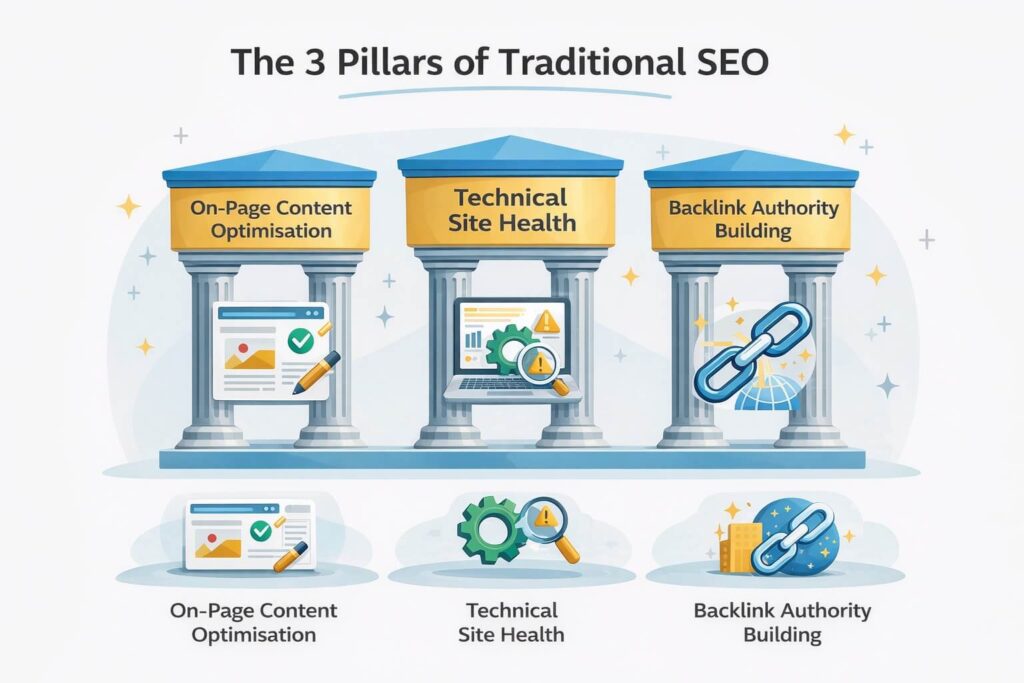
3.5 Backlinks: Getting Other Sites to Vouch for You
A backlink is a vote of confidence from another website. Quality beats quantity here every time.
- Get listed in Malaysian business directories: Malaysia SME, Hotfrog Malaysia, local chamber of commerce sites
- Guest post on relevant Malaysian blogs or news outlets
- Aim for PR mentions in local media: The Star, Free Malaysia Today, SAYS, Vulcan Post
- Build relationships with complementary local businesses for cross-linking
- Unlinked brand mentions matter too, especially for AI citation. More on this below.
4. Getting Into Google’s AI Overview
4.1 What is AI Overview?
AI Overview is Google’s AI-generated summary that appears at the very top of search results for many queries. It pulls from multiple web sources and synthesises an answer. The key thing to understand: being cited in AI Overview does not require you to rank #1 organically. It requires your content to be the clearest, most trustworthy answer to the question.
AI Overviews are now live in Malaysia and appearing for a wide range of searches, from how-to queries to product research and local service lookups.
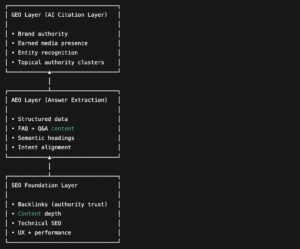
4.2 AEO: Answer Engine Optimisation
AEO is the practice of structuring your content so AI systems can extract and cite it as an answer. It is fast becoming as important as traditional keyword optimisation.
Key AEO strategies:
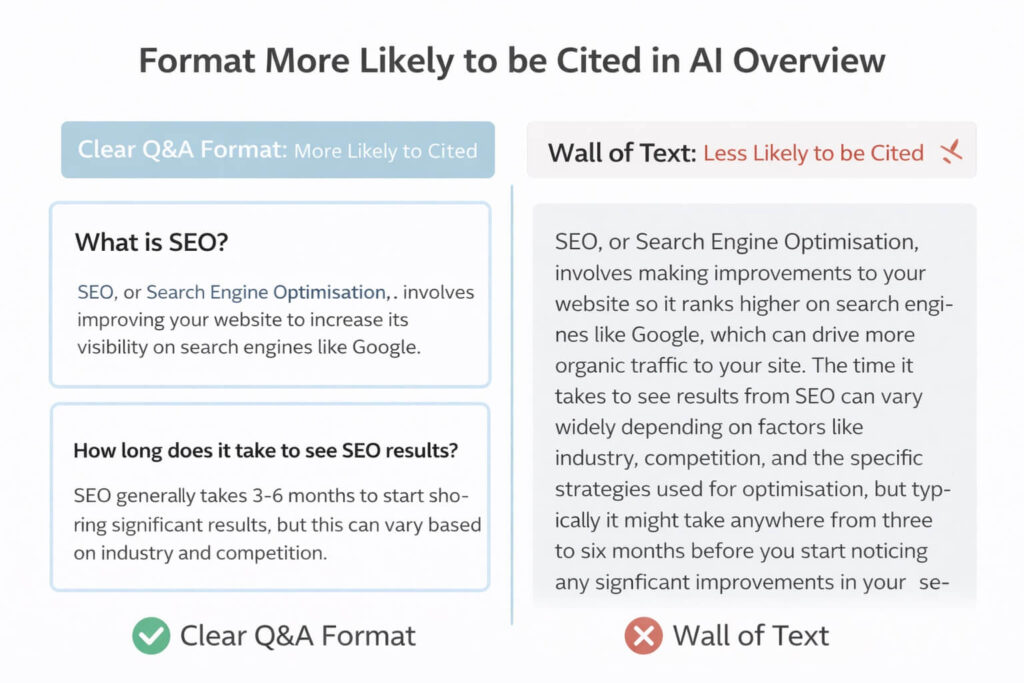
- Write in Q&A format. Structure sections around actual questions your audience asks.
- Put your core answer in the first 2 to 3 sentences under each heading. That’s what AI Overview pulls.
- Implement FAQ Schema and How-To Schema markup on relevant pages.
- Use People Also Ask as your content map. Build entire articles around PAA clusters.
- Build topical authority: one post is not enough. You need a cluster of interlinked content covering a topic from multiple angles.
- Avoid vague, hedging language. Be direct and declarative in your answers.
PRO TIP Test this yourself: Google a question in your industry in Malaysia right now. If an AI Overview appears, look at what sources it cites. Visit those pages. Study how they structure their answers. That’s your template.
4.3 What Gets You Excluded from AI Overview
- Thin content with no real depth or original insight
- Content that contradicts well-established facts or lacks citations
- Websites with weak trust signals: no HTTPS, no author info, no business details
- Outdated data without any update notes or refresh dates
5. Showing Up in Google AI Mode
5.1 What is AI Mode?
AI Mode is Google’s conversational search experience. Instead of returning a list of links, it synthesises answers from across the web in response to complex, multi-step queries. Think of it as Google Search meeting a research assistant. It is more thorough than AI Overview and handles queries like ‘compare accounting software options for a Malaysian SME with under 20 staff’ rather than just ‘accounting software Malaysia’.
5.2 GEO: Generative Engine Optimisation
GEO is the newer discipline of optimising content to be cited and surfaced by AI-powered engines, including Google AI Mode, Perplexity, ChatGPT, and others. The underlying logic is different from traditional SEO because these systems search by meaning, not just keywords.
Core GEO strategies:
- Write authoritatively with cited facts and data. AI models prefer well-sourced claims over opinion.
- Use entity-rich language: name specific places, organisations, tools, regulations, and dates. This helps AI systems map your content to the right knowledge graph nodes.
- Structure content semantically. Each section should cover one concept completely before moving on. This is what makes content retrievable by vector search.
- Build brand mentions across the web. AI models learn brand authority from unlinked mentions across forums, news sites, and directories, not just formal backlinks.
- Publish original Malaysia-specific data. Local statistics are highly citeable because they are rare and verifiable.
- Maintain consistent NAP (Name, Address, Phone) across every platform you appear on. This is how AI systems confirm your entity exists and is legitimate.
PRO TIP Perplexity, ChatGPT, and Google AI Mode all rely on vector embeddings to retrieve content. When you structure each section of your content to cover one topic clearly and completely, you make it dramatically easier for these systems to retrieve and cite you. This is not a theory, it’s how RAG (Retrieval Augmented Generation) systems work under the hood.
5.3 The Vector Search Layer: Simplified
Traditional SEO matches keywords. AI search matches meaning. When someone asks Google AI Mode a question, the system converts that question into a mathematical representation (a vector) and retrieves content with the closest semantic meaning.
What this means practically for your content:
- Write in natural, complete sentences, not keyword-stuffed fragments
- Each paragraph should be self-contained and meaningful in isolation
- Use natural variations of your key terms instead of repeating the same phrase
- Answer implied questions, not just the literal keyword. If someone searches for ‘GST for small business Malaysia’, they also want to know about SST, registration thresholds, and penalties.
6. Local SEO: The Malaysian Business Owner’s Page 1 Shortcut
6.1 Google Business Profile
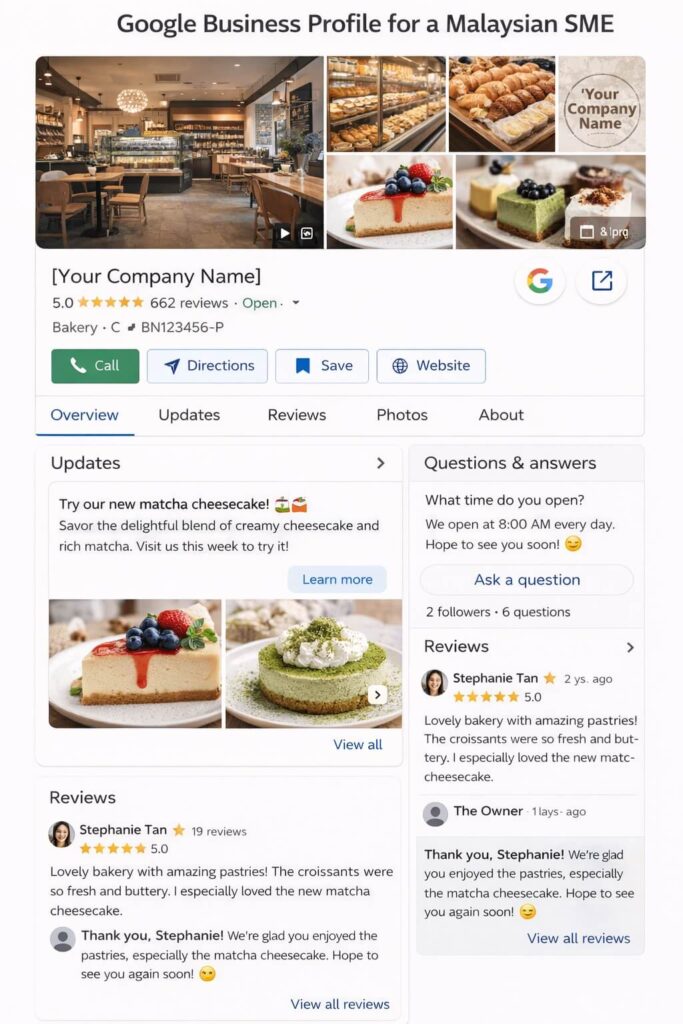
If you own a physical business in Malaysia and you are not using Google Business Profile (GBP), you are leaving free page 1 real estate on the table. The local pack (the map block with 3 listings) appears above organic results for most local searches.
GBP optimisation checklist:
- Claim and verify your profile if you haven’t already
- Select the most accurate primary category for your business
- Fill in every field: hours, services, description, photos, products with MYR pricing
- Post updates at least twice a month. Google rewards active profiles.
- Respond to every review, positive and negative. Response rate and quality affect your ranking.
- Add your products and services with descriptions that include natural keyword language
6.2 Local Citations and Directory Signals
Beyond GBP, your business needs to appear consistently across directories. Inconsistent NAP data (different phone numbers, misspelled addresses) confuses Google and AI systems that cross-reference your entity.
- Priority directories: Foursquare, Yelp Malaysia, Yellow Pages Malaysia, local chamber directories
- Industry-specific directories matter too, depending on your sector
- Reviews in both Bahasa Malaysia and English signal local relevance to Google
- Build location-specific landing pages for each city or area you serve: ‘Wedding Photography Kuala Lumpur’ and ‘Wedding Photography Penang’ should be separate pages with distinct content
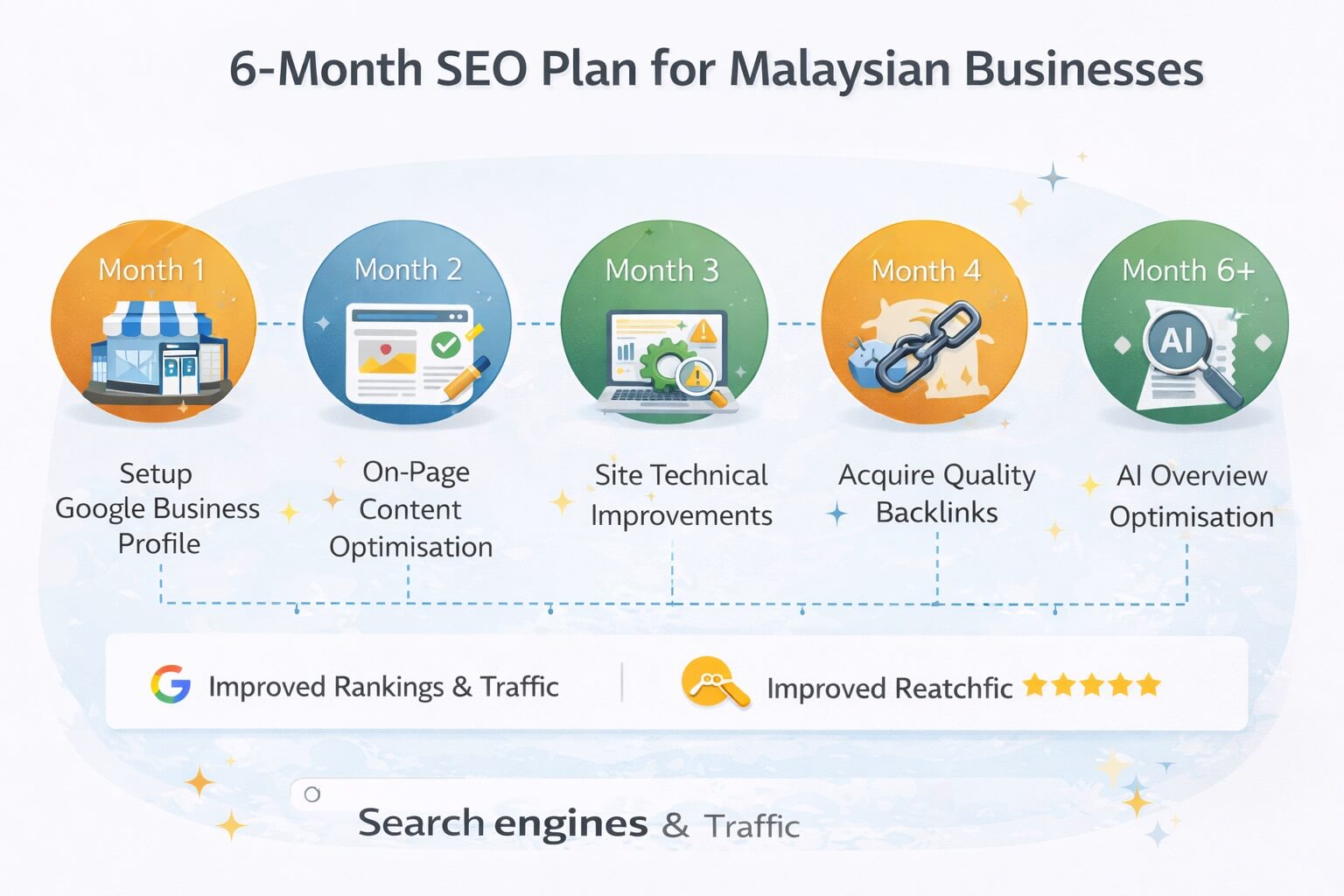
7. Your Priority Action Plan
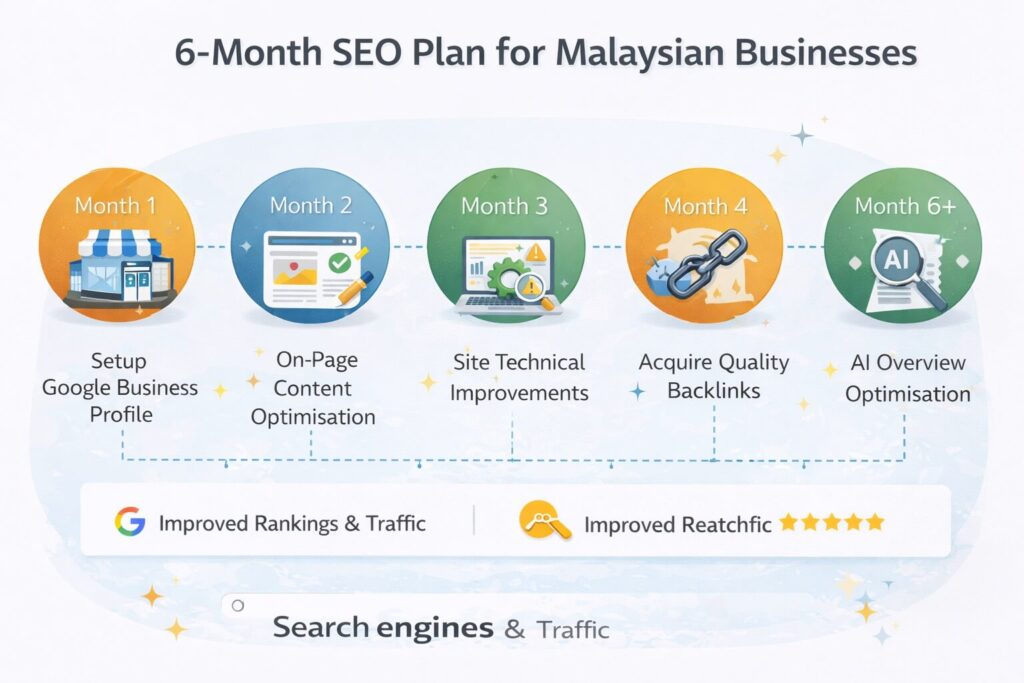
Month 1 to 2: Foundation
- Set up and verify your Google Business Profile
- Confirm your site runs on HTTPS and passes Google’s Mobile-Friendly Test
- Write or rewrite your About page with clear EEAT signals
- Identify 15 target keywords in English and Bahasa Malaysia using Keyword Planner
- Optimise your 5 most important pages with correct title tags, H1, and meta descriptions
Month 3 to 6: Momentum
- Publish at least 2 blog posts per month answering real customer questions in Q&A format
- Add FAQ Schema to key service pages
- Get listed in 10 Malaysian business directories with consistent NAP
- Systematically request Google reviews from satisfied customers
- Set up Google Search Console and track your impressions, clicks, and position data weekly
Month 6 and Beyond: AI Visibility
- Build topical content clusters around your core services, not isolated blog posts
- Add Malaysia-specific original data or research to cornerstone content
- Optimise for PAA questions across your industry using structured Q&A formatting
- Monitor AI Overview appearances manually and via Search Console
- Refresh older content with updated data, better structure, and improved answers
8. Recommended Tools for Malaysian SEO
| Purpose | Free Tool | Paid Tool | Best For |
| Keyword Research | Google Keyword Planner | Ahrefs / Semrush | Starting out |
| Rank Tracking | Google Search Console | Ahrefs / SERPWatcher | Ongoing monitoring |
| Technical Audit | PageSpeed Insights | Screaming Frog | Site health |
| Content Optimisation | PAA + Docs | Surfer SEO | Blog content |
| Local SEO | Google Business Profile | BrightLocal | Local biz |
| AI Visibility | Manual SGE testing | SE Ranking / Authoritas | AI search |
Frequently Asked Questions
How long does it take to rank on Google Page 1 in Malaysia?
For competitive keywords, expect 4 to 12 months of consistent effort. For local and long-tail keywords, some pages can reach page 1 within 6 to 8 weeks. There are no shortcuts, but local SEO through Google Business Profile can show results faster than organic rankings.
Does Google in Malaysia rank Bahasa Malaysia content separately from English?
Yes and no. Google serves results based on the query language. A search in Bahasa Malaysia will surface BM-language results more prominently, while English queries favour English content. For broad reach, create content in both languages, especially for high-intent service pages.
Can a brand new website rank on page 1 in Malaysia?
Yes, but not immediately. New sites need to build trust signals over time. The fastest path for new sites is local SEO through Google Business Profile and targeting very specific, low-competition long-tail keywords with strong EEAT signals from day one.
What is the difference between AI Overview and AI Mode on Google?
AI Overview is an automatic summary box that appears above organic results for many queries. AI Mode is a separate, opt-in search experience that handles complex, multi-step research queries conversationally. Both require similar content optimisation strategies but AI Mode favours deeper, more comprehensive sources.
How do I know if my content appeared in Google AI Overview?
Google Search Console does not yet fully differentiate AI Overview impressions from regular impressions. The best method is manual: search your target queries directly in Google Malaysia and check if your site is cited. Some third-party tools like SE Ranking and Authoritas have begun tracking AI Overview citations.
Do I need to hire an SEO agency in Malaysia or can I do this myself?
Technical SEO and content strategy can absolutely be done in-house with the right tools and consistency. Where agencies add value is in execution speed, backlink building, and keeping up with algorithm changes. For most Malaysian SMEs starting out, mastering the basics yourself first means you will be a much better client when you do hire.
Conclusion
Google Page 1 in Malaysia now spans three distinct surfaces: the traditional blue links, AI Overviews, and AI Mode. Each rewards the same core things: clear, trustworthy, well-structured content that genuinely answers what people are searching for.
The businesses that will dominate Malaysian search over the next two to three years are the ones building authority now, not just chasing quick rankings. That means consistent content, strong local signals, proper EEAT foundations, and content that AI systems can actually read, understand, and cite.
Start with the basics. Be consistent. And build content you would be proud to have cited by Google itself.